Training and progression
Whether you’re preparing for your first century ride, chasing personal records on local climbs, or simply wanting to ride stronger and longer, understanding how cyclists actually improve is the difference between spinning your wheels and making real progress. Training and progression in cycling isn’t about riding harder every day—it’s about riding smarter, with intention behind every pedal stroke.
The challenge most riders face isn’t a lack of motivation, but a lack of structure. Without understanding the fundamental principles of training zones, performance metrics, proper fueling, and recovery, you risk stagnating or worse, burning out. This resource connects the dots between physiology, technique, nutrition, and mental resilience to give you a complete framework for sustainable progression on the bike.
From decoding what your power meter is actually telling you, to mastering the technical skills that separate confident riders from hesitant ones, to knowing when to push hard and when to back off—every aspect of becoming a stronger cyclist is rooted in principles you can learn and apply immediately.
Understanding Training Zones and Intensity Distribution
The single most transformative concept in cycling training is understanding that not all riding should feel hard. The intensity at which you ride determines which physiological systems you’re developing, and mixing these intensities strategically is what drives adaptation.
The 80/20 Principle: Why Slower Riding Makes You Faster
Counterintuitively, elite cyclists spend roughly 80% of their training time at low intensity and only 20% at moderate to high intensity. This polarized approach works because easy rides build aerobic capacity without accumulating the fatigue that prevents you from going truly hard when it counts. When you ride too hard on your easy days, you end up too tired to hit proper intensity on hard days—leaving you stuck in a perpetual state of medium effort that produces medium results.
For practical application, if you ride five hours per week, four of those hours should feel conversational and sustainable for multiple hours. That remaining hour is where you do focused intervals, tempo work, or race-pace efforts.
Zone 2 Training and Fat Adaptation
Zone 2 represents the intensity where your body preferentially burns fat for fuel while building mitochondrial density—the cellular engines that produce energy. This zone feels almost too easy: you can hold a conversation, your breathing is controlled, and you could sustain the effort for three or more hours.
The challenge is that cardiac drift—the gradual rise in heart rate even at constant power—means you need to monitor effort carefully. What starts as Zone 2 can creep into Zone 3 after 90 minutes if you’re not paying attention. The minimum effective dose appears to be rides of at least 90 minutes, though three-hour rides produce notably stronger adaptations.
Sweet Spot and Threshold Development
Between your all-day pace and your maximum sustainable hour effort lies the sweet spot: roughly 88-94% of your functional threshold power (FTP). This zone delivers significant fitness gains without the deep fatigue of true threshold work, making it ideal for time-crunched riders who need efficient training stimulus.
True threshold work—riding at or near your FTP—is mentally and physically demanding and should be used sparingly. Two 20-minute threshold intervals can leave you deeply fatigued, requiring 48 hours or more for full recovery. Sweet spot intervals of 2×20 or 3×15 minutes deliver 80% of the benefit with half the recovery cost.
Measuring Performance: Metrics That Matter
Numbers don’t lie, but they can mislead if you’re tracking the wrong ones. Average speed tells you almost nothing about fitness—it’s heavily influenced by wind, traffic, route, and group dynamics. The metrics that actually prove progression are more specific and require proper testing protocols.
Establishing Your FTP Baseline
Functional Threshold Power represents the maximum average power you can sustain for approximately one hour. It serves as the anchor point for all your training zones. The 20-minute test (ride maximally for 20 minutes, then multiply average power by 0.95) has been the standard for years, but ramp tests—where resistance increases progressively until failure—are gaining popularity for being less mentally daunting and more repeatable.
Neither test is perfect. The 20-minute protocol requires exceptional pacing and mental fortitude; the ramp test can underestimate FTP for diesel-engine riders who excel at sustained efforts but lack explosive power. Testing every 6-8 weeks provides checkpoint data to validate that your training is working.
Power-to-Weight Ratio: The Climbing Metric
On flat roads, absolute power matters most—a heavier rider producing 300 watts will ride similarly to a lighter rider at 300 watts. But the moment the road tilts upward, watts per kilogram becomes the determining factor. A 70kg rider holding 280 watts (4.0 w/kg) will drop a 90kg rider producing 315 watts (3.5 w/kg) on any sustained climb.
This explains why lightweight climbers dominate in mountains despite having lower absolute power numbers. For most recreational riders, improving power-to-weight means both increasing FTP and managing body composition—though performance gains from power increases are typically faster and more sustainable than aggressive weight loss.
Monitoring True Progress Beyond Single Numbers
Your FTP might stay flat for months while you’re still improving. Other indicators reveal progress that single metrics miss:
- Decoupling: the relationship between heart rate and power over long rides—if your heart rate stays stable relative to power output, your aerobic fitness is improving
- Repeatability: the ability to produce similar power across multiple intervals in a session indicates better fatigue resistance
- Heart rate variability (HRV): higher morning HRV generally indicates better recovery and readiness to train hard
- Perceived exertion at threshold: when your FTP watts start feeling easier, you’re ready to retest and likely raise your zones
Cadence, Position and Pedaling Efficiency
How you turn the pedals matters nearly as much as how hard you turn them. Cadence, body position, and pedaling mechanics directly influence both your power output and your injury risk over thousands of repetitions.
The often-cited 80-90 RPM target exists because this range minimizes joint stress while maintaining muscular efficiency. Grinding at 60 RPM applies excessive force to your knees with each pedal stroke—particularly problematic on climbs. Spinning above 100 RPM can improve neuromuscular coordination but becomes metabolically expensive as you’re moving your legs rapidly with less force per stroke.
On technical terrain, position shifts dramatically. The attack position on descents—weight back, heels dropped, elbows bent—lowers your center of gravity and prepares you to absorb impacts. For long time trials or flat efforts, an aerodynamic tuck reduces wind resistance significantly, but sustainability depends on core and lower back strength to maintain the position without pain for hours.
Cleat position also influences both comfort and power transfer. Fixed cleats (zero-degree float) can stress knee cartilage by forcing your foot into an unnatural position, while floating cleats allow your foot to find its natural angle throughout the pedal stroke—generally safer for recreational riders though some racers prefer the solid connection of fixed systems.
Fueling Your Rides: Nutrition Strategies That Work
Your body can only store enough glycogen for roughly 90 minutes of moderate-intensity riding. Beyond that, you must consume carbohydrates during the ride or watch your power crater as you bonk. The question isn’t whether to fuel, but how much and what type.
Current research suggests most riders can absorb and utilize 60-90 grams of carbohydrates per hour during intense riding, with trained athletes potentially processing up to 120 grams when using multiple carbohydrate sources (glucose plus fructose). That translates to roughly two gels or one gel plus a bar each hour for rides exceeding 90 minutes.
The choice between gels, bars, real food, or drink mix depends on intensity and digestion. At high intensities (tempo and above), liquid carbohydrates and gels digest fastest because they require minimal processing. During Zone 2 rides, your digestive system handles solid food well—many riders prefer flapjacks, rice cakes, or sandwiches on long endurance rides to avoid flavor fatigue and provide psychological satisfaction that gels can’t match.
Stomach cramps typically result from three errors: consuming too much at once (spiking blood sugar and causing GI distress), inadequate hydration (concentrating stomach contents), or eating unfamiliar foods during hard efforts. Training your gut by practicing race-day nutrition during training rides is as important as training your legs.
Technical Skills Across Disciplines
Fitness gets you up the climb, but technical skill determines whether you can descend safely, corner confidently, or handle challenging terrain without excessive energy expenditure from tension and braking.
Mountain Bike and Gravel Techniques
Off-road riding demands active bike handling. Looking ahead—focusing 3-5 meters down the trail rather than at your front wheel—allows your brain to process upcoming obstacles and choose lines while your hands make micro-adjustments automatically. Staring at the wheel in front of you in a group, or at obstacles on the trail, creates target fixation and slower reaction times.
Suspension management matters on technical climbs: locking out your suspension increases pedaling efficiency by eliminating bob, but on rough terrain, an open suspension maintains traction by keeping your tires in contact with the ground. The decision point is whether you’re losing more speed to suspension bob or to wheel skip and lost traction.
Braking technique separates smooth riders from sketchy ones. Feathering—applying light, continuous pressure—maintains control and prevents wheel lockup in slippery conditions. Grabbing the brakes creates a binary locked-or-unlocked scenario that causes skids and loss of steering on wet mud or loose surfaces.
Road Cycling Efficiency and Aerodynamics
On the road, small aerodynamic gains compound over hours. Holding an aero tuck requires core strength and hip flexibility—without these, you’ll gradually creep upward into a less efficient position as discomfort builds. Riders who can sustain proper position for three hours save an estimated 30-50 watts compared to an upright posture at speeds above 30 km/h.
Pacing strategy matters enormously on long rides. Negative splits—completing the second half faster than the first—require the discipline to ride conservatively early while your legs feel fresh. Riders who hammer the first hour often pay the price in the final 20 miles when glycogen depletes and power collapses.
Group Riding Dynamics and Safety
Riding in a group introduces both efficiency gains and crash risks. Drafting behind another rider can reduce your energy expenditure by 20-30%, but wheel overlap, sudden movements, and communication failures cause most group ride crashes.
The fundamental safety rule is maintaining predictable lines. Swerving to grab a gel, unwrap food, or avoid a pothole without signaling creates danger for riders behind you who are watching the road ahead, not your rear wheel. Hand signals for slowing, stopping, and obstacles are non-negotiable in groups, supplemented by verbal calls for “hole,” “slowing,” or “car back.”
In crosswinds, experienced groups form echelons—diagonal pacelines that shelter each rider from the wind while maintaining rotation. This requires trust, communication, and spatial awareness. Novice riders often refuse to move over sufficiently, creating a single file that provides no shelter to following riders.
The concertina effect—the accordion-like compression and expansion of a group—means riders at the back work significantly harder than those at the front. Every slight deceleration at the front amplifies toward the rear, forcing back-markers to brake hard then sprint to close gaps. Riding near the front of recreational groups is often easier, despite taking more pulls at the front.
Mental Resilience and Tactical Awareness
Physical fitness provides the engine, but mental resilience determines whether you access that fitness when it hurts. Every cyclist encounters the dark place—that moment when your legs scream to stop, your brain offers compelling reasons to quit, and continuing feels impossible.
Elite riders use specific mental techniques: breaking the effort into smaller chunks (“just make it to the next turn”), externalizing the pain (“my legs hurt, but I am not my legs”), and associating rather than dissociating (focusing on pedal stroke, breathing, and form rather than trying to mentally escape). These skills are trainable—deliberately practicing discomfort during training builds mental resilience for racing and challenging rides.
Tactical awareness means reading terrain before you’re in it. Learning to read gradient spikes from your computer or visual cues prevents the common error of hitting a 20% wall at the wrong gear and cadence. Experienced riders shift preemptively, maintain momentum through dips, and modulate effort on undulating terrain rather than riding at constant power and suffering through the steep sections.
Fighting headwinds for hours tests mental fortitude as much as physical fitness. Rather than fixating on decreased speed, successful riders focus on maintaining target power or effort, accept the conditions, and use mantras or micro-goals to fragment the suffering into manageable pieces.
Recovery and Adaptation: When Fitness Actually Improves
Training doesn’t make you stronger—it makes you weaker. Recovery after training is when adaptation occurs, as your body rebuilds damaged tissues stronger than before. Misunderstanding this principle causes the majority of training plateaus and overtraining cases.
Immediate Post-Ride Recovery
The first 30 minutes after a hard ride represent a critical window. Consuming protein and carbohydrates during this period accelerates glycogen replenishment and initiates muscle repair. A recovery drink or meal with a 3:1 or 4:1 carb-to-protein ratio starts the adaptation process. Gentle movement, stretching, and gradual cool-down prevent blood pooling and reduce next-day soreness that makes stairs an ordeal after century rides.
Monitoring Recovery Metrics
Heart rate variability provides objective recovery data. When your morning HRV reads significantly lower than baseline, your nervous system remains stressed from previous training, illness, or life stress. Pushing hard on low-HRV days risks accumulating fatigue without adaptation. These are ideal days for Zone 2 rides, rest, or active recovery.
Sleep quality and duration directly correlate with performance gains. Blue light from screens before bed and late caffeine consumption measurably reduce sleep quality. Riders tracking sleep scores typically observe that improving sleep from 6 to 8 hours raises next-day performance more than additional training volume.
Periodization and Strategic Rest
The supercompensation principle explains why systematic rest is non-negotiable: stress from training temporarily decreases performance, recovery brings you back to baseline, and with proper rest you adapt to a higher level. But if you apply new stress before completing recovery, you dig yourself deeper into fatigue rather than climbing toward fitness.
Every third or fourth week should reduce training volume by 30-50% to allow deep recovery and consolidation of fitness. Riders who train hard continuously often feel strong for weeks before suddenly experiencing performance collapse, illness, or persistent fatigue. Planned rest prevents this predictable cycle.
Indoor training on a turbo trainer delivers more concentrated training stimulus than outdoor riding because every pedal stroke counts—no coasting, no stoplights, no descents. A 60-minute structured indoor session can match the training stimulus of a 2-hour outdoor ride, but the mental and physical intensity requires proper recovery to avoid burnout.
Progression in cycling happens at the intersection of consistent training stress, adequate recovery, proper nutrition, technical skill development, and mental resilience. No single element dominates—champions in one area while neglecting others produces limited results. By understanding these fundamental principles and applying them systematically, you build a foundation for continuous improvement whether you’re chasing podiums or simply chasing the joy of riding stronger than you did last year.
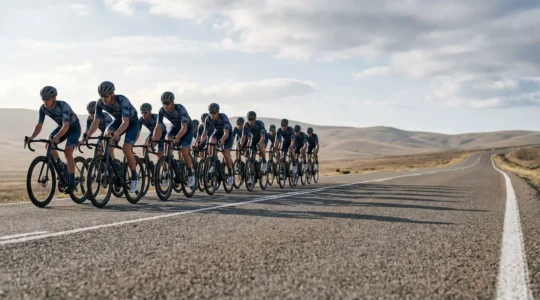
Free Speed: How to Save 30% Energy by Mastering the Wheel Suck
Mastering drafting is less about raw power and more about managing an ‘energy ledger’ within the group’s shared aerodynamic system. Optimal drafting isn’t a fixed distance; it’s a dynamic balance between the massive aerodynamic gains of proximity (up to 40%…
Read more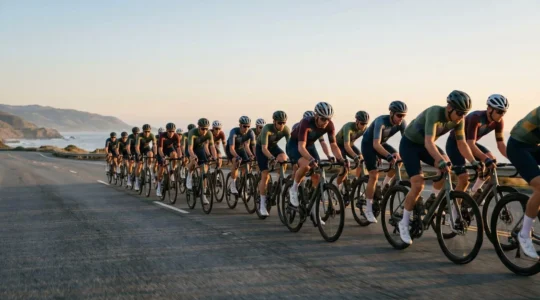
The Bunch Effect: How to Ride Safely and Efficiently in a 20-Rider Pack
Surviving a large peloton isn’t about raw power; it’s about mastering the invisible forces of communication, energy conservation, and predictive riding. Clear communication—both hand signals and verbal calls—is the foundation of preventing predictable incidents and building group trust. Maintaining a…
Read more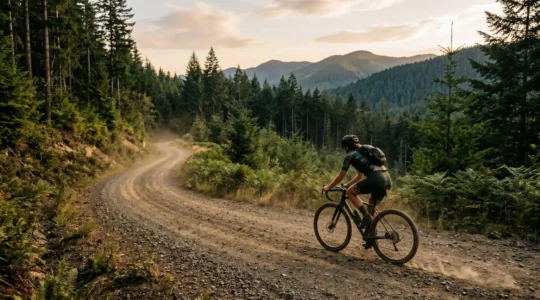
Double-Track Speed: Using Forestry Roads for Sustained Power Intervals
Sustained power on gravel isn’t about hitting your road numbers; it’s about mastering the physics of a constantly changing surface to deliver efficient, usable watts. The “Roughness Tax” means holding 250 watts on a fire road is physiologically harder than…
Read more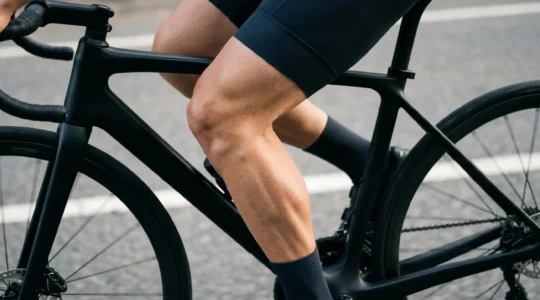
Grinding vs. Spinning: What Is the Ideal Cadence to Save Your Knees?
The key to solving knee pain isn’t just “spinning more” or hitting 90 RPM; it’s learning to interpret the biomechanical dialogue between your brain, muscles, and joints to find a cadence that respects your body’s limits. Low-cadence “grinding” creates high-torque…
Read more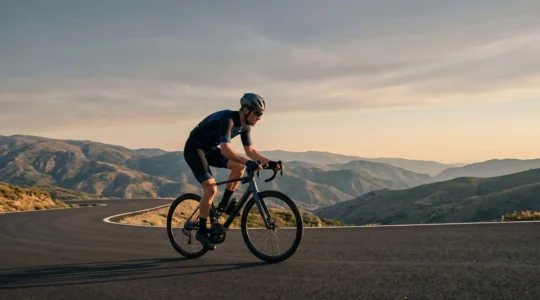
Is FTP the Only Number That Matters? Understanding Your Power Profile
Obsessing over your FTP number won’t make you a faster cyclist; it often creates the critical performance blind spots that get you dropped. Real-world speed depends on situational power (climbing, sprinting, surging), not just the sustained aerobic effort measured by…
Read more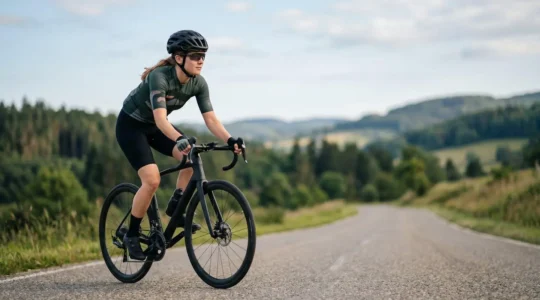
The Time-Crunched Cyclist’s Blueprint: How to Boost Your FTP on 6 Hours a Week Without Burnout
To boost your FTP on a tight time budget, the secret isn’t smashing every ride; it’s mastering the physiological principles of strategic stress, deliberate recovery, and training precision. The 80/20 rule is non-negotiable: most of your time must be spent…
Read more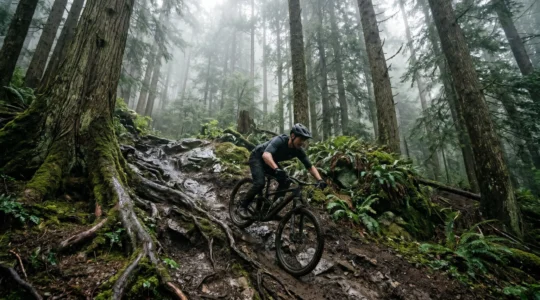
How to Ride Steep, Slippery Chutes Without Locking Your Brakes?
In summary: Riding steep, technical terrain is a mental skill built on a physical foundation; it’s about deconstructing fear, not ignoring it. Mastering your “grip budget” is key. Learn to feather your brakes to control speed without locking wheels, especially…
Read more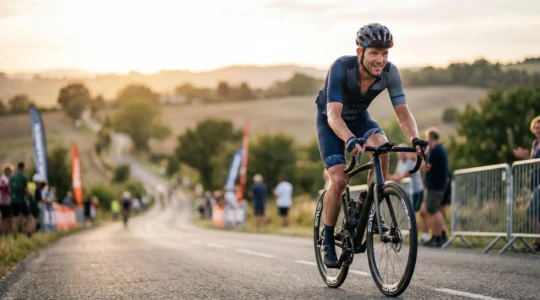
Your Coach’s Guide to Finishing a 100-Mile Sportive Without Hitting the Wall
In summary: Finishing a 100-mile sportive strong isn’t about luck; it’s about executing pre-planned systems for fuelling, pacing, and logistics. Proactive fuelling, starting with the first hour, is non-negotiable. Aim for 60-90g of carbs per hour and train your gut…
Read more