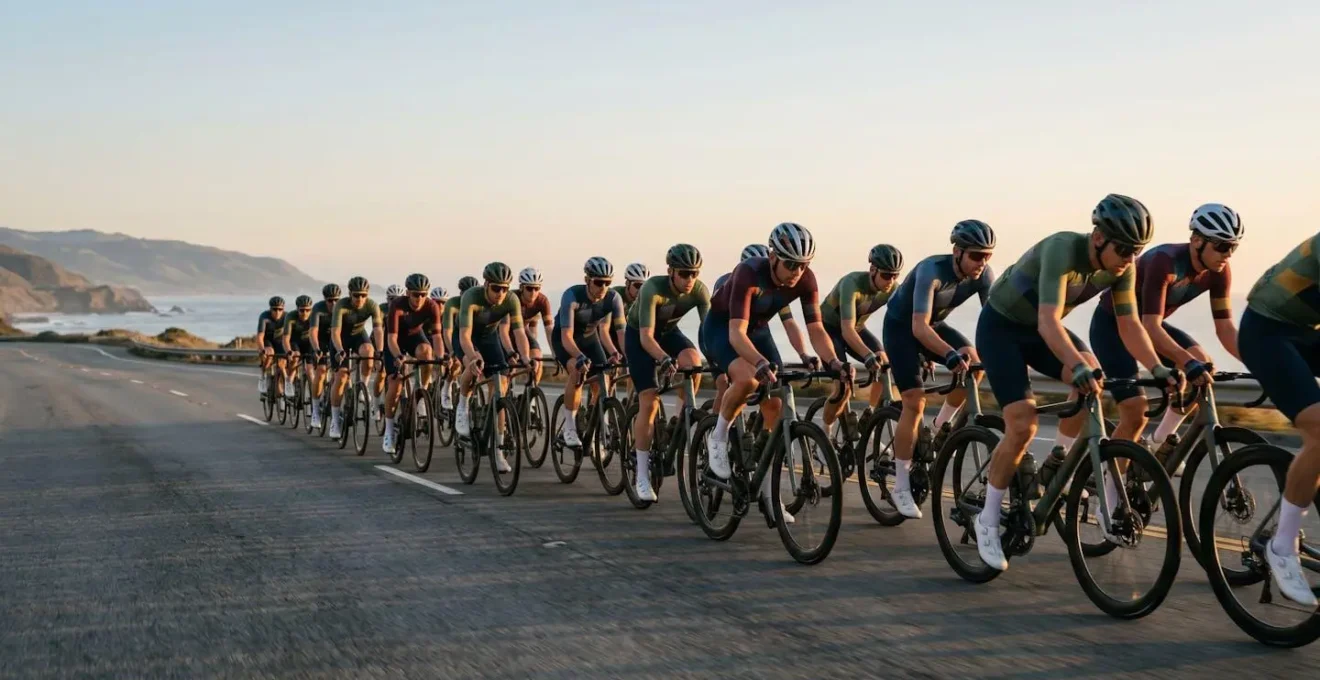
Surviving a large peloton isn’t about raw power; it’s about mastering the invisible forces of communication, energy conservation, and predictive riding.
- Clear communication—both hand signals and verbal calls—is the foundation of preventing predictable incidents and building group trust.
- Maintaining a stable line when fatigued and managing gaps correctly are non-negotiable skills for both group safety and aerodynamic efficiency.
Recommendation: Shift your mindset from simply reacting to the wheel in front to actively predicting the pack’s next move five riders ahead.
The first time you roll into a pack of 20 or more riders, the feeling is electric. The sound of dozens of freehubs buzzing in unison, the sheer speed, the sense of being part of a larger, more powerful machine. But that thrill is quickly followed by a healthy dose of fear. The margin for error shrinks to zero. Every movement is magnified, and a single mistake can have a cascading effect. You’ve probably heard the basic advice: “hold your line,” “don’t overlap wheels.” But for a sport rider moving from a casual group of four to the organized chaos of a gran fondo or race pack, that advice is woefully incomplete.
The truth is, those platitudes are just the entry ticket. They don’t teach you how to handle the sudden accordion of the concertina effect, how to eat a gel without causing a pile-up, or why a slight wobble from exhaustion can be more dangerous than a pothole. They don’t explain the unwritten social contract of the peloton, where trust is built in centimeters and destroyed by a single selfish move like half-wheeling. The real key to thriving in the bunch isn’t just following rules; it’s understanding the underlying physics and psychology of the group.
This is where we move beyond basic etiquette. This guide is your veteran’s briefing on survival. It’s about developing a sixth sense for the group’s rhythm, mastering the art of “predictive riding,” and learning to manage your energy like a pro. We will deconstruct the critical moments and micro-skills that separate a nervous passenger from a confident and respected member of the bunch. By understanding these dynamics, you won’t just survive the pack; you’ll learn to control your environment within it, save massive amounts of energy, and ride faster and safer than you ever thought possible.
This article breaks down the essential survival skills you need to master. We’ll cover everything from the nuances of communication to the physics of drafting, providing a clear roadmap to becoming a confident pack rider.
Summary: Mastering the Dynamics of a Large Cycling Pack
- Hand Signals vs. Shouting: What Every Rider Must Know to Avoid Pile-Ups?
- The Wobble: How to Ride Straight When You Are Exhausted?
- Unwrapping Gels: How to Eat Without Swerving into the Rider Next to You?
- The Sin of Half-Wheeling: Why Everyone Hates It When You Push the Pace?
- The Concertina: How to Save Energy at the Back of the Group?
- The Gap: How Close Is Too Close for Safety vs Aerodynamics?
- The Shout: Why Communication Is Key to Not Crashing the Group?
- Free Speed: How to Save 30% Energy by Mastering the Wheel Suck
Hand Signals vs. Shouting: What Every Rider Must Know to Avoid Pile-Ups?
In a tight pack, communication is your first line of defense. It’s the nervous system of the peloton. While shouting is effective for immediate, critical warnings, hand signals are the language of predictability. They telegraph intent long before an action occurs, giving the entire group time to react smoothly. The key is clarity and consistency. A lazy, ambiguous flick of the wrist is worse than no signal at all. Use a straight, committed arm to point out a hazard or indicate a turn. The signal should be a clear declaration, not a mumble.
The responsibility doesn’t end with the person at the front. Effective communication relies on a relay system. When you see a signal for a pothole, your job is twofold: avoid the pothole and immediately repeat the signal for the rider behind you. This creates a chain reaction that ensures the message reaches the back of the pack with minimal degradation. Think of it as an echo that preserves the original warning. Combining a hand signal with a verbal call (“Hole left!”) for significant hazards adds another layer of security, engaging both the visual and auditory senses of the riders around you.
Remember, your signals must be unambiguous. Research highlights that even in ideal conditions, signals can be misinterpreted. The goal is to make your intent so obvious that it requires zero cognitive load for the riders behind you to process. They should see your signal and instantly know what’s coming. This builds trust and transforms a collection of individuals into a cohesive, safer unit.
Your Pre-Ride Communication & Safety Audit
- Signal Review: Before clipping in, physically rehearse the three core signals: a flat palm down for stopping/slowing, a clear point for a road hazard, and a decisive arm sweep for turning.
- Verbal Call Inventory: Confirm the group’s standard calls before the ride. Is a car approaching from behind “Car Back” or “Oil Up”? Knowing the local dialect prevents confusion.
- Equipment Check: Ensure your brakes are responsive without being overly grabby. Check for anything loose on your bike (like a pump or bottle cage) that could rattle free or cause an unexpected wobble.
- Fueling Accessibility: Are your gels and bars pre-torn or in flasks? Practice reaching for them with one hand without looking down or deviating from your line.
- Mental Rehearsal: Before the ride, visualize a sudden stop or a strong gust of crosswind. Decide now how you will react calmly and predictably, without grabbing a fistful of brake.
The Wobble: How to Ride Straight When You Are Exhausted?
Fatigue is the enemy of stability. As your energy stores deplete, your fine motor control is the first thing to go. Your upper body slumps, your focus wavers, and the dreaded “wobble” begins. This is not just a sign of tiredness; it’s a critical safety hazard in a tight bunch. An unpredictable deviation of just a few centimeters can cause a chain-reaction crash. Holding a straight line when you’re deep in the pain cave is not a matter of strength, but of technique and mental focus. The secret lies in your core and your gaze.
First, engage your core. A strong, stable core acts as the chassis of your bike-body system, isolating the movement of your legs from your upper body. When you’re tired, the temptation is to relax your midsection, which allows the bike to wander. Instead, actively tense your abs and lower back, creating a rigid platform. This prevents the bike from swaying side-to-side with each pedal stroke. Second, and even more importantly, fix your gaze. Do not stare at the wheel directly in front of you. That’s a recipe for target fixation and over-correction. Instead, look up and through the pack, 5-10 riders ahead. This smooths out your line, allowing you to anticipate the group’s flow rather than reacting to every twitch of the rider in front.
This image demonstrates the ideal posture: a relaxed grip on the handlebars, elbows slightly bent to absorb shock, and a focused gaze locked on a point far down the road. This tunnel vision is the key to maintaining composure and line integrity when your body is screaming at you to stop.
The consequences of failing to manage fatigue-induced instability are severe. It’s a classic cause of crashes where a rider’s wobble leads to a slight wheel overlap, hooking a spoke on a quick release, and instantly locking the front wheel. Mastering the fixed gaze and core engagement isn’t just about looking pro; it’s a fundamental survival skill for group riding.
Unwrapping Gels: How to Eat Without Swerving into the Rider Next to You?
Fueling in a fast-moving pack is a high-stakes maneuver. Taking your hands off the bars, fumbling with a stubborn wrapper, and looking down for even a second can lead to a disastrous swerve. The art of eating and drinking in a group is about preparation, timing, and creating a momentary bubble of safety. Never try to rip open a new energy bar or gel with your teeth for the first time in the middle of a 20-rider bunch. That’s a rookie move.
Your fueling strategy should begin before you even clip in. All wrappers should be pre-torn or prepared for easy, one-handed access. Create a small tear in each packet that you can easily finish with a quick pull. Better yet, transfer gels into a small, soft flask that you can operate without taking your eyes off the road. Timing is also critical. Look for lulls in the pace and terrain to create a “fueling window.” The best moments are:
- On a steady, flat section with a predictable pace.
- At the bottom of a climb, just before the gradient kicks up.
- As you are rotating towards the back of the paceline, where a slight speed variation is less critical.
When it’s time to fuel, signal your intent. A simple call of “Eating!” or “Grabbing a bottle!” alerts those around you. For maximum stability, keep one hand firmly on the tops of the handlebars, close to the stem. If you must use your teeth, place the pre-torn wrapper in your mouth and use a quick head movement to rip it open, rather than pulling with your hand. The safest method is to briefly drift to the back of your immediate 3-4 rider pod. This gives you a small buffer of space without forcing you to burn a match to get back on from the very end of the entire group.
The Sin of Half-Wheeling: Why Everyone Hates It When You Push the Pace?
There is no greater sin in group riding etiquette than “half-wheeling.” It is the quickest way to be ostracized from a group ride, and for good reason. Half-wheeling occurs when a rider on the front pulls alongside their partner but pushes their front wheel slightly ahead, typically by half a wheel’s length. It’s an act of passive aggression, a subtle power play that says, “You’re not going fast enough.” The partner is then forced to accelerate slightly to draw level, at which point the half-wheeler often pushes the pace again. This seemingly minor overlap initiates a constant, nervous acceleration through the entire group.
This surge creates a ripple effect, forcing every rider to expend a little extra energy to close the newly created gaps. While it may feel insignificant at the front, by the time this acceleration wave reaches the back of the pack, it has amplified into a full-blown sprint followed by hard braking. This is the dreaded “concertina effect,” and it’s incredibly inefficient and dangerous. It shatters the smooth, steady rhythm that makes group riding so effective. Half-wheeling is a selfish act that prioritizes one rider’s ego over the energy conservation and safety of the entire group.
This abstract visualization shows how a small pace variation at the front (bottom left) creates an amplified, chaotic spacing at the rear (top right). The staggered, accordion-like pattern represents the wasted energy and increased risk caused by inconsistent pacing, which is often initiated by half-wheeling.
The rule is simple: when you are on the front, your handlebar should be perfectly in line with your partner’s. You are a team, responsible for setting a steady, predictable tempo. As the experts at Black Sheep Adventures state in their guide to peloton etiquette, “Effective communication, mutual respect, and adherence to established etiquette are the cornerstones of a successful and safe group ride.” Half-wheeling violates the core principle of mutual respect.
Clear and consistent communication within a group is non-negotiable. Effective communication, mutual respect, and adherence to established etiquette are the cornerstones of a successful and safe group ride.
– Black Sheep Adventures, Road Cycling Safety for Group Tours & Peloton Etiquette guide
The Concertina: How to Save Energy at the Back of the Group?
Riding at the back of a large group might seem like the easiest place to be, offering the most aerodynamic shelter. In reality, it can be the most physically demanding and mentally taxing position due to the “concertina effect,” also known as the accordion or slinky effect. As we saw, small speed changes at the front are amplified as they travel down the line. By the time they reach the 20th rider, they’ve become significant surges and decelerations. This forces riders at the back into a constant cycle of sprinting to close gaps and then grabbing the brakes to avoid running into a slowing pack, burning precious energy.
Surviving the concertina is an advanced skill of anticipatory riding. The key is to stop reacting to the wheel directly in front of you and start reading the pack as a whole. Look through the gaps, five to ten riders ahead. By watching the body language of riders further up the road, you can see a slowdown coming long before it reaches you. This gives you time to react smoothly instead of panicking. You can start to soft-pedal or sit up slightly to use your body as an air brake, rather than slamming on your actual brakes. This maintains momentum and avoids alarming the riders behind you.
Here are some advanced techniques for taming the accordion:
- Maintain a Buffer: Leave a slightly larger gap to the wheel in front (an extra 15-30cm). This small sacrifice in draft gives you a crucial buffer to absorb speed changes without braking.
- Feather the Rear Brake: If you must brake, use the rear brake lightly and intermittently (“feathering”). It’s less powerful and won’t cause your wheel to lock up as easily.
- Reduce Pressure, Not Cadence: Instead of stopping pedaling (coasting), simply ease the pressure on the pedals. This allows for smoother speed modulation and keeps your legs engaged.
While riding at the very back exposes you to the worst of the concertina, finding the right position in the pack is a balance. According to various studies show that riders can save 15-40% energy by drafting effectively. Your goal is to find the sweet spot where you get a great draft without being subjected to the constant whiplash of the very back.
The Gap: How Close Is Too Close for Safety vs Aerodynamics?
The gap between your front wheel and the rear wheel of the rider ahead is the most critical measurement in group riding. It’s a constant negotiation between maximizing aerodynamic benefit and maintaining a safe reaction time. Too far, and you’re wasting energy fighting the wind. Too close, and you have zero margin for error. So, what is the perfect distance? The answer is: it depends. The ideal gap is a dynamic variable that changes with speed, terrain, wind conditions, and, most importantly, the level of trust you have in the rider you are following.
From a purely physics perspective, closer is always better. The aerodynamic “draft” or pocket of still air is strongest directly behind the lead rider. Research has shown that at a gap of just 10 centimeters, a following rider saves roughly 90 watts out of the 250 watts needed to maintain the same speed. That’s a colossal energy saving. However, a 10cm gap provides almost no time to react to sudden braking or a swerve. For most non-professional group rides, a safer and more realistic distance is between 30 to 50 centimeters (about one foot). This provides a balance, offering significant draft benefits while still giving you a fraction of a second to react.
Case Study: The Dynamic Gap in a Crosswind Echelon
The concept of a simple front-to-back gap is shattered in crosswinds. When the wind blows from the side, the area of maximum shelter (the draft pocket) is no longer directly behind the lead rider but is shifted to the downwind side. To stay in this pocket, riders must form a diagonal line called an echelon. Here, the “gap” becomes a diagonal measurement. Each rider positions their front wheel slightly behind and to the side of the rear wheel of the rider ahead. Mastering this diagonal positioning is fundamental to surviving in crosswinds, proving that the correct gap is not a fixed distance but a dynamic calculation based on wind direction and trust.
Ultimately, the gap you maintain is a personal risk assessment. If you are following a smooth, experienced rider you trust implicitly, you can sit closer. If the rider in front is twitchy, unpredictable, or unknown to you, it is wise to give them more space. Your safety is more important than a few extra watts saved.
The Shout: Why Communication Is Key to Not Crashing the Group?
While hand signals are for predictable maneuvers, verbal calls—the “shout”—are for the immediate and the unseen. A shout cuts through the noise and demands instant attention. It is the group’s emergency broadcast system. A calm, clear verbal call can alert the group to an approaching car, a patch of loose gravel, or a sudden change in pace. A sharp, urgent shout can be the only thing that prevents a multi-rider pile-up when an unexpected hazard appears.
The effectiveness of verbal calls depends on a shared vocabulary. A peloton needs a simple, standardized set of terms that everyone understands without a moment’s hesitation. Shouting “Watch out!” is uselessly vague. Does it mean a car, a dog, a pothole? In contrast, a specific call like “Car Back!” gives riders a precise piece of information: a vehicle is approaching from behind, so hold your line and don’t make any sudden movements. Like hand signals, these calls must be relayed down the line. If you hear “Gravel!” from the front, you echo “Gravel!” so the riders behind you get the message.
The tone of the shout is as important as the words themselves. A calm “Hole” indicates a minor pothole you can easily navigate. A sharp, loud “HOLE!” signifies an immediate, dangerous crater that requires an urgent reaction. Learning to both use and interpret this vocal nuance is a critical skill. The table below outlines some of the most common and essential verbal calls used in peloton riding. Your group should agree on these or similar terms before every ride.
| Verbal Call | Meaning | Expected Action | Urgency Level |
|---|---|---|---|
| Car Up / Car Front | Vehicle approaching from ahead | Tighten formation, move right if safe | Medium |
| Car Back / Car Rear | Vehicle approaching from behind | Hold your line, no sudden movements | Medium |
| Car Left / Car Right | Vehicle approaching from specified side | Be aware, prepare to yield space | High |
| Hole / Pothole | Road hazard ahead (calm tone) | Look ahead, prepare to avoid | Low |
| HOLE! | Immediate road hazard (sharp tone) | React immediately, urgent avoidance | Critical |
| Slowing / Stopping | Pace reduction ahead | Prepare to reduce speed, cover brakes | Medium |
| Steady | Maintain current pace, no surges | Hold consistent speed, no accelerations | Low |
| On Your Left | Passing on left side | Hold line, do not drift left | Medium |
| Gravel | Loose surface ahead | Ride cautiously, maintain stability | Medium |
Key Takeaways
- Group riding is a skill of prediction, not reaction. Look through the pack, not just at the wheel in front.
- Clear, consistent communication (signals and shouts) is the social contract of the peloton; it builds trust and prevents crashes.
- Energy conservation is an active process of managing gaps, avoiding the concertina effect, and mastering the draft.
Free Speed: How to Save 30% Energy by Mastering the Wheel Suck
We’ve talked about safety, communication, and etiquette. Now, let’s talk about the ultimate reward for mastering these skills: “free speed.” Drafting, or “wheel sucking,” is the fundamental reason group riding is so much faster than riding solo. By sitting in the slipstream of the riders ahead, you are sheltered from the wind, dramatically reducing the amount of power you need to produce to maintain the same speed. The energy savings are not trivial; they are monumental. While older estimates suggested a 30-40% reduction in effort, the reality is even more astounding.
The most detailed analysis of peloton aerodynamics reveals a staggering benefit. Using wind tunnel testing with 121 models, groundbreaking 2018 research by Professor Bert Blocken revealed that a rider in the core of the pack experiences as little as 5% of the aerodynamic drag of a solo rider. This means a 95% reduction in the force you are fighting against. This is the “free speed.” It’s the currency of the peloton. By mastering the skills of holding a steady line, managing your gap, and communicating effectively, you earn the right to access this incredible energy-saving zone.
This image provides a macro view of the intimate proximity required for an optimal draft. The focus on the stretched fabric of the jersey highlights the tactile, almost physical connection between riders, where every centimeter counts in the quest to stay within the precious draft pocket.
Mastering the wheel suck is the culmination of all other group riding skills. You cannot sit close enough to get a good draft if you can’t hold a straight line. You can’t trust the wheel in front of you without clear communication. You can’t stay in position if you are constantly surging and braking due to the concertina effect. Every skill we have discussed is a prerequisite for unlocking this massive aerodynamic advantage. It is what allows the group to travel faster and further than any single individual could.
By integrating these skills, you transform from a passenger into an active, valuable member of the peloton. The next step is to take this knowledge and apply it consciously on every group ride, building confidence and trust with every pedal stroke.