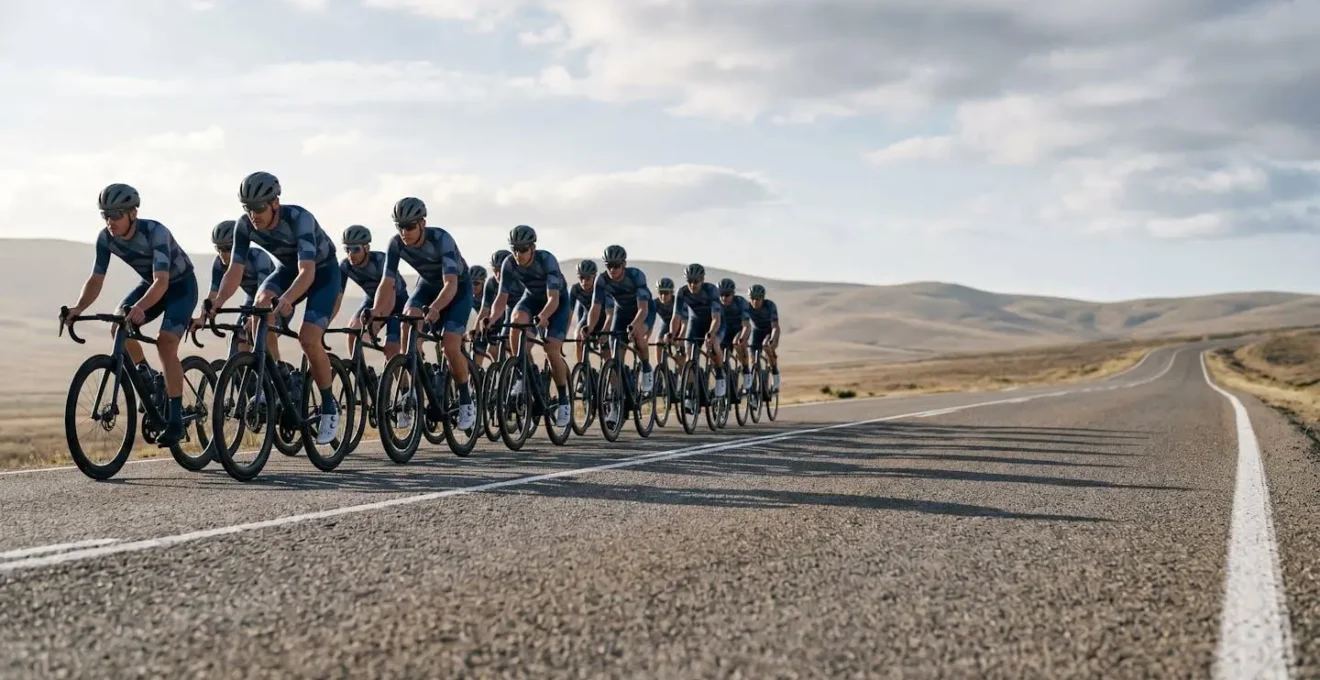
Mastering drafting is less about raw power and more about managing an ‘energy ledger’ within the group’s shared aerodynamic system.
- Optimal drafting isn’t a fixed distance; it’s a dynamic balance between the massive aerodynamic gains of proximity (up to 40% energy saved) and the crucial need for safety and predictive awareness.
- Smoothness is speed. Every abrupt movement or gap in rotation creates ‘micro-accelerations’ that drain your energy reserves and disrupt group cohesion.
Recommendation: Shift your focus from the wheel in front to reading the entire paceline 3-4 riders ahead. This ‘X-Ray vision’ is the key to anticipating changes, ensuring safety, and conserving maximum energy.
Every competitive rider knows the frustration: you have the watts, you’ve done the training, yet in the swirling chaos of a fast-moving bunch, you find your energy draining away faster than everyone else’s. You’re strong, but you’re not efficient. The common advice is always the same: “get closer to the wheel in front,” “do your turn,” and “don’t overlap wheels.” While true, this is like telling a chef to “use heat.” It’s the bare minimum, not the secret to mastery.
As a coach, I see riders treating the group like a simple wall to hide behind. This is a fundamental mistake. A paceline isn’t a static object; it’s a living, breathing system of energy exchange. The real key to efficiency isn’t just hiding, but actively managing your position within the constantly shifting aero bubble. It’s about maintaining a positive balance in your personal energy ledger, avoiding the tiny, costly withdrawals that come from constant reactions and adjustments. These are the ‘micro-accelerations’ that kill your legs long before the finish line.
This is not another beginner’s guide. This is a coaching session to reframe your entire approach to group riding. We will deconstruct the physics and psychology of the paceline, moving beyond the obvious “what” to the expert “how” and “why.” You will learn to stop being a passenger in the draft and start becoming a master of the system, someone who actively creates and conserves energy where others waste it. This is how you find true ‘free speed’.
To help you master this skill, this guide breaks down the critical components of high-performance drafting, from handling challenging conditions to perfecting the subtle art of group communication and awareness.
Summary: Mastering the Dynamics of Group Riding for Peak Efficiency
- Crosswinds: How to Form an Echelon When the Wind Hits from the Side?
- The Gap: How Close Is Too Close for Safety vs Aerodynamics?
- Up and Over: How to Keep the Pace Smooth When Changing Turns?
- The X-Ray Vision: Why You Should Never Stare at the Wheel in Front?
- Overlap Danger: How to Protect Your Front Wheel in a Tight Bunch?
- Deep Section Wheels in British Gusts: Danger or Free Speed?
- The Wobble: How to Ride Straight When You Are Exhausted?
- How to Gain 1.5mph on Windy UK Roads Without Buying a New Bike?
Crosswinds: How to Form an Echelon When the Wind Hits from the Side?
A steady headwind is simple, but the moment a crosswind hits, the simple paceline shatters. This is the ultimate test of group cohesion. The aero bubble no longer sits directly behind the rider in front; it’s blown to the side. The instinct for many is to fight the wind alone, a catastrophic waste of energy. The expert response is to form an echelon, a diagonal line of riders that stretches across the road, creating a new, angled shelter.
The goal is to position your front wheel just behind and to the leeward side (the side sheltered from the wind) of the rear wheel in front of you. If the wind comes from the left, the line of shelter streams to the right, and the echelon forms towards the right side of the road. This is a fluid, cooperative dance. The rider at the front, taking the full force of the wind, does a short turn before peeling off on the windward side and drifting to the back to slot into the last available sheltered spot. Constant communication and smooth, predictable movements are essential to prevent gaps from opening, which can split the group and leave riders stranded in the wind.
Mastering the echelon isn’t just a defensive tactic; it’s an offensive one. A well-drilled group can maintain a much higher speed in a crosswind than riders struggling individually, effectively putting rivals “in the gutter”—off the back with no shelter to be found. To execute this correctly, follow a precise rotation.
- Position yourself slightly behind and to the side of the rider in front, opposite to the wind direction.
- If wind comes from the left, move to the right side of the rider ahead, and vice versa.
- Rotate in a circular motion across the road width, always seeking shelter from the crosswind.
- When at the front, after your turn, drift backward diagonally and accelerate to latch onto the last wheel in the echelon.
- Time your rotation precisely to avoid gaps that disrupt circulation and force unnecessary effort from others.
The Gap: How Close Is Too Close for Safety vs Aerodynamics?
The single biggest factor in energy saving is proximity. This is where the concept of the aero bubble becomes tangible. This isn’t a vague “shelter”; it’s a low-pressure zone created by the lead rider parting the air. The closer you are to the back of their wheel, the more you are pulled into this vacuum, and the less energy you expend. The relationship between distance and drag reduction is not linear; it’s exponential. The greatest gains are found in the final few inches.
This is where the trade-off between physics and safety becomes critical. The physics are undeniable: one aerodynamic analysis confirmed that following at 10 metres provides a massive benefit, with the drafter experiencing only 77% of the drag faced by a solo rider. This effect is exponential, dropping to a mere 52% at a 2.64-metre gap. Riding inches away can save you up to 40% of your energy, a colossal figure. However, this proximity leaves zero margin for error. A sudden touch of the brakes, a swerve to avoid a pothole—these can lead to an instant crash.
The optimal gap is therefore not a fixed number. It’s a dynamic calculation based on conditions, trust, and your own handling skills. On a smooth, straight road with predictable riders, you can close the gap to a few inches. In a nervous group, on rough roads, or in wet conditions, you must increase that gap to buy reaction time. The art is in constantly modulating this distance, closing it to maximize savings when it’s safe and opening it slightly to create a safety buffer when risks increase. You are constantly balancing your energy ledger against your risk assessment.
Up and Over: How to Keep the Pace Smooth When Changing Turns?
A paceline’s speed and efficiency are dictated by its weakest link: the transition. A poorly executed rotation at the front can send a shockwave of braking and acceleration through the entire group, forcing everyone to burn matches. These are the micro-accelerations that slowly bleed your energy ledger dry. The goal is a seamless “up and over” rotation where the group’s speed remains absolutely constant.
The essence of paceline riding is predictability. Any abrupt moves or unexpected actions dangerously disrupt the paceline.
– Road Bike Rider Coaching Staff, Guide to Cycling in a Paceline
This predictability starts with the rider on the front. Your job is not to be a hero and surge the pace. Your job is to hold the speed steady for your turn. When your turn is over, the handover must be flawless. A flick of the elbow is the universal signal, but what happens next is crucial. Don’t immediately slam on the brakes or stop pedalling. This is the most common mistake; you rocket backwards relative to the group, forcing the rider behind to swerve or brake.
Instead, the perfect pull-off involves a slight, gentle deceleration as you smoothly move to the side. You continue pedalling, just with less force, allowing the next rider to come through at the same speed without needing to accelerate. You then drift to the back of the line, timing your effort to smoothly accelerate and latch onto the last wheel without creating a gap. A smooth paceline feels like a single, well-oiled machine.
- Flick your elbow on the side you want the rider behind to pull through, signaling your rotation direction.
- Wait a moment after your elbow flick before pulling off, giving the rider behind time to adjust their position.
- Accelerate slightly while moving diagonally off the front to maintain a smooth transition.
- Gently ease off power but continue pedaling to avoid rocketing backwards relative to the group.
- Make it easy for the following rider to pass while maintaining momentum to rejoin at the back.
The X-Ray Vision: Why You Should Never Stare at the Wheel in Front?
The most common and dangerous habit for an inexperienced drafter is target fixation: staring intently at the rear wheel of the rider directly in front. This feels safe, but it’s precisely the opposite. By focusing on that one spot, you lose all peripheral awareness. Your world shrinks to a 12-inch circle of rubber and spokes. You are no longer riding proactively; you are purely reactive. If that wheel moves, you move. You have no time to anticipate, only to panic.
Mastering the draft requires developing what I call ‘X-Ray Vision’. This is the ability to look ‘through’ the rider in front of you to see what is happening two, three, or even four riders up the line. Your conscious focus should be on the shoulders and head of the riders ahead, scanning for signs of a change in pace, a deviation in the line, or an upcoming road hazard. You are reading the body language of the entire group, not just one person.
So how do you track the wheel you’re meant to be drafting? This is where your peripheral vision comes in. You use a ‘soft focus’, where the wheel in front is held in your lower peripheral vision. You are aware of its position and your gap to it without ever looking directly at it. This frees up your conscious mind to engage in predictive riding. You see the pothole before the rider in front of you does. You see the group starting to surge before you feel it. This gives you tenths of a second to make smooth, measured adjustments instead of sudden, energy-wasting reactions.
Action Plan: Develop Your ‘X-Ray Vision’
- Keep your front wheel slightly off-center from the rider ahead to give yourself an escape route and avoid wheel-touch crashes.
- Practice looking past the rider in front, focusing on their hips or back, rather than fixating on their rear wheel.
- Consciously use your peripheral vision to monitor the wheel while your main focus scans 3-4 riders ahead for group dynamics.
- Train yourself to look around the sides of the rider in front to spot road hazards, traffic, and changes in the paceline’s shape.
- Automate your bike handling through repetition on safe roads, freeing up mental capacity for strategic observation instead of basic control.
Overlap Danger: How to Protect Your Front Wheel in a Tight Bunch?
There is one cardinal sin in group riding from which there is often no recovery: overlapping your front wheel with the rear wheel of the rider ahead. This single mistake is responsible for more crashes in amateur races and sportives than almost any other. It is a non-negotiable rule because the physics are brutal and unforgiving. If the rider in front moves sideways even an inch, their rear wheel will strike your front wheel, instantly turning it sideways. You will be on the ground before you can even process what happened.
Protecting your front wheel is your number one priority at all times. This means maintaining a position where your front wheel is always behind the rear wheel in front, never alongside it. In a tight, chaotic bunch, this requires constant vigilance. You must be aware not only of the rider directly in front but also of riders moving up alongside you. You must create and defend your own space. This is not about being aggressive; it’s about being assertive and predictable.
Holding a straight, true line is paramount. Any deviation or weaving from you not only endangers your own front wheel but also the wheels of everyone behind you. This is another reason why ‘X-Ray Vision’ is so critical. By looking ahead and anticipating the flow of the group, you can make smooth, early adjustments to your line, avoiding the sudden swerves that lead to overlapped wheels and disaster. Your safety, and the safety of those around you, depends on your ability to maintain this discipline, especially when you are tired and your focus begins to wane.
Deep Section Wheels in British Gusts: Danger or Free Speed?
In the quest for aerodynamic efficiency, deep section wheels are a potent weapon. Their profile is designed to slice through the air more effectively than a shallow, box-section rim, reducing drag. At racing speeds, this isn’t a minor factor; it’s the dominant one. According to racing aerodynamics research, at around 30 mph (50 km/h), almost 90% of a rider’s energy is spent just overcoming air resistance. In this context, deep wheels offer genuine, measurable ‘free speed’.
However, this comes with a significant trade-off, particularly on gusty UK roads. A deep rim presents a larger surface area to side winds. A sudden gust hitting a 60mm front wheel can feel like someone grabbing your handlebars, requiring an instant and forceful correction to hold your line. This can be unnerving and, for a less experienced or lighter rider, genuinely dangerous. It can cause you to swerve, potentially leading to a wheel overlap or forcing you out of the precious aero bubble.
So, are they a danger or a benefit? For a competitive rider, they are a calculated risk worth taking. The key is skill and anticipation. You must learn to ride with relaxed arms, allowing the bike to move slightly underneath you without fighting every twitch. A stiff, rigid upper body will transfer every gust into a swerve. You must also become a student of the environment, reading the wind’s effect on trees and hedgerows to anticipate gusts before they hit you, especially when passing gaps in a hedge or emerging from a sheltered dip. With practice, the aerodynamic benefit far outweighs the handling challenge, but you must respect the conditions and master the skill before you can bank the speed.
The Wobble: How to Ride Straight When You Are Exhausted?
Fatigue is the enemy of efficiency. When your energy ledger is deep in the red, your fine motor control is the first thing to go. Your smooth, circular pedal stroke degenerates into a jerky, stomping motion. Your core, which should be stabilizing your upper body, disengages. The result is ‘The Wobble’: an inability to hold a straight line. You begin to weave slightly, your speed oscillates, and you become unpredictable and dangerous to everyone around you.
This is the moment when all the hard-earned energy savings from drafting can be lost in an instant. A wobbling rider creates gaps, forces others to brake, and ultimately disrupts the harmony and speed of the entire group. From a coach’s perspective, this is a sign that the rider has failed to manage their effort and nutrition. The wobble is often the first physical symptom of glycogen depletion, or “bonking.” By the time you feel it, it’s often too late.
The solution is both preventative and immediate. The long-term prevention is proper pacing and fuelling—eating and drinking *before* you feel the signs of exhaustion. But when you feel the wobble starting, you must act immediately to regain control. The instinct is to tense up and grip the bars tighter, but this only makes it worse. Instead, you need to consciously re-engage your stabilizing systems and smooth out your power delivery. Shifting to an easier gear and increasing cadence is far more effective than grinding a heavy gear, as it promotes a smoother pedal stroke.
- Engage your core: Actively tighten your abdominal and lower back muscles to create a stable platform, reducing tension on the handlebars.
- Focus on the pedal stroke: Shift your mental focus from how tired you are to the feeling of executing a perfect, smooth, 360-degree circle with your feet.
- Shift to an easier gear: Increase your cadence to smooth out power delivery instead of grinding a heavy gear, which causes herky-jerky movements.
- Fuel before you fade: Recognize that the wobble is a late-stage sign of energy depletion. This is a reminder to fuel earlier and more consistently on your next ride.
Key Takeaways
- Drafting is not passive hiding; it is the active management of your personal ‘Energy Ledger’ by manipulating your position within the group’s ‘Aero Bubble’.
- The greatest energy savings are found within inches of the wheel ahead, but this must be constantly balanced against safety, conditions, and group trust.
- Smoothness equals speed. Every jerky movement or poorly managed rotation creates ‘micro-accelerations’ that drain your energy and disrupt the group’s efficiency.
How to Gain 1.5mph on Windy UK Roads Without Buying a New Bike?
Ultimately, the promise of ‘free speed’ is not a marketing gimmick; it is a direct result of mastering the physics of group riding. Without spending a penny on a new bike or lighter components, a rider who perfects their drafting technique can achieve a significant increase in average speed for the same energy output. This is the single most powerful upgrade you can make to your riding. The prize for mastering these skills is a significant performance boost without any increase in fitness. It’s well-documented that drafting saves 20-40% of the energy needed to ride alone at the same speed.
This energy saving translates directly into higher speed or, more strategically, into having more energy left for the critical moments of a race or sportive—the final climb, the decisive attack, or simply finishing strong instead of fading. The difference between a rider who understands these dynamics and one who doesn’t is stark. The skilled drafter glides through the bunch, seemingly immune to the wind, while the unskilled rider fights for every pedal stroke, constantly battling to close small gaps and wasting precious energy.
The amount of energy saved is not uniform; it depends on your position in the group, your proximity to the rider in front, and the overall speed. Being the second rider in a line is far more beneficial than being the tenth, and riding at 25 mph offers a greater percentage of savings than at 15 mph. The table below, based on a comprehensive guide to paceline dynamics, breaks down how these savings vary with position and skill.
| Position in Group | Energy Savings | Optimal Distance | Skill Level Required |
|---|---|---|---|
| 2nd rider at 25 mph | ~30% | 6-12 inches (15-30 cm) | Advanced |
| 10th rider in peloton | 15-20% | Variable | Intermediate |
| Beginner drafting | 20-25% | 2-3 feet (60-90 cm) | Beginner |
| Maximum draft benefit | Up to 40% | Very close (<6 inches) | Expert/Professional |
Start applying these principles on your next group ride. Focus on one skill at a time, whether it’s smoothing your rotation or practicing your ‘X-Ray Vision’. This is how you stop wasting energy and start riding faster.