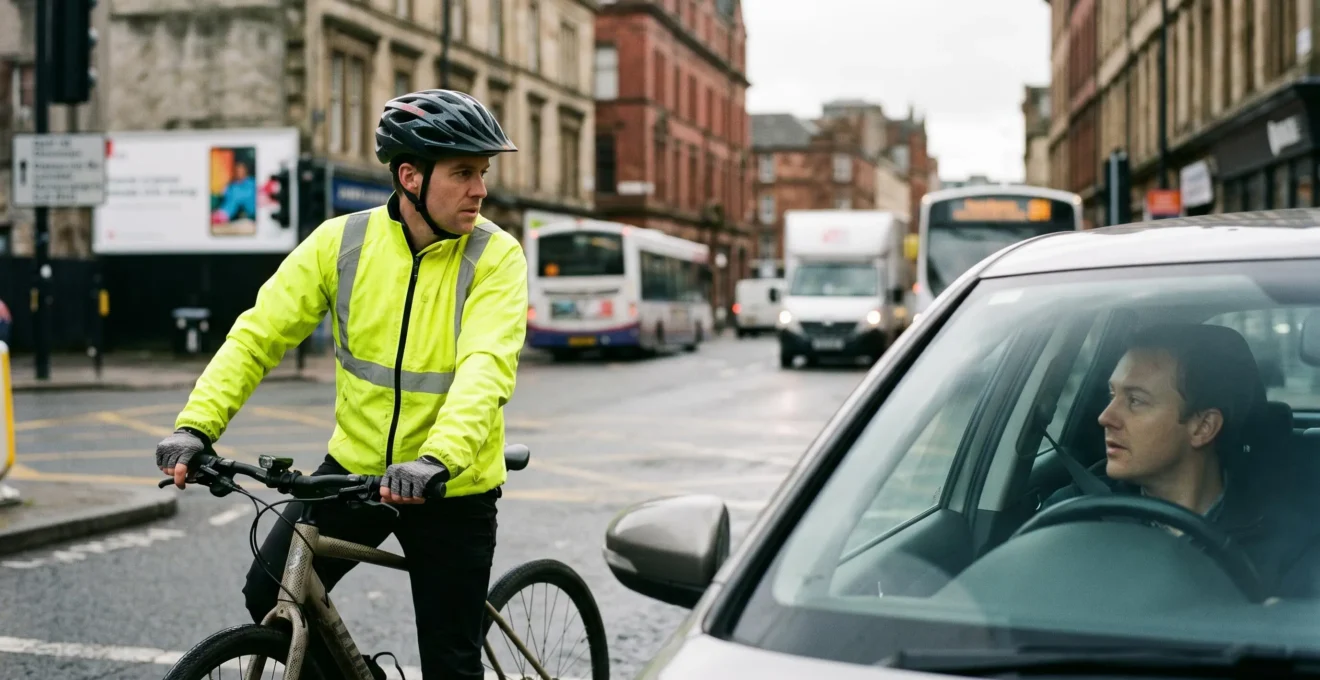
Many cyclists believe safety is a matter of bright clothing and following rules. This guide argues for a more profound approach: true road safety is an active psychological skill. It’s about predicting driver behaviour by understanding their blind spots and cognitive limits, managing the space around you like a chess master, and communicating with a confidence that preempts conflict before it begins.
The sudden squeal of tyres, the jolt of adrenaline from a near-miss—these are experiences all too familiar for those who navigate city streets on two wheels. As a vulnerable road user, it’s easy to feel at the mercy of the metal boxes whizzing past. For years, the standard advice has been a predictable chorus: wear a helmet, use lights, be visible. While this advice is not wrong, it is profoundly incomplete. It treats safety as a passive state, a checklist of gear to wear, rather than what it truly is: an active, dynamic, and psychological skill.
This is where the mindset of an advanced instructor diverges from conventional wisdom. True safety isn’t about being seen; it’s about being understood. It’s not just about following the rules of the road, but about mastering the unwritten rules of human behaviour in traffic. The goal is to move from a position of reaction to one of prediction. You are not just a cyclist; you are an operator, constantly reading cues, managing space, and communicating your intentions with such clarity that you influence the behaviour of those around you. It’s about playing chess, not checkers, anticipating the other player’s moves three steps ahead.
This guide will deconstruct common, high-risk scenarios not as isolated incidents, but as failures in communication and prediction. We will explore the psychology behind dooring, HGV blind spots, and junction conflicts. By shifting your focus from simply avoiding collisions to actively managing the cognitive space on the road, you can transform your ride from an exercise in vulnerability to a demonstration of confident control.
To navigate this complex interplay of road positioning and human psychology, this article breaks down the essential skills you need to master. The following sections provide a structured approach to predicting and influencing driver behaviour, turning abstract concepts into concrete, life-saving actions.
Summary: Mastering the Psychology of Defensive Cycling
- The Meter Rule: Why Riding Too Close to Parked Cars Is a Fatal Mistake
- Undertaking vs. Filtering: When Is It Legal to Pass Traffic on the Left?
- The HGV Trap: How to Stay Visible at Junctions Near Large Vehicles?
- Beyond the Arm: How Body Language Communicates Your Next Move to Drivers
- De-escalation: What to Do When a Driver Becomes Aggressive?
- Priority Rules: Who Goes First on the New Cyclops Junctions?
- Leading or Following: Where Should You Position Yourself When Riding with Kids?
- LTNs and Superhighways: How to Use New Cycle Infrastructure Safely?
The Meter Rule: Why Riding Too Close to Parked Cars Is a Fatal Mistake
The “door prize” is a reward no cyclist wants to win. Getting ‘doored’ is not just a freak accident; it’s often the predictable result of poor positioning. Riding within a metre of parked cars places you in a high-probability impact zone known as the ‘dooring zone’. While national estimates suggest hundreds of incidents a year, the reality on the ground is more telling. In a city like San Francisco, for instance, dooring accounts for 10% of bicyclist-motor-vehicle injury crashes. This isn’t a game of chance; it’s a game of space.
The “Meter Rule” is your primary defence. It dictates that you maintain a position in the lane that is at least one full car door’s width away from any parked vehicle. This is not about being difficult to drivers behind you; it is a non-negotiable safety protocol. By taking this position, you are not just giving yourself physical space; you are giving yourself reaction time. More importantly, you are making a clear statement of intent and presence. You become a vehicle that must be overtaken correctly, rather than an obstacle to be squeezed past.
However, advanced riding goes beyond a static rule. You must practice dynamic risk assessment. A taxi or rideshare vehicle has a much higher probability of a door opening than a private car on a quiet residential street. Look for clues: interior lights, exhaust vapour in the cold, or pedestrians walking towards a car. These are all signals that the risk profile of that parked car has just increased, and you must adjust your position accordingly. Your positioning is a constant negotiation with your environment.
Undertaking vs. Filtering: When Is It Legal to Pass Traffic on the Left?
Navigating slow or stationary traffic is a core urban cycling skill, but it’s fraught with ambiguity and risk. It’s crucial to understand the distinction between two actions: undertaking and filtering. ‘Undertaking’ is passing a moving vehicle on its left (in the UK). ‘Filtering’ is moving past stationary or slow-moving traffic in the same lane. While filtering is generally legal and recognised in the Highway Code, it operates on a razor’s edge of driver awareness.
The fundamental psychological problem is that most motorists are simply not expecting to be passed on their left. Your safety when filtering relies almost entirely on the driver having checked their mirrors and blind spots before any manoeuvre. A 2017 legal case involving a cyclist named Robert, who was filtering on the left when a vehicle turned across his path, reinforced a key principle. The courts found that the responsibility remains with drivers to check before manoeuvring, a principle now enshrined in the Highway Code’s hierarchy of road users. This legal protection, however, is a poor substitute for a functional collarbone. You cannot rely on it.
Therefore, your job as the filtering cyclist is to manage this risk actively. Assess every gap. Make eye contact where possible. Look for signs of impending movement: wheels turning, a driver checking their right mirror (a sign they intend to move left), or indicator lights. Never assume a stationary driver has seen you. Treat every car as potentially about to move into your path. Filtering is a high-skill, high-risk manoeuvre that demands 100% concentration. The benefit of making progress must always be weighed against the catastrophic potential of a driver’s momentary lapse in attention.
The HGV Trap: How to Stay Visible at Junctions Near Large Vehicles?
If there is one non-negotiable rule for urban cycling, it is this: give large vehicles—especially Heavy Goods Vehicles (HGVs)—an abundance of space, particularly at junctions. The statistics are chillingly clear. According to recent UK data, 104 cyclists were killed in collisions with HGVs over a five-year period, representing almost one in five of all cycling fatalities. The most common and deadly scenario is the ‘left hook’. An analysis of these incidents reveals a devastating pattern: a staggering 52% of fatal collisions involved a lorry turning left across a cyclist’s path.
This happens not because HGV drivers are malicious, but because of fundamental physics and human psychology. An HGV has enormous blind spots around the front, sides, and rear of the cab. When you are in one of these zones, you are functionally invisible. The driver could be checking their mirrors diligently and still not see you. The “HGV Trap” is when a cyclist positions themselves on the left of an HGV at a junction, intending to go straight on, while the HGV is preparing to turn left.
To avoid this trap, you must understand two principles. First, never, ever position yourself on the left of an HGV at a junction. Either stay well behind it, where the driver can see you in their rear-view mirror, or position yourself well ahead and in the centre of the lane, clearly visible through their windscreen. Second, adopt the mantra: “If you can’t see their mirrors, they absolutely cannot see you.” Your primary task is to position yourself for maximum visibility, even if it means sacrificing a few seconds of your journey time. Never gamble on an HGV driver’s field of vision.
Beyond the Arm: How Body Language Communicates Your Next Move to Drivers
A simple arm signal is the most basic form of communication on the road, but it is far from the most effective. Advanced communication is about using your entire body to project competence and predictability. Drivers are constantly, subconsciously assessing other road users to predict their behaviour. Your job is to make their assessment of you as simple as possible: “This person knows what they are doing and their next move is obvious.” This is the essence of projecting predictive competence.
This starts with the “exaggerated head check.” Before a turn or lane change, don’t just glance over your shoulder. Make a deliberate, almost theatrical movement of turning your head 90 degrees or more. This has two functions. First, it ensures you get a comprehensive view of the blind spot. Second, and more importantly, it’s a massive, unmissable signal to the driver behind or beside you. It says, “I am aware of my surroundings, and I am about to make a move.” It forces their brain to register your presence and intent.
Your posture on the bike also sends a powerful message. An upright, alert posture with a steady, smooth pedalling cadence and a straight riding line signals control and predictability. Conversely, a wobbly, hesitant riding style or hunched-over posture can signal inexperience or distraction, which may either make drivers give you more space or, perversely, treat you with less respect. Use confident hand signals, read the driver’s body language through their windscreen—are they looking at their phone?—and use your entire presence as a communication tool. Your body is your billboard; make sure it’s broadcasting the right message.
De-escalation: What to Do When a Driver Becomes Aggressive?
Unfortunately, no amount of perfect riding can completely eliminate the chance of a hostile encounter. Road rage is a reality, and for a vulnerable cyclist, it can be a terrifying and dangerous experience. In these moments, your ego is your greatest enemy, and your ability to de-escalate is your greatest strength. The first and most important rule is to understand that you cannot “win” an argument with an aggressive driver, and you certainly cannot win a physical confrontation with a one-ton vehicle.
As cycling law expert David Shellnutt advises, “Since you can’t predict the outcomes or can’t possibly know who you are dealing with, the safest bet is to avoid the motorist completely or de-escalate.” This is the core principle. Your objective is not to prove a point, assert your rights, or educate the driver. Your sole objective is to remove yourself from the situation safely. This requires swallowing your pride and prioritizing self-preservation above all else.
This means you do not retaliate, gesture, shout back, or engage. Create physical distance by turning down a side street or pulling over. Once you are safe, take a moment to manage the adrenaline surging through your body. Deep breaths can help prevent the “cognitive tunneling” that can lead to you making a secondary mistake. If you can, memorize the license plate and text it to yourself or a friend. The urge to confront is powerful, but it is a fool’s errand. The safest response is always, without exception, to disengage.
Your De-escalation Action Plan
- Create Distance: Your first priority is to get off the road immediately or turn down a side street to create a physical barrier.
- Manage Adrenaline: Take several deep, slow breaths. This calms the ‘fight or flight’ response and prevents cognitive tunneling that could cause a secondary accident.
- Secure Information: Use a memory technique to repeat the vehicle’s license plate number in your mind until you can safely stop and text it to yourself or a contact.
- Seek Social Grounding: If another rider or pedestrian witnessed the incident, start a calm conversation to ground yourself and process the event collaboratively.
- Resist Retaliation: Do not approach the other person, touch their property, or engage in any way. Any interaction can be interpreted as aggression and escalate the danger.
Priority Rules: Who Goes First on the New Cyclops Junctions?
New infrastructure like “Cyclops” (Cycle Optimised Protected Signals) junctions is designed to segregate and protect cyclists. However, these complex, multi-stage environments can create new forms of ambiguity. When cyclists, pedestrians, and multiple streams of traffic intersect in novel ways, the formal rules of priority can become less clear. In these moments of shared hesitation, you must become a master of the micro-agreement.
A micro-agreement is a rapid, informal, non-verbal contract forged with another road user to resolve a moment of uncertainty. It’s the deliberate, held eye contact with a driver that says, “I’m going now, you wait.” It’s the small, permissive hand gesture or nod that says, “After you.” These are the subtle social lubricants that keep complex junctions from grinding to a halt in a standoff of mutual confusion.
Your task at these junctions is not to rigidly assert your right-of-way, but to proactively manage uncertainty. If you and a pedestrian both arrive at a crossing point simultaneously and hesitate, take the initiative. Use eye contact and a clear gesture to establish who goes first. Don’t assume anything. Anticipate conflict not just from cars, but from e-scooters, delivery riders, and other cyclists who may be equally confused by the new layout. Even within the “safe” confines of a protected lane, maintain defensive positioning and be prepared for the unexpected. The infrastructure provides a safety net, but it doesn’t absolve you of the responsibility to think.
Leading or Following: Where Should You Position Yourself When Riding with Kids?
Riding with children introduces an entirely new dimension of responsibility. Your positioning is no longer just about your own safety; it’s about theirs, and about the long-term skills you are teaching them. The debate often boils down to two models: riding in front as ‘the guide’, or riding behind as the ‘psychological shield’. Both have their merits, and the correct choice depends on the environment and the child’s competence.
Leading the way allows you to model correct road positioning and decision-making. You become the ‘minesweeper’, identifying hazards ahead of time. However, this leaves the child exposed from the rear and means you can’t see them if they struggle or stop. Riding behind them, conversely, allows you to act as a physical and psychological buffer against traffic from the rear. You can monitor their riding, offer encouragement, and present a larger, more cohesive “unit” to overtaking drivers. For younger or less confident children on busy roads, the ‘shield’ position is generally safer.
However, the advanced technique goes beyond static positioning. It’s about using the ride as a live coaching session. Use a narration technique to vocalize your own defensive thought process. “Okay, I see that blue car waiting to pull out, let’s make sure the driver sees us.” Or, “We’re taking the lane here because the road gets narrow.” This does two things: it demystifies the decision-making process for the child, and it actively builds their own predictive mindset. You are not just getting them from A to B; you are training the next generation of competent, confident cyclists.
Key takeaways
- True road safety is a proactive skill of prediction and psychological management, not a passive checklist of gear.
- Every action you take is a form of communication; your goal is to project competence and predictability to reduce the cognitive load on drivers.
- Never assume visibility or right-of-way. Actively manage uncertainty by creating “micro-agreements” through eye contact and clear positioning.
LTNs and Superhighways: How to Use New Cycle Infrastructure Safely?
The rise of Low Traffic Neighbourhoods (LTNs), cycle superhighways, and other segregated infrastructure is a welcome development. However, these “safe” spaces can breed a dangerous enemy: infrastructure complacency. When you are within a protected lane, separated from traffic by a physical curb, it’s easy to let your vigilance drop. You might put in headphones, zone out, and enjoy the ride. This is a mistake.
The most dangerous points in any new infrastructure are the interfaces—the points where segregation ends and you are reintroduced into mixed traffic. This is known as the “edge effect.” Transitioning from a calm, protected environment back into a complex, chaotic junction requires a significant mental recalibration that many riders fail to perform. Furthermore, new layouts create “new infrastructure errors” where confused or frustrated drivers make illegal turns or stop in designated bike boxes. You must learn to predict these novel hazards that didn’t exist on traditional road layouts.
Therefore, even in the safest of lanes, you must maintain situational awareness. Treat the infrastructure as a tool that reduces risk, not one that eliminates it. Heighten your senses at every junction, side road, and bus stop. Watch for pedestrians stepping out, delivery drones, or other unexpected lane users. The goal is to use the energy you save from not having to battle with traffic to be even more aware of your immediate surroundings. Protected infrastructure should sharpen your focus, not dull it.
Start applying these psychological principles on your next ride and transform your relationship with the road from one of vulnerability to one of confident control.