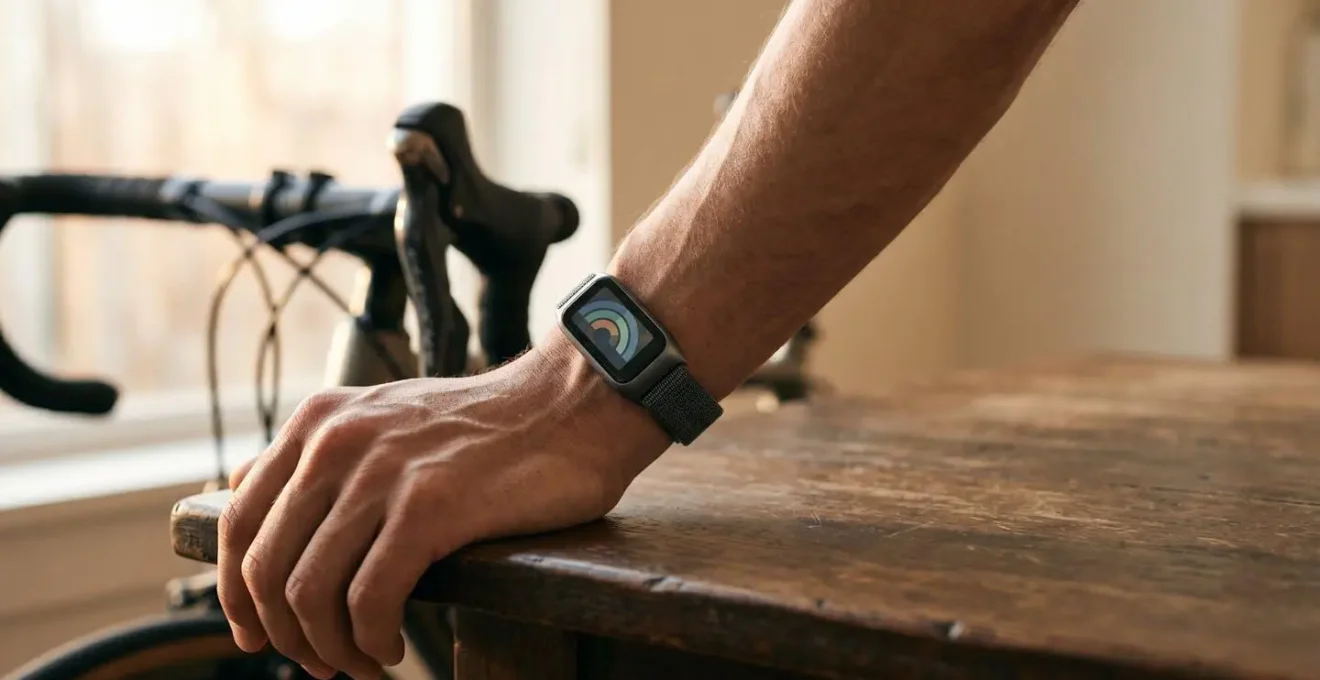
The biggest performance gains aren’t in your power meter, but in the data your body produces while you sleep.
- Raw metrics are useless without a system to interpret them; focus on trends over volatile daily scores to build data-driven intuition.
- Use your tracker as a ‘Polarization Enforcer’—an objective tool to verify that your easy days are truly easy, enabling maximal effort on key interval days.
Recommendation: Adopt a dual-device approach. Use a chest strap for workout accuracy and a wrist-based tracker for 24/7 holistic health trends like HRV and sleep architecture.
As a data-obsessed cyclist, you’ve equipped your bike with a power meter, a cadence sensor, and a GPS computer that tracks every pedal stroke. You upload your rides, analyze your watts per kilo, and hunt for marginal gains. Yet, you’ve hit a plateau. The same question surfaces after every stagnant FTP test: where is the next breakthrough coming from? The latest answer from the world of endurance sports points away from the bike and toward your own biology, with 24/7 health trackers like Whoop, Oura, and advanced Garmin watches promising a new frontier of optimization.
The common advice is to simply “track your sleep” and “listen to your body.” But this advice often falls short. It doesn’t explain what to do when your watch flashes a low recovery score the morning of a big ride, or why its heart rate data seems to fail during the most intense intervals. It treats the data as a report card rather than what it truly is: a stream of actionable bio-signals. The truth is, collecting data is easy; the hard part is building a system to use it effectively.
This guide reframes the conversation. The key isn’t the device itself, but the creation of a personal physiological feedback loop. We’re moving beyond the brand names to ask a more fundamental question: how can you translate the signals from your wrist into tangible watts on the road? It’s not about blindly following an algorithm. It’s about using technology to develop a deeper, data-informed intuition about your body’s capacity to perform.
Throughout this article, we’ll dissect the most critical metrics, confront the hardware’s limitations, and provide actionable protocols to build your own high-performance system. We will explore the practical steps to turn data into a decisive training advantage, ensuring every metric you track has a purpose.
Contents: Whoop, Oura, or Garmin: Do You Need 24/7 Tracking to Be a Better Cyclist?
- Heart Rate Variability: What to Do When Your Watch Says “Low Recovery”?
- Optical vs. Chest Strap: Why Your Watch Misses High-Intensity Spikes?
- The Data Web: Pushing Health Metrics into TrainingPeaks for Better Coaching
- Blue Light and Caffeine: Improving Sleep Score to Boost Watts
- Charging Anxiety: Which Tracker Actually Lasts a Week on One Charge?
- The Supercompensation Trap: Why You Get Weaker If You Don’t Rest Every 4th Week
- Bluetooth Blues: How to Force Upload Your Ride When the App Refuses
- How to boost FTP on 6 Hours a Week Without Burnout?
Heart Rate Variability: What to Do When Your Watch Says “Low Recovery”?
Heart Rate Variability (HRV) is the single most important bio-signal your 24/7 tracker provides. It measures the variation in time between consecutive heartbeats, acting as a direct window into your autonomic nervous system (ANS) activity. A high HRV generally indicates a state of “rest and digest,” signaling your body is recovered and ready for stress. A low HRV suggests a “fight or flight” response, meaning you’re still recovering from previous stressors, be it training, poor sleep, or life events. This isn’t just a theoretical number; it has a direct impact on performance. For instance, research demonstrates that cyclists with an abnormal HRV status may see a 6% reduction in peak power compared to those with a normal HRV.
So, you wake up to a “Low Recovery” notification. The cardinal rule is: don’t panic. A single low reading is just a data point, not a diagnosis. The goal is to correlate this objective data with your subjective feeling (Rate of Perceived Exertion or RPE) and make an informed decision, not a reactive one. A low HRV on race day, for example, is common due to pre-competition anxiety and doesn’t automatically predict poor performance. The real power of HRV tracking lies in observing the 7-day rolling average to identify trends.
Instead of scrapping your workout, use the data to modulate it intelligently. A low HRV score is a signal to adjust, not abandon. Here is a simple decision-making framework to translate that number into an action:
- Low HRV + Good RPE and Mood: Your body is stressed, but you feel good. Don’t do the planned VO2 max intervals. Instead, swap them for a Tempo or Sweet Spot session to maintain training stimulus while respecting your ANS’s need for less intensity.
- Low HRV + Physical Fatigue/Soreness: This is a clear signal. The planned workout is off. Prescribe an active recovery Zone 1 spin (30-45 minutes easy) or take a complete rest day. Pushing through here is the fastest way to non-functional overreaching.
- High HRV During a Heavy Block: Be vigilant. While usually good, a prolonged, unusually high HRV can be a paradoxical sign of overtraining, where the body’s systems begin to shut down. Monitor for this alongside performance metrics.
- Female Cyclists: Remember to track your menstrual cycle. HRV is often naturally lower during the late luteal phase. Contextualizing your data this way prevents unnecessary training adjustments based on normal hormonal fluctuations.
By treating HRV as a guide rather than a command, you begin to build a sophisticated feedback loop that fine-tunes your training load based on your body’s real-time readiness.
Optical vs. Chest Strap: Why Your Watch Misses High-Intensity Spikes?
One of the most common frustrations for data-driven cyclists is looking down at their wrist-based tracker during a sprint and seeing a heart rate of 110 bpm when they feel like it’s 180. This isn’t a faulty device; it’s a limitation of the technology. Optical heart rate (OHR) sensors in watches like Garmin, Oura, and Whoop use photoplethysmography (PPG)—shining an LED light onto the skin to measure changes in blood volume. While excellent for tracking resting heart rate and 24/7 trends, this method struggles with the realities of cycling. Constant grip on the handlebars, road vibrations, and rapid changes in heart rate during intervals can create significant inaccuracies. In fact, industry tests have shown error rates ranging from ±1% to ±13.5% for OHR during cycling.
In contrast, a chest strap monitor uses electrocardiography (ECG), directly measuring the electrical signals of your heart. It is the gold standard for accuracy during exercise, immune to the issues of grip and vibration that plague OHR sensors. For a cyclist, this distinction is critical. Your power zones and training adaptations are directly tied to accurate heart rate data during high-intensity efforts. Relying on a wrist sensor for interval training means you could be working in the wrong zone entirely, compromising the effectiveness of your workout.
This doesn’t mean your 24/7 tracker is useless. It simply means you need to assign the right tool to the right job. The most effective strategy is a dual-device approach, which leverages the strengths of both technologies.
Case Study: The Dual-Device Best Practice for Serious Cyclists
The optimal setup for a competitive cyclist involves using a chest strap paired with a bike computer for real-time performance data during structured workouts and high-intensity intervals. This ensures every watt-sucking effort is accurately measured and recorded. Simultaneously, the wrist-based tracker is reserved for what it does best: off-bike holistic health tracking. It continues to monitor your sleep stages, recovery scores, and 24/7 HRV trends. This dual-device system ensures you have the most accurate data where it matters most—during the ride for performance, and off the ride for recovery.
By embracing this specialized approach, you eliminate data contamination and gain confidence that both your workout efforts and your recovery insights are built on a foundation of accuracy.
The Data Web: Pushing Health Metrics into TrainingPeaks for Better Coaching
Collecting data on separate platforms—Whoop for recovery, Garmin Connect for rides, TrainingPeaks for coaching—creates data silos. The true power of holistic tracking is unlocked when these streams converge, creating a single, comprehensive view of your athletic life. Integrating your 24/7 health metrics into your primary training platform like TrainingPeaks transforms your coach’s (or your own) ability to make informed decisions. It provides the “why” behind your performance.
This integration allows a coach to see your HRV, sleep score, and resting heart rate right next to your power file from the previous day’s workout. A “failed” interval session is no longer just a set of bad numbers; it’s re-contextualized by a night of poor REM sleep or a plummeting HRV score. This proactive approach is standard practice at the elite level, where recovery data dictates training adjustments in real-time. This level of insight isn’t just for pros; it’s accessible to any amateur willing to connect their accounts.
Case Study: The Coach’s Morning Review Workflow in the Grand Tours
During a study of elite cyclists at the Tour de France, coaches reviewed recovery metrics from wearables each morning before analyzing power files. The data revealed that sleep quality dropped significantly during the race compared to pre-race periods. By monitoring these metrics daily, coaches could distinguish between poor performance caused by inadequate recovery versus a decline in fitness. This allowed for crucial, real-time interventions, such as swapping a planned high-intensity session for an endurance ride or prescribing a rest day before physiological breakdown and potential injury could occur.
Many athletes question the accuracy of these consumer devices, but their value lies in trend analysis, not clinical precision. As the research team from the same Tour de France study noted, “Garmin smartwatches are comparable to other consumer-available health trackers for sleep estimation… these devices demonstrate good sleep-wake classification accuracy (85%-90%).” This is more than sufficient for identifying the trends that impact performance.
Your Action Plan: Auditing Your Personal Data Ecosystem
- Points of Contact: List all devices currently emitting signals about your physiology (e.g., Whoop, Garmin watch, Wahoo computer, smart scale).
- Data Collection: Inventory the specific data points you already have access to (e.g., HRV, Sleep Stages, Resting HR, Power, Cadence, Weight).
- Coherence Check: For one week, compare your tracker’s key recovery metric (like HRV or Whoop score) with your subjective feeling (mood, energy, soreness on a 1-5 scale). Do they generally align?
- Signal vs. Noise: Review your past month of data. Identify one unique, recurring pattern (e.g., “My HRV consistently drops after a late-night meal”) versus the daily, generic fluctuations.
- Integration Plan: Choose the one pattern you identified and decide on a single behavioral change to test for the next week. The goal is to see if you can positively influence that specific metric.
This unified view transforms your data from a collection of interesting facts into a powerful, predictive tool for managing your training load and peaking at the right time.
Blue Light and Caffeine: Improving Sleep Score to Boost Watts
You can have the most advanced training plan and the most expensive bike, but if your sleep architecture is compromised, you are leaving massive performance gains on the table. Sleep is not a passive state; it is the most critical period for physiological repair, hormonal regulation, and memory consolidation. For a cyclist, this is when muscle tissue is rebuilt and adaptations from training are locked in. The link between sleep and performance is not subtle. Research on elite cyclists showed that functional threshold power fell 10.3% in Continental-level riders after a period of sleep-restricted racing. This isn’t a minor dip; it’s a catastrophic drop in performance.
The problem is widespread. A recent 2024 study found that 41% of elite and junior cyclists displayed poor sleep quality. For the data-obsessed amateur, the 24/7 tracker’s greatest contribution is its ability to make the invisible visible. It moves you beyond simply tracking “hours slept” to analyzing your sleep architecture—the specific amounts of Deep, REM, and Light sleep. Deep sleep is when 50-70% of your daily growth hormone is released for muscle repair, while REM sleep is crucial for mental recovery and learning.
Your tracker’s sleep score is a direct reflection of your pre-bed habits. Two of the biggest culprits that sabotage sleep architecture are blue light from screens and late-day caffeine intake. Blue light suppresses the production of melatonin, the hormone that signals your body it’s time to sleep. Caffeine, with its long half-life, can linger in your system for 8-10 hours, disrupting the natural progression into deep sleep, even if you don’t have trouble falling asleep. Optimizing your sleep is a bio-hacking protocol with a direct return on investment in watts.
Here is a simple sleep protocol to implement, especially during heavy training blocks or the taper week before a key event:
- Target 7.5-8.5 hours of actual sleep per night, extending to 9 hours during taper weeks.
- Prioritize deep sleep by aiming for 60-90 minutes nightly for optimal muscle repair.
- Implement “sleep banking” 3-4 days before a race by adding 30-60 minutes of extra sleep per night.
- Eliminate all blue light exposure from screens 90 minutes before bedtime. Use amber-tinted glasses if screen use is unavoidable.
- Time your final caffeine intake at least 8-10 hours before your target bedtime.
- Use your tracker data to verify that your pre-race rituals (e.g., meditation, carb-loading) are actually improving your deep and REM sleep percentages, not just total time.
- Avoid gaming the sleep score. Prioritize subjective restfulness; if you feel great despite a low score, trust your body. This is known as Goodhart’s Law: “When a measure becomes a target, it ceases to be a good measure.”
This isn’t just about feeling more rested; it’s a deliberate strategy to optimize your hormonal environment for maximum recovery and adaptation, directly fueling your on-bike power.
Charging Anxiety: Which Tracker Actually Lasts a Week on One Charge?
For a cyclist, especially one participating in multi-day events, stage races, or bikepacking trips, battery life isn’t a convenience—it’s a critical feature. “Charging anxiety” is a real phenomenon that can undermine the very reason you wear a tracker: to have a continuous, uninterrupted stream of physiological data. A device that dies mid-way through a training camp or a 3-day gravel race creates a black hole in your data, rendering trend analysis useless. The advertised battery life from manufacturers is often based on ideal, low-usage scenarios. The reality of frequent GPS use, continuous heart rate monitoring, and smart notifications can cut that life in half.
The market offers a wide spectrum of battery performance, and the right choice depends entirely on your specific use case as a cyclist. An Apple Watch Ultra 2, with its powerful processor and bright screen, might be perfect for single-day events but is a non-starter for a week-long tour. Conversely, a device like the Withings ScanWatch 2 prioritizes longevity over a feature-rich app ecosystem. Understanding this trade-off is key to selecting a device that aligns with your cycling ambitions.
The following table provides a realistic comparison of popular trackers, specifically tailored for a cyclist’s needs, considering both typical and heavy-use scenarios like a race weekend or training camp.
| Device | Typical Battery Life | Heavy Use Mode | Best For Cyclists |
|---|---|---|---|
| Garmin Instinct 2X Solar | Unlimited (solar) | 30+ days | Bikepacking, stage races |
| Withings ScanWatch 2 | 30 days | 20+ days | Long tours, minimal charging |
| Amazfit Balance | 14 days | 7 days | Training blocks, weekly races |
| Whoop 4.0 | 4-5 days | 3-4 days | Daily tracking with frequent charging |
| Oura Ring Gen 3 | 4-7 days | 4-5 days | Week-long training camps |
| Apple Watch Ultra 2 | 36 hours | 18 hours | Single-day events only |
Beyond choosing the right device, you can also employ specific strategies to maximize the battery life you have, especially during a crucial event. These small adjustments can mean the difference between having data for your entire event or just the first half.
- Disable continuous SpO2 monitoring; it is the single largest battery drain on most devices.
- Turn off gesture-activated screen wake during long endurance rides.
- Reduce screen brightness to 30-50%, which is more than enough for daylight conditions.
- Disable smart notifications and phone connectivity during a stage race when your phone is in a gear bag anyway.
- For ultra-endurance events, switch to GPS-only mode instead of multi-band options (like GPS+GLONASS) to extend tracking time.
- For Whoop users, always carry the slide-on battery pack. You can fully charge the device during a 20-minute post-ride shower without losing data continuity.
By matching your device’s battery profile to your cycling habits and using these conservation tricks, you can eliminate charging anxiety and ensure your data stream remains intact when it matters most.
The Supercompensation Trap: Why You Get Weaker If You Don’t Rest Every 4th Week
The fundamental principle of training is stress plus rest equals adaptation. We apply a training stimulus that causes fatigue (stress), and then during recovery (rest), our body adapts and becomes stronger than before (supercompensation). The data-obsessed cyclist, driven by a desire to constantly push, often masters the “stress” part of the equation but neglects the “rest” component. A common mistake is following a rigid, calendar-based training structure, like the classic “3 weeks on, 1 week off,” without listening to individual physiological feedback. This can lead to the supercompensation trap: applying new stress before the body has fully recovered and adapted, leading to a gradual decline in performance, not an increase.
You don’t get stronger from the hard workouts; you get stronger by recovering from them. If you continually stack hard days without adequate recovery, your performance will stagnate and eventually regress. This is where 24/7 trackers provide an immense advantage. They offer an objective measure of your recovery status, allowing you to move from a rigid, calendar-based deload week to a flexible, HRV-guided recovery protocol. Your body doesn’t run on a perfect 7-day cycle, and your recovery needs will fluctuate based on training load, sleep quality, and external life stress.
Instead of forcing a deload week every fourth week, you can use your 7-day rolling HRV average as a trigger. When you see a consistent downward trend in your HRV, it’s a clear bio-signal that your nervous system is overloaded and it’s time to initiate a recovery block, whether that falls on week 2.5 or week 4. This personalized approach is proven to be more effective.
Case Study: HRV-Guided Periodization Outperforms Traditional Programs
A study of seventeen well-trained cyclists compared an HRV-guided training plan against a traditional periodization model over 8 weeks. The HRV-guided group adjusted their daily training intensity based on morning HRV readings, rather than a fixed schedule. The results showed that this personalized prescription led to better performance enhancements. The key insight was that individual athletes required recovery at different intervals—anywhere from 2.5 to 4 weeks—depending on their unique response to training and life stress. HRV-guided training ensures rest is prescribed precisely when it’s needed most to facilitate supercompensation.
By letting your physiology, not the calendar, dictate your rest, you ensure that every training block builds upon the last, leading to consistent, long-term performance gains.
Bluetooth Blues: How to Force Upload Your Ride When the App Refuses
There is no greater frustration for a data-obsessed cyclist than finishing a grueling, FTP-boosting workout only to find the ride won’t sync from your device to Strava or TrainingPeaks. The app spins endlessly, Bluetooth connections are dropped and re-established, and the phone is restarted multiple times, all to no avail. This “Bluetooth Blues” is a common problem caused by buggy app updates, corrupted cache files, or simple connectivity glitches. When this happens, your precious data is effectively held hostage on your device. Fortunately, you don’t have to lose that ride. There is a manual, “brute force” method to extract the data and upload it directly.
Nearly all modern cycling computers and high-end watches (like Garmin and Wahoo) save your ride data in a standardized .FIT (Flexible and Interoperable Data Transfer) file format. By connecting your device to a computer via USB, you can access its internal storage and retrieve this file, bypassing the fickle app and Bluetooth connection entirely. This is your ultimate fallback plan to ensure no ride is ever lost.
Follow this protocol for manual FIT file extraction:
- Connect your Garmin, Wahoo, or other cycling computer to your laptop via its USB charging cable. The device will appear as an external drive.
- Navigate to the device’s storage. Look for a folder named ‘Activity’ (on Garmin) or ‘data’ (on Wahoo).
- Inside, you will find a list of .FIT files. The files are timestamped with the date and time of the activity, making it easy to locate the one you need.
- Copy the correct .FIT file from the device to your computer’s desktop.
- Log into Strava.com or TrainingPeaks.com using a web browser (this process does not work on the mobile apps).
- Find the upload option (usually a ‘+’ icon) and choose ‘Upload File’. Select the .FIT file from your desktop.
- Verify the ride data, maps, and power numbers appear correctly before celebrating.
In many cases, the sync issue is caused by a corrupted cache in the companion app on your phone. Before resorting to a full manual extraction, a simpler first step is to clear the app’s cache, which often resolves the issue for future syncs without deleting your ride history or login information.
- On Android: Go to Settings > Apps > [App Name, e.g., Garmin Connect] > Storage > Clear Cache. Do not click Clear Data.
- On iOS: Go to Settings > General > iPhone Storage > [App Name] > Offload App. This removes the app but keeps its documents and data. You can then reinstall it from the App Store.
- After clearing the cache or offloading, it’s good practice to restart your phone and re-pair the device before attempting to sync again.
Mastering these simple tech hacks ensures that a temporary software glitch will never stand between you and your valuable training data.
Key Takeaways
- Your tracker is a compass, not a map: Use its data to guide your decisions, not dictate them. Correlate objective metrics with subjective feelings.
- Adopt a dual-device strategy: Use a chest strap for workout precision and a wearable for 24/7 recovery trends to get the best of both worlds.
- True gains come from acting on bio-signals: Prioritize sleep hygiene and HRV-guided rest to unlock your body’s full power potential.
How to boost FTP on 6 Hours a Week Without Burnout?
The biggest challenge for the time-crunched cyclist isn’t a lack of motivation, but a lack of time. With only 6-8 hours per week to train, every minute counts. The traditional approach of adding “junk miles” is impossible. The key to boosting your FTP on a limited time budget is radical polarization: making your hard days incredibly hard and your easy days incredibly easy. This is where a 24/7 tracker becomes not just a data-gatherer, but a ‘Polarization Enforcer.’ Its value isn’t in telling you to train more, but in providing the objective feedback needed to maximize the quality of your limited time.
A typical 6-hour week might consist of two high-intensity interval sessions and two longer, low-intensity endurance rides. The most common failure point is not going hard enough on the interval days because you aren’t fully recovered, often due to “easy” days that were actually too strenuous. Your tracker’s recovery metrics (a combination of HRV, resting HR, and sleep quality) provide a daily, objective check. A high recovery score is the green light to go deep on your interval day. A low score is a firm command to keep your endurance ride truly in Zone 1 or 2, ensuring you are recovered for the next quality session. This data-driven approach ensures you arrive at your two key workouts of the week with the physiological capacity to execute them perfectly.
Daily training prescription based on HRV could result in a better performance enhancement than a traditional periodization in well-trained cyclists.
– Jose Antonio Rodriguez-Marroyo research team, Training Prescription Guided by Heart-Rate Variability in Cycling
But do you absolutely *need* a $300 device and a monthly subscription to achieve this? No. The core principles of recovery tracking can be implemented with zero cost, using the most sensitive instrument you own: your own body. While a tracker automates the process, an analog system can provide 70-80% of the insight by correlating subjective metrics that are proven to align with physiological recovery.
If you’re skeptical of the cost or complexity of 24/7 trackers, consider this powerful, zero-cost alternative:
- Create a Morning Journal: Every morning, within 10 minutes of waking, rate the following on a 1-5 scale: Sleep Quality, Muscle Soreness, and Mood. Also, take your resting heart rate manually for 60 seconds.
- Establish Your Baseline: Record these metrics for 2-3 weeks of normal training to understand your personal baseline numbers.
- Identify Trends: Calculate a 7-day rolling average for each metric. Don’t react to daily blips; look for trends.
- Trigger Rest: A rest or active recovery day is triggered when: your sleep quality score drops below baseline for 3+ consecutive days, muscle soreness is a 4 or 5 for 2+ days, or your resting HR is 5+ beats above your baseline.
Whether you use a high-tech tracker or a simple pen and paper, the goal is the same: to build a robust feedback loop that ensures you are applying stress when your body is ready to adapt, turning your limited training time into maximum FTP gains.