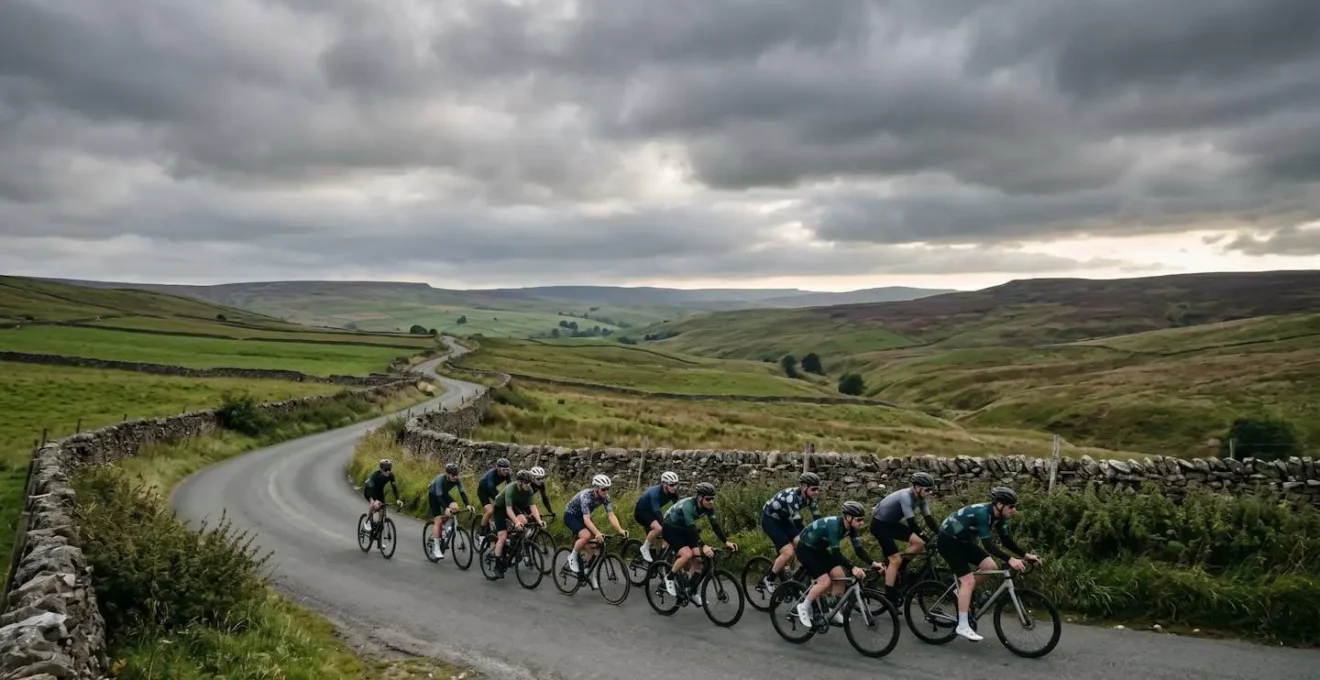
Joining a cycling club is less about being fast enough and more about entering a supportive system designed for safety and improvement.
- Clubs provide a crucial financial safety net through third-party liability insurance, a protection solo riders often lack.
- They offer a structured environment to learn essential group riding skills, from communication to etiquette, making you a safer, more efficient cyclist.
Recommendation: Instead of worrying about your speed, focus on finding a club whose culture (social vs. competitive) matches your goals. Your development will follow naturally from there.
The feeling is a familiar one for many solo riders. You love being on the bike, the freedom of the open road, and the personal satisfaction of pushing your own limits. But eventually, you hit a plateau. The same local loops start to feel repetitive, your motivation dips on grey mornings, and you wonder how to take that next step in your cycling journey. You’ve thought about joining a club, but the idea can be intimidating. Visions of super-fit, Lycra-clad cliques disappearing over the horizon, leaving you behind, are enough to make anyone stick to their solo routine. It’s a common fear: “Am I good enough? Will I fit in?”
While many articles will tell you that clubs make you faster or introduce you to new routes, they often miss the most fundamental point. The true value of a British Cycling affiliated club isn’t just about social rides or motivation; it’s about stepping into a structured ecosystem of shared knowledge and mutual responsibility. It’s a place where the unwritten rules of the road become clear, where safety is a collective effort, and where your development as a rider is nurtured in a way that’s simply impossible to replicate on your own. It’s not a test you have to pass, but a school you get to join.
But what if the key to unlocking your potential isn’t found in more solo miles, but in understanding the underlying fabric of club life? This guide is designed to act as a friendly welcome from a club secretary. We’ll pull back the curtain on how clubs really work, demystifying the culture, explaining the critical safety nets you gain, and showing you the path from an apprehensive solo rider to a confident member of the bunch. We will explore how to find your tribe, understand the language of the group, and even see how your hobby can make you better in your professional life.
This article breaks down the essential aspects of club cycling to give you a clear picture of what to expect. The following sections will guide you through everything from finding the right club culture to mastering the art of riding safely and efficiently in a group.
Contents: Your Guide to Joining a Cycling Club
- Race Team or Cafe Club: How to Spot the Culture Before You Join?
- Third Party Cover: Why Club Membership Is a Financial Safety Net?
- The Shout: Why Communication Is Key to Not Crashing the Group?
- Marshaling and Baking: The Hidden Cost of Club Membership
- Go-Ride: How Clubs Turn Kids into Olympic Champions?
- The Sin of Half-Wheeling: Why Everyone Hates It When You Push the Pace?
- Cyclist or Professional? How to Break the Stereotype in a Corporate Environment
- The Bunch Effect: How to Ride safely and Efficiently in a Pack of 20?
Race Team or Cafe Club: How to Spot the Culture Before You Join?
Your biggest apprehension is likely valid: not all clubs are the same. The fear of joining a high-octane race team when all you want is a sociable Sunday spin is real. The first and most crucial step is to understand that cycling clubs exist on a spectrum, from fiercely competitive race teams to laid-back “cafe clubs”. The former is focused on training, performance metrics, and competition. The latter prioritises scenery, conversation, and the quality of the coffee and cake stop. Many clubs, thankfully, offer a mix of both.
Your mission, before you even think about signing up, is to do a little detective work to identify a club’s true character. Look for keywords. A club that heavily uses terms like “smashing PBs,” “KOM hunting,” or “interval sessions” on its social media is signalling a competitive nature. Conversely, phrases like “no-drop ride” (meaning no one gets left behind), “sociable pace,” and “all welcome” are hallmarks of a more inclusive, social culture. The ultimate test is often how a group treats its slowest rider on a guest ride—are they encouraged and waited for, or left to fend for themselves?
Case Study: Ilkley Cycling Club’s Diverse Culture
Take Ilkley Cycling Club in Yorkshire, the UK’s largest. It masterfully accommodates a huge range of ambitions. It runs multiple, distinct ride groups every weekend, from fast-paced training chaingangs for racers to various social groups focused on enjoying the Dales at a more relaxed pace. This proves that race and cafe cultures can coexist within a single, well-organised club, allowing every rider to find their tribe.
The aesthetic of the club kit can even be a clue. Aggressive designs with heavy sponsor logos often point to racing ambitions, while understated or retro designs suggest a more social focus. By observing these details, you can make an informed choice and join a group where you’ll feel at home from day one.
Your Action Plan: Assess a Club’s Culture from Home
- Analyse social media language: Scour the club’s Instagram, Strava, and Facebook pages for recurring vocabulary. Note the balance between performance terms (‘interval sessions’) and social terms (‘no-drop ride’, ‘coffee stop’).
- Attend a guest ride and observe: The true test is seeing how the group treats its slowest member. Are they supported and encouraged, or are they dropped and left behind?
- Decode the club kit: Look at photos of the official kit. Heavy sponsorship and aggressive designs often signal competitive goals, whereas classic or playful patterns suggest a social-first mindset.
- Listen to post-ride chat: If you join a trial ride, pay attention to the conversation afterwards. Is it all about power data and average speeds, or is it about the route’s scenery and the next social event?
Third Party Cover: Why Club Membership Is a Financial Safety Net?
Riding solo, you are entirely on your own, and that includes financially. It’s a risk few cyclists truly consider until it’s too late. Imagine a momentary lapse in concentration: you clip a wing mirror on a parked car or, worse, cause an incident involving another rider or a pedestrian. The costs for damages, legal fees, and personal injury claims can be financially ruinous. This is arguably the single most compelling, yet least talked about, reason to join an affiliated club: the built-in financial safety net.
When you join a club affiliated with British Cycling, a significant portion of your membership fee contributes to comprehensive liability insurance. This isn’t just a minor perk; it’s a multi-million-pound shield. For instance, the liability insurance for affiliated clubs provides coverage for claims made against you during any club activity. This includes not just the weekend club run, but also official training sessions and events. The policy provides public liability indemnity up to £20 million, a figure that covers even the most catastrophic and unlikely of scenarios.
This protection transforms your relationship with risk. You can ride with the peace of mind that a simple mistake won’t lead to a lifetime of debt. The table below illustrates the stark difference in financial exposure between a solo rider and a club member in several common scenarios.
| Incident Scenario | Solo Rider (Uninsured) Cost | Club Member (British Cycling) Cost |
|---|---|---|
| Scratching a parked car (minor damage) | £800-£2,000 (out of pocket) | £0 (covered by policy) |
| Causing multi-rider pile-up with injuries | £30,000-£100,000+ (personal liability) | £0 (covered up to £20m) |
| Pedestrian collision requiring medical treatment | £5,000-£100,000+ (healthcare, legal, loss of earnings) | £0 (covered by liability insurance) |
| Legal defense costs for a wrongful claim made against you | £5,000-£15,000 (solicitor fees) | £0 (legal support included) |
As this comparison of liability scenarios demonstrates, the value of this insurance alone can often exceed the entire annual cost of club membership. It’s the responsible choice for any cyclist who regularly rides on public roads.
The Shout: Why Communication Is Key to Not Crashing the Group?
From the outside, the cacophony of shouts and hand signals in a cycling bunch can seem like an exclusive, impenetrable code. But this “language of the bunch” isn’t designed to exclude; it’s the primary safety system that allows dozens of riders to move as one, just inches apart. As a solo rider, your awareness is limited to what you can see and hear. In a club run, you are borrowing the eyes and ears of the twenty riders in front of you. Learning to speak and understand this language is your first major step towards becoming a confident group rider.
The system is built on a simple principle: see a hazard, announce it, and pass the message down the line. A call of “Hole!” from the front rider should be echoed by every rider behind, ensuring the person at the very back knows about the pothole long before they reach it. It’s a chain of communication that creates collective situational awareness. Pointing down at the road for a hazard, holding a hand up for “slowing” or “stopping,” and waving a hand behind your back for “obstacle” are the basic grammar of this visual dialogue.
Becoming proficient is a gradual process, and nobody expects a newcomer to be an expert on day one. Your journey in group communication can be broken down into clear, progressive levels. The key is to start by listening and repeating, then gradually build the confidence to become the one who spots the hazard first. An advanced rider doesn’t just call out what they see, but anticipates what’s next, giving the group more time to react smoothly.
- Level 1 – The Repeater: As a beginner, your main job is to listen and echo. When the rider in front of you shouts “Car up!”, you repeat it loudly for the rider behind you. You are a vital link in the communication chain.
- Level 2 – The Originator: As you get more comfortable, you’ll start spotting hazards yourself. Scan the road 20-30 metres ahead. Be the first to call “Gravel!” or point out a drain cover.
- Level 3 – The Anticipator: Advanced riders provide context. Instead of just “Slowing!”, they’ll call “Slowing, junction ahead!” This gives everyone the ‘why’ and allows for a much smoother group reaction.
- Level 4 – The Pre-Briefer: Many clubs now use apps like WhatsApp to brief riders on the route, known hazards, and pace expectations before the ride even starts, ensuring everyone is aligned.
Marshaling and Baking: The Hidden Cost of Club Membership
A thriving cycling club doesn’t run on membership fees alone. It runs on the collective energy and contribution of its members. This is the “hidden cost” of joining: you’re not just a customer, you’re part of a community, and that comes with a degree of shared responsibility. This might mean taking a turn to marshal a corner during a club-hosted race, helping with the sign-on at a sportive, or even baking a cake for a social event. For some, this can feel like a chore, but for many, it’s the most rewarding aspect of club life.
This contribution is what transforms a group of individual cyclists into a true club. It’s the glue that holds everything together. Without volunteers, there would be no organised rides, no races, no social evenings, and no youth coaching. When you pay your subs, you’re paying for the essentials like insurance and affiliation. When you give your time, you’re investing in the culture and community of the club itself. It’s the difference between a transactional service and a living, breathing organisation.
Many riders find that this is where they derive the most satisfaction, long after their racing ambitions have faded. It’s an opportunity to pass on knowledge, support the next generation, and build deeper connections with fellow members off the bike. Far from being a cost, this contribution becomes a profound benefit.
I realised that I had a lot of experience to share with the new generation of cyclists and coaching enabled me to get involved with the racing side of cycling and I found it massively rewarding seeing the riders I coach improve as they enjoy riding their bikes.
– John Wych, British Cycling Club Coach Case Study
As John Wych’s experience shows, the act of giving back is often its own reward. It’s the moment you stop thinking about what the club can do for you, and start thinking about what you can do for the club. This is when you truly become a member, not just a subscriber.
Go-Ride: How Clubs Turn Kids into Olympic Champions?
When you join a local cycling club, you are connecting to something much bigger than just your weekly ride. You are becoming part of a national development pathway that has a proven track record of turning grassroots enthusiasm into elite success. The heart of this system is the Go-Ride programme, British Cycling’s initiative for developing young riders. Most clubs with a youth section are Go-Ride accredited, providing a fun, safe, and structured environment for children to learn bike handling skills.
This isn’t just about keeping kids active; it’s the first rung on the ladder of the Great Britain Cycling Team performance pathway. The traffic-free coaching sessions, the mini-races, and the skills challenges are designed by experts to build confidence and competence from a young age. It’s in these club sessions that the next generation of national and Olympic champions are discovered and nurtured. The results of this structured approach speak for themselves.
According to British Cycling, over 60% of the riders on the Great Britain Cycling Team started their journey in a Go-Ride club. This incredible statistic shows the direct link between the volunteer coach at your local club and the heroes you see on television. Your membership fee helps subsidise these activities, ensuring the club has the equipment and facilities to continue this vital work.
Seeing a group of under-10s expertly navigating a cone-slalom course is a powerful reminder of the club’s role in the wider sporting ecosystem. It fosters a sense of pride and purpose that extends far beyond your own personal cycling goals. You’re not just a member; you’re a supporter of the future of the sport in the UK.
The Sin of Half-Wheeling: Why Everyone Hates It When You Push the Pace?
Once you’ve mastered the basic shouts and signals, you’ll begin to learn the more subtle, unwritten rules of group riding etiquette. And there is no greater sin in the unwritten rulebook than “half-wheeling.” It’s a simple act: when riding side-by-side with someone at the front of the group, you persistently keep your front wheel just a few inches ahead of theirs. It seems innocuous, but it’s a passive-aggressive way of forcing the pace and it can single-handedly ruin the harmony of a group ride.
Why is it so disliked? Because it breaks the invisible contract of a social ride. The rider next to you, feeling the pressure, will instinctively speed up to draw level. You, the half-wheeler, will then push ahead again, and this micro-acceleration ripples through the entire bunch. The pace slowly but surely creeps up, turning a sociable chat into a breathless effort. Riders at the back, feeling the “concertina effect,” will be surging and braking, and eventually, people will get dropped. It’s a selfish move that says “my pace is more important than the group’s.”
The goal when riding two-abreast at the front is to maintain a constant speed and keep your handlebars perfectly in line with your partner’s. This creates a stable, predictable environment for everyone behind you. It’s an act of trust and cooperation. If you feel you are consistently stronger than the group’s pace, the correct etiquette is to do longer turns on the front, or join a faster group next time, not to force 20 other people to ride at your tempo.
Avoiding this simple mistake is one of the quickest ways to earn the respect of experienced club riders. It shows that you understand that group riding is a team activity, not a solo time trial. It’s about collective rhythm, not individual strength.
Cyclist or Professional? How to Break the Stereotype in a Corporate Environment
The discipline, strategy, and resilience you develop in a cycling club are not confined to the weekend. These are highly transferable skills that have immense value in a professional environment, yet they are often overlooked or stereotyped. You’re not just “a cyclist who disappears for two hours at lunch”; you are a project manager, a data analyst, and a strategic leader. Learning to translate your on-bike achievements into the language of the corporate world can be a powerful career asset.
Think about what you’re actually doing. Successfully completing a 100-mile sportive isn’t just “a long bike ride.” It’s a long-term project requiring meticulous planning, resource management (nutrition and hydration), and sustained performance under pressure. Leading a club ride through unpredictable weather isn’t just “going for a spin.” It’s real-time risk assessment and dynamic leadership. Analysing your power data to peak for an event is data-driven decision-making to achieve a measurable goal.
The key is to reframe these activities, moving away from cycling jargon and towards professional competencies. By doing so, you can break the stereotype of the single-minded athlete and present yourself as a well-rounded professional whose hobby enhances their work, rather than distracts from it. Many of the core functions of club life directly mirror corporate responsibilities.
- On-bike skill: Completing a 100-mile sportive with strategic pacing and nutrition.
Corporate translation: ‘Proven ability to manage complex long-term projects requiring strategic resource allocation and sustained performance.’ - On-bike skill: Serving as Club Treasurer managing an annual budget.
Corporate translation: ‘Financial planning and budget management experience with P&L responsibility and stakeholder reporting.’ - On-bike skill: Analysing training data (TSS, FTP, power curves) to optimise performance.
Corporate translation: ‘Data-driven decision-making using quantitative metrics to identify performance gaps and track progress against KPIs.’ - On-bike skill: Organising weekly club rides for 30+ members.
Corporate translation: ‘Stakeholder coordination, managing diverse needs and expectations while maintaining engagement and safety standards.’
Your commitment to cycling demonstrates dedication, goal-orientation, and a growth mindset. By articulating these benefits effectively, you can turn your passion into a compelling part of your professional identity.
Key Takeaways
- Finding the right club is about matching its culture (social vs. competitive) to your personal cycling goals.
- Club membership provides a critical, often overlooked, financial safety net through third-party liability insurance.
- Group riding is a learned skill built on communication and shared responsibility, not just raw fitness.
The Bunch Effect: How to Ride safely and Efficiently in a Pack of 20?
The ultimate expression of club cycling is riding smoothly and safely within a large group, a phenomenon known as the “bunch effect.” For a solo rider used to battling the wind alone, the first time you tuck into the slipstream of a peloton is a revelation. The feeling of being pulled along, with the noise of the wind dropping away as you expend significantly less energy, is a core joy of the sport. This isn’t just a feeling; it’s physics. The aerodynamic shelter provided by the group is immense.
Riding in a bunch is the art of conserving energy. Research has shown that the reduction in aerodynamic drag for a rider in a peloton can be enormous. According to an aerodynamic study published in MDPI Proceedings, drafting can reduce a rider’s effort by anywhere from 27% to 66% depending on their position. This is the secret that allows a club run to cover vast distances at a speed that would be exhausting for a solo rider. You are sharing the workload, with riders taking short turns on the front to “pull” the group before rotating to the back to recover.
However, this efficiency comes with a prerequisite: predictability and trust. Riding safely in a pack of 20 means holding a steady line, avoiding sudden braking or swerving, and communicating hazards effectively. It requires you to be constantly aware, not just of the wheel in front of you, but of the rhythm of the entire group. It’s a collective dance where every rider’s smoothness and predictability contributes to the safety and speed of the whole. It’s the culmination of all the other skills: the communication, the etiquette, and the shared responsibility.
This is the ultimate transformation for the solo rider. You move from being an individual fighting the elements to being a component in a larger, more efficient machine. It’s a skill that takes time to learn, but once mastered, it opens up a whole new dimension of cycling.
The journey from a solo rider to a confident club member is a rewarding one. It’s about more than just finding people to ride with; it’s about becoming a more skilled, safer, and connected cyclist. The next logical step is to explore the clubs in your local area. A great place to start is the British Cycling Club Finder, where you can find a list of affiliated clubs near you and begin the process of finding your tribe.