In summary:
- UK gravel is not about long, straight roads but technical, constantly changing surfaces that demand specific skills and equipment.
- Smooth, fast-rolling tyres suited for US gravel are a liability on Britain’s wet, greasy chalk and muddy bridleways; knobbly treads are essential.
- Success requires mastering a low-traction environment, prioritizing smooth cadence over raw power and learning to read the terrain.
- Shared-use bridleways have a unique etiquette, and a lower, wider gear range is non-negotiable for the short, steep climbs.
- Forget the American gravel dream; embracing the UK’s unique challenge is the key to enjoying this distinct discipline of cycling.
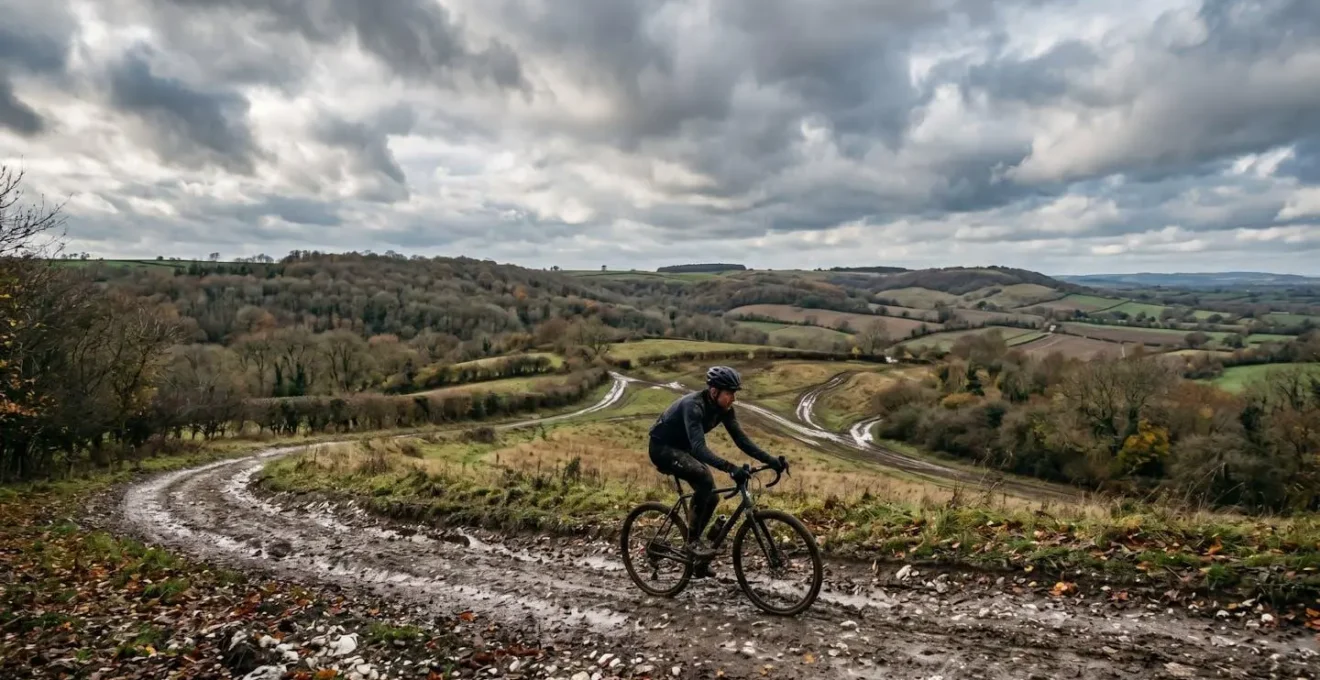
You’ve seen the videos: endless ribbons of sun-drenched gravel disappearing into a vast American landscape. You’ve bought into the dream of “hero gravel”—fast, flowing, and free. So you’ve taken the plunge, moving from the predictability of tarmac to the adventure of off-road. But as a road cyclist transitioning to gravel in the UK, the reality you encounter is likely to be a shock. The smooth fire roads of your imagination are replaced by greasy chalk, slick roots, and deep, wheel-sucking mud. The bike that felt perfect on paper feels twitchy and unpredictable, and the joyous freedom you anticipated feels more like a frustrating battle for grip.
Many guides will simply tell you “it’s muddier here” or advise “get wider tyres.” This advice, while not wrong, is dangerously superficial. It fails to address the fundamental disconnect between the American gravel ideal and the British reality. The difference isn’t just about the weather; it’s rooted in geology, land access laws, and a topography shaped over thousands of years. The flint that shreds tyres, the chalk that turns to ice when wet, and the ancient, narrow bridleways are not just obstacles; they are the very essence of UK gravel.
But what if the key wasn’t to try and replicate the American experience, but to embrace the UK’s unique technical challenge? This guide is your reality check. We’re going to dismantle the US gravel dream and rebuild your understanding from the ground up. This isn’t about compromise; it’s about re-learning. It’s about understanding the physics of traction on slippery surfaces, adapting your technique, and making specific technological choices that will transform your riding from a fight for survival into a dance of control.
We’ll explore why your roadie habits and American-spec gear are holding you back. From tyre selection and cornering technique to gearing and trail etiquette, you’ll gain the specific, actionable knowledge needed to not just survive, but thrive on the glorious, challenging, and uniquely British “gravel” that awaits.
This article provides a comprehensive overview of the essential adjustments you’ll need to make. We’ve structured this guide to take you from fundamental equipment changes to advanced techniques and cultural understanding, ensuring you have a complete toolkit for your UK gravel adventures.
Summary: A Road Cyclist’s Guide to Mastering Real UK Gravel
- Knobs vs. Slicks: Why Your 40mm File Treads Fail in British Winter?
- The Tripod Technique: Should You Put a Foot Out on Slippery Gravel Turns?
- Spinning Out: Why Road Gearing Is Too High for 20% Gravel Climbs?
- Bells and Horses: Managing Conflict on Busy Bridleways
- Dirty Reiver or Local Loop: How to Choose Your First Gravel Event?
- Center Strip vs. Full Knobbly: Matching Tread to Your Local Terrain
- Lockout or Open: When Should You Actually Stiffen Your Suspension on Tech Climbs?
- Pressure Drop: Why 45mm Tyres at 25psi Are Faster Than You Think?
Knobs vs. Slicks: Why Your 40mm File Treads Fail in British Winter?
The first and most brutal lesson UK gravel teaches a road cyclist is about grip. Your American-inspired 40mm file treads, designed for speed on hard-packed dirt, are a serious liability here. The fundamental difference lies in the surface. US gravel often involves maintaining purchase on a loose-over-hard surface. In the UK, you’re frequently trying to find grip through a soft, slippery top layer of mud, wet leaves, or greasy chalk. A file tread, which relies on surface area contact, simply skims across this layer, offering almost zero traction for braking, climbing, or cornering.
To gain control, you need a tyre with knobs that can penetrate the soft layer and bite into the firmer ground beneath. This is where full knobbly or at least aggressive side-knob tyres become non-negotiable. As the experts at Cycling UK bluntly state in a group test of gravel tyres, “File or smooth tread performs poorly, especially when it’s damp.” The UK is, more often than not, damp. This reality demands a shift in mindset: you must trade the perceived rolling-speed advantage of a slicker tyre for the actual, usable speed that comes from confident handling and control.
Width is the other part of the equation. While you might get away with 38mm in the US, British conditions reward volume. Wider tyres allow for lower pressures, which increases the contact patch and allows the tyre to conform to uneven surfaces. According to leading UK gravel bike manufacturer Ribble, a width of 40-45mm is the sweet spot for most UK gravel riding. This extra volume provides a crucial cushion against sharp flint and allows the knobs to do their work without the tyre feeling harsh. Sacrificing a little on-road speed for immense off-road confidence and safety is the first and most important trade you’ll make.
The Tripod Technique: Should You Put a Foot Out on Slippery Gravel Turns?
On tarmac, cornering is a predictable science of lean angles and grip limits. On UK gravel, it’s a dynamic art of managing a constantly shifting “traction budget.” Every time you brake, lean, or pedal through a corner, you are spending some of your available grip. On a wet, off-camber chalk trail, that budget is perilously small. A common panic reaction is to unclip and stick a foot out—the “tripod” technique. While it can save you from a fall in a low-speed, tight corner, it’s a sign that you’ve already lost control and bled all your momentum. True mastery lies in avoiding the need for it.
Developing what can be called “surface literacy” is key. This is the skill of reading the terrain far ahead, identifying patches of greasy mud, slick roots, or loose stones before you enter the turn. This allows you to set your entry speed and line proactively rather than reacting to a slide. Your body position is your primary tool for managing traction. By lowering your centre of gravity—dropping your outside heel, bending your elbows, and staying relaxed—you press the tyres into the ground and can better absorb small slips without tensing up and making them worse.
The goal is to maintain momentum by making smooth, deliberate inputs. Aggressive handlebar movements or sudden braking will instantly bankrupt your traction budget. Instead, focus on looking through the turn, weighting your outside pedal to maximize the tyre’s contact patch, and guiding the bike with subtle body English. The foot-out dab is a last resort, not a primary technique. Mastering cornering in the UK is about staying clipped in, staying smooth, and keeping that tripod in reserve for true emergencies only.
Your UK Cornering Technique Audit
- Surface Analysis: Are you actively reading the terrain for greasy chalk, wet roots, and leaf cover well before the turn?
- Body Positioning: Is your centre of gravity low, with dropped heels and bent elbows, ready for a potential slip?
- Weight Management: Are you deliberately weighting the outside pedal to maximize tyre grip on flat, slippery corners?
- Steering Inputs: Are you using subtle counter-steering inputs, or are you making aggressive handlebar movements that can break traction?
- Slip Correction: Do you have a clear strategy, using a quick ‘dab’ for minor slips and reserving the full ‘tripod’ for low-speed, high-risk situations?
Spinning Out: Why Road Gearing Is Too High for 20% Gravel Climbs?
A road cyclist’s instinct on a climb is to get out of the saddle and apply power. On a steep, loose British gravel climb, this is the fastest way to go nowhere. As soon as you unweight the rear wheel, your tyre will break traction and spin out. UK gravel is littered with short, viciously steep climbs—often exceeding 20% gradients—on surfaces of mud or loose stone. Conquering them requires a complete reversal of road technique: you must stay seated and prioritize a smooth, high cadence over raw, stomping power.
By staying seated and shifting your weight back on the saddle, you keep pressure on the rear wheel, helping the tyre’s knobs dig in and maintain grip. The key is to deliver power smoothly. A lumpy, low-cadence pedal stroke creates torque spikes that overwhelm the available traction. A higher, “spin to win” cadence, however, delivers a more constant, even force to the rear wheel, significantly reducing the chance of a spin-out. This is where your road gearing will betray you. A standard road cassette simply doesn’t offer a low enough gear to maintain a high cadence when the gradient bites.
This reality has fueled a significant debate in the UK gravel scene about drivetrains. While 1x (single chainring) systems are popular for their simplicity, their larger jumps between gears can be a disadvantage here.
Case Study: The 1x vs. 2x Drivetrain Debate for UK Terrain
UK gravel terrain features short, punchy, and repetitive climbs that are hallmarks of British topography. As noted in analysis by outlets like Cycling Weekly, the larger jumps between gears in many 1x drivetrains can disrupt a rider’s cadence and momentum on these variable gradients. A sudden, large shift can break the smooth power delivery needed for traction. For this reason, the traditional 2x system with its closer gear ratios is often more suitable for maintaining the high, smooth cadence necessary to deliver power without overwhelming tyre grip on loose, technical surfaces. It allows for finer adjustments to effort, keeping you in that critical “spinning” zone.
Bells and Horses: Managing Conflict on Busy Bridleways
In the vast landscapes of the American Midwest, you can ride for hours without seeing another soul. In the densely populated UK, your gravel ride is a shared experience by default. The network of trails accessible to cyclists is a complex and often contentious patchwork. According to Cycling UK, cycling is excluded from nearly 80 per cent of the rights of way network in England and Wales. This funnels cyclists, walkers, dog owners, and horse riders onto the same narrow bridleways and byways, creating a significant potential for conflict.
For a cyclist used to the open road, this is a major cultural shift. Your speed, even at a moderate pace, can be intimidating to other users. A silent approach can startle a dog or, more dangerously, a horse. Mastering the “Bridleway Code” is as crucial as any bike handling skill. This starts with a simple piece of equipment: a bell. Not a “ding-ding” city bell, but a clear-sounding trail bell (like a Timber Bell) that creates a constant, gentle jingle, announcing your presence from a distance without being aggressive. It gives other users, particularly horse riders, ample time to hear you and prepare.
The legal framework is also critical to understand. As a cyclist, you must know where you are and are not permitted to be. In a briefing on access, the advocacy group Cycling UK clarifies the rule for England and Wales:
Cyclists have a right to ride on bridleways, byways and restricted byways, but not footpaths.
– Cycling UK, Bridleways, byways and cycle tracks (England & Wales)
Riding on a footpath is not just poor etiquette; it’s against the law and damages the reputation of all cyclists. When passing others, always slow down to a walking pace, give a friendly verbal warning (“Good morning! Cyclist coming past on your right!”), and be prepared to stop. A smile and a “thank you” go a long way. In the UK, being a good gravel cyclist means being a good ambassador for the sport on every single ride.
Dirty Reiver or Local Loop: How to Choose Your First Gravel Event?
The American gravel scene is defined by epic, mass-participation races like Unbound Gravel, which are as much about endurance and straight-line speed as they are about off-road skill. The UK’s gravel event calendar is a more diverse and nuanced landscape, reflecting the country’s different terrain and cycling culture. Choosing your first event requires looking beyond the hype and understanding what kind of experience you’re looking for.
At one end of the spectrum are the large-scale, US-style “gravel races.” These are becoming increasingly popular, with the growth in participation being a clear indicator of the sport’s health. For instance, the British Gravel Championships, a key event in the UK calendar, has seen its participation expand from just under 300 riders to more than 1,000 registered competitors between its first and latest editions. These events offer full signposting, feed stations, and a competitive atmosphere.
A prime example of this is the legendary Dirty Reiver, which has cemented its place as a cornerstone of the UK gravel scene and offers a taste of that big-event feel.
Case Study: The Dirty Reiver Experience
Now in its 10th year, the Dirty Reiver has established itself as probably the UK’s best-known gravel event, attracting hundreds of cyclists to the vast Kielder Forest in Northumberland. It offers a 200km challenge over a rolling landscape of forest tracks and trails, featuring long sections of what many would call “hero gravel,” reminiscent of the US style. With feed stations and mechanical support, it embodies the well-supported, mass-participation model and provides a clear contrast to the more grassroots culture of traditional UK reliability trials.
At the other end are the local club-run “reliability trials” or smaller, self-supported bikepacking events. These are often cheaper, more intimate, and demand greater self-sufficiency and navigation skills. They are a fantastic way to discover local routes and connect with the grassroots community. For your first event, consider your goals. Do you want the buzz of a big race or the quiet satisfaction of a self-navigated adventure? Starting with a shorter, local event is often the wisest choice, allowing you to test your skills, bike, and fitness in a lower-stakes environment before tackling a 200km monster.
Center Strip vs. Full Knobbly: Matching Tread to Your Local Terrain
We’ve established that aggressive knobs are vital for UK conditions, but the world of tyre treads is more complex than just “slick vs. knobbly.” The specific pattern of those knobs can be tuned to your local terrain and the ratio of road-to-trail in your typical rides. As a road cyclist, the idea of a “fast-rolling” centre strip with side knobs for cornering grip might seem like the perfect compromise. However, this design has a critical flaw in the UK’s technical, off-camber environment.
Tyres with a smooth centre and aggressive shoulder knobs have a “transitional void”—a zone between the centre and side where there is very little tread. When riding upright on a road or smooth trail, you’re on the fast centre. When you lean hard into a corner, you engage the grippy side knobs. The problem arises on off-camber trails or in shallow-angle, slippery turns, where the bike is never leaned over far enough to fully engage the side knobs. You end up riding in this transitional void, which offers dangerously little grip precisely when you need a bit of lateral support. This is a common cause of “washing out” the front wheel.
For most of the year in most of the UK, a full knobbly tyre is the safer and ultimately faster choice because it provides consistent, predictable grip at any lean angle. The perceived penalty in rolling resistance is often overestimated with modern rubber compounds and is a small price to pay for the confidence to carry more speed through technical sections. A semi-slick is a tool for a very specific job: dry summer days or rides that are 70%+ on tarmac. For the all-around UK gravel rider, consistent grip trumps all.
The following table provides a clear comparison of how different tread patterns perform across key metrics relevant to British riding, based on general tyre performance principles discussed in publications like Cycling Weekly.
| Tread Pattern | Best For | Rolling Resistance | Wet Grip | Mud Clearance | UK Terrain Suitability |
|---|---|---|---|---|---|
| Slick/Semi-Slick | 70%+ road, smooth gravel | Lowest | Poor | Poor | Limited – fails in damp conditions |
| File Tread | Mixed road/light gravel | Low | Moderate (dry only) | Poor | Marginal – struggles with UK wet surfaces |
| Center Strip + Side Knobs | 50/50 road/gravel | Medium | Moderate | Moderate | Transitional void issue on off-camber terrain |
| Full Knobbly | 60%+ off-road, technical terrain | Higher (but modern compounds reduce this) | Excellent | Excellent | Optimal for UK’s greasy, leaf-covered, muddy conditions |
Lockout or Open: When Should You Actually Stiffen Your Suspension on Tech Climbs?
For a road cyclist, stiffness equals efficiency. The idea of front suspension on a gravel bike can seem like an unnecessary addition of weight and complexity that only serves to sap power. The instinct, if you have it, is to use the lockout feature on any climb to make the bike feel more like a rigid road bike. This is a critical mistake. On a technical, bumpy UK gravel climb, a locked-out fork is your enemy. You should almost never use a full lockout off-road.
The purpose of suspension on a gravel bike is not primarily comfort; it is traction. When a rigid fork hits an obstacle like a rock or a root, the wheel deflects upwards and bounces off it. For that split second, the tyre is airborne, and you have zero steering control and zero grip. An active suspension fork, however, absorbs the impact, keeping the tyre pressed firmly onto the ground. This continuous contact is what allows you to steer accurately and maintain momentum over rough terrain.
Using a full lockout turns your suspension fork into a rigid one, reintroducing this problem of deflection and traction loss. Instead, modern gravel suspension forks offer a “trail” or “platform” mode. This setting stiffens the initial part of the travel to resist “pedal-bob” from your body movement, but allows the suspension to become active to absorb impacts from the trail. It’s the best of both worlds for UK conditions. Thinking of your suspension as a “traction finder” rather than a comfort device is a crucial mental shift.
Here are the five essential rules for using your suspension on UK gravel:
- Never use full lockout on bumpy, technical climbs. It causes wheel deflection, losing traction and momentum.
- Set your suspension to “trail” or “platform” mode for most UK gravel. This provides support while remaining active enough to absorb impacts.
- Think of suspension as a “traction finder.” An active fork tracks the terrain, maintaining grip where a rigid fork would skip.
- Reserve full lockout exclusively for smooth tarmac sections between off-road segments.
- On wet roots and greasy chalk climbs, fully open suspension helps the tyre maintain contact with unpredictable surface contours, maximizing grip.
Key takeaways
- UK gravel demands a mindset shift: prioritize grip and control over raw speed and low weight.
- Your equipment must be adapted: knobbly tyres, wider gear ranges, and appropriate tyre pressures are non-negotiable.
- Technique is paramount: learn to manage traction through smooth cadence on climbs and deliberate body positioning in corners.
Pressure Drop: Why 45mm Tyres at 25psi Are Faster Than You Think?
The final, and perhaps most counter-intuitive, piece of the puzzle is tyre pressure. As a road cyclist, you are conditioned to believe that high pressure equals low rolling resistance and therefore, more speed. On a perfectly smooth surface, this is true. But gravel is not a perfectly smooth surface. The idea of running your 45mm gravel tyres at a seemingly “squishy” 25 PSI (around 1.7 Bar) might feel incredibly slow, but the reality is the opposite. On rough UK terrain, lower pressure is faster.
This is due to a concept called “suspension loss.” A high-pressure tyre is rigid. When it hits a stone or a root, the entire bike and rider are lifted up and over the obstacle. This upward movement is wasted energy and kills your momentum. A lower-pressure tyre, however, is more compliant. It deforms and absorbs the obstacle without lifting the rider’s mass. This preserves your forward momentum. As the team at Polygon Bikes succinctly puts it, “Wider gravel tires don’t feel slow because they’re soft, they feel fast because they smooth out rough terrain and maintain momentum.”
This compliance also massively increases your traction and control. The larger contact patch gives your tyre’s knobs more chance to grip, and the tyre’s ability to conform to the ground keeps it in contact more of the time. According to tubeless setup recommendations, wider gravel tyres (35-50mm) can comfortably operate at much lower pressures, typically within the 25-50 PSI range. Finding your personal sweet spot within this range (depending on your weight, tyre size, and terrain) is one of the most effective ways to upgrade your bike’s performance—and it costs nothing. Letting go of the “high pressure = fast” dogma is the final step in truly adapting to the demands of UK gravel.
By letting go of the American dream of fast, flowing gravel and embracing the technical, challenging, and rewarding reality of the British landscape, you will unlock a far more profound and engaging cycling experience. The key is not to fight the terrain, but to adapt to it. Start by applying these principles to your own setup and technique.