In summary:
- Effective cassette cleaning in a small space relies on a contained, surgical system, not messy, brute-force scrubbing.
- Use bike-specific, pH-neutral degreasers to avoid damaging your components and a two-jar system to reuse liquid and contain waste.
- Combine a gear claw for bulk grime with a stiff brush or “flossing” for deep cleaning between sprockets.
- Perfectly drying the cassette before applying lube is critical to prevent “false lubrication” and accelerated wear.
- Your lubrication choice (wax vs. drip) dictates your entire long-term maintenance routine and cleanliness.
That black, greasy cassette is the drivetrain’s badge of shame. It’s a magnet for road grit, a killer of performance, and the source of those dreaded chainring tattoos on your calf. For riders with a garden and a pressure washer, tackling this grime is a messy but straightforward affair. But for those in a flat or with limited outdoor space, the prospect of spraying solvent and black sludge all over the balcony or, worse, the bathroom, is a non-starter. The internet is full of advice that involves buckets, hoses, and a level of splatter that’s simply incompatible with apartment living.
This is where the professional detailer’s mindset changes the game. The secret to a fast, effective, and contained clean isn’t about more power or more chemicals; it’s about a smarter, more surgical process. It’s a closed-loop system that treats your drivetrain with the precision of a watchmaker, not the brute force of a car wash. This approach minimizes mess, maximizes the effectiveness of your products, and ensures that every one of your 10 minutes is spent actually cleaning, not just making a bigger mess.
This guide will walk you through that professional system. We’ll dissect the products, the tools, and the techniques that allow for a pristine clean without needing a dedicated workshop. From choosing the right degreaser to understanding the critical science of drying, you’ll learn not just how to clean your cassette, but why each step is essential for drivetrain longevity and peak performance. Forget the mess; it’s time to embrace the method.
To help you navigate this professional approach, we’ve broken down the process into key stages. This structured guide covers everything from product selection and tooling to the crucial final steps of lubrication that define the long-term health of your drivetrain.
Summary: The Pro Detailer’s Guide to a Spotless Cassette
- Citrus vs. Chemical: Which Degreaser Melts Grime Without Damaging Paint?
- Toothbrush or Claw: The Best Tools for Getting Between the Sprockets
- Whip and Lockring: Is It Worth Taking the Cassette Off for a Deep Clean?
- Black Sludge: Where Do You Pour the Dirty Degreaser After Cleaning?
- The Water Trap: Why Lube Fails If You Don’t Dry the Cassette Perfectly
- 300km Rule: How to Know When Your Wax Coating Has Worn Off?
- Chain Wear on Mid-Drives: Why You Might Need a New Chain Every 1,000 Miles
- Hot Wax vs. Drip Wax: Is the “Silent Chain” Worth the Kitchen Hassle?
Citrus vs. Chemical: Which Degreaser Melts Grime Without Damaging Paint?
The first decision in our contained cleaning system is the active agent. The choice isn’t simply “natural” citrus versus “strong” chemical; it’s a calculated decision about effectiveness versus material safety. As a detailer, my primary concern is removing grime without causing collateral damage. Many powerful household cleaners can strip paint, etch aluminum, or permanently dull the finish on expensive components. Therefore, using a bike-specific formula is non-negotiable.
The gold standard is a pH-neutral degreaser. These formulas are engineered to be safe on delicate surfaces like carbon fiber, clear coats, and the anodized finishes found on many high-end cassettes and lockrings. High-alkaline degreasers, while effective at cutting grease, can cause irreversible cosmetic damage. Even “natural” citrus degreasers can be problematic; concentrated citric acid is caustic and can harm paint if not rinsed thoroughly. The key is to look for formulas designed for bikes, which are balanced for power and safety. According to testing, the right bike-specific degreasers can achieve 97% of grease and oil removed in a single application while remaining safe for your frame and components.
Regardless of your choice, the final step is a thorough water rinse. This isn’t just about washing away dirt; it’s about neutralizing the degreaser and removing any residue. Leftover degreaser can interfere with lube adhesion and, over time, lead to paint peeling, especially around the dropouts. In our contained system, this rinse will be done with a simple spray bottle and a rag, not a hose.
Toothbrush or Claw: The Best Tools for Getting Between the Sprockets
With the right chemical chosen, we turn to the tools for a surgical clean. A common mistake is to attack the cassette with a single, overly aggressive brush, which flings black sludge everywhere. The professional approach is a two-stage process using specialized tools for efficiency and containment. Your primary tool should be a gear claw or “cassette claw.” This hook-shaped tool is designed to get under the largest chunks of solidified gunk and pull them out in solid pieces, not as a liquid spray. This step alone removes 80% of the mess with minimal splatter.
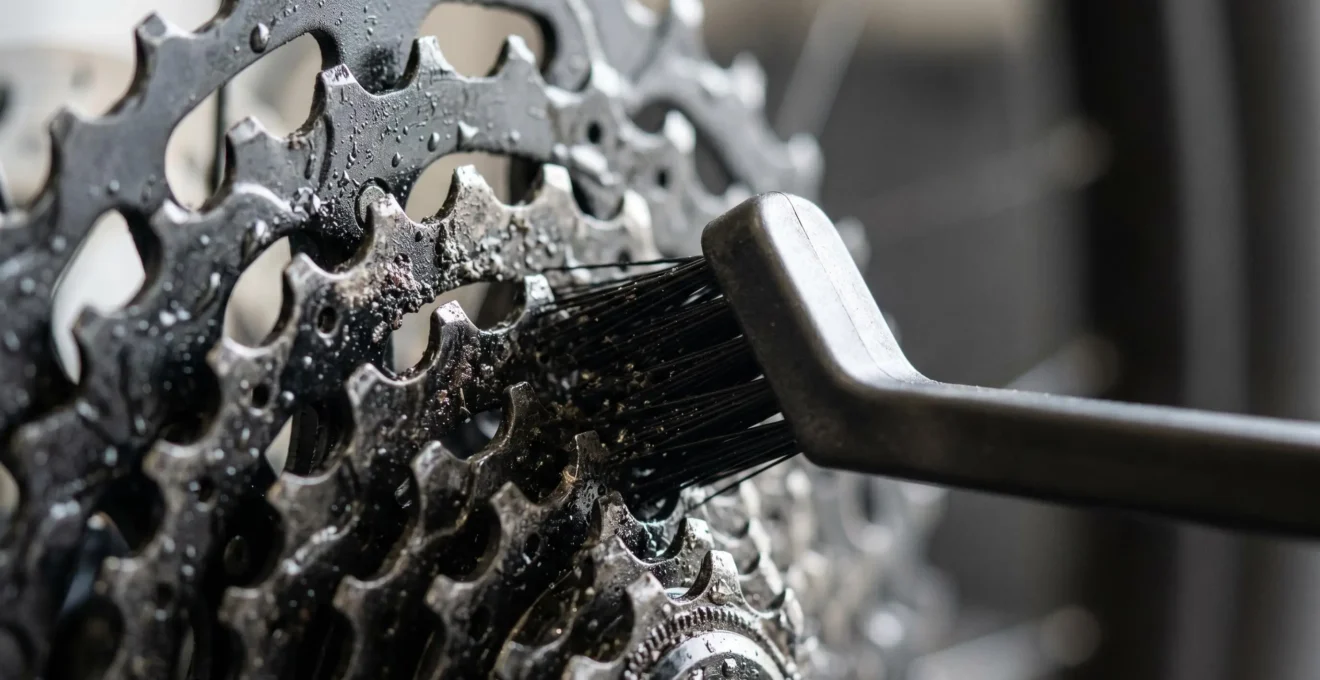
After the bulk removal, you switch to a detail tool. While a stiff toothbrush can work, a dedicated cassette brush with longer, stiffer bristles and a shaped head provides better access. The technique is crucial: apply a small amount of degreaser directly to the brush, not the cassette, and use a “down-and-away” motion to scrub, directing any dislodged grime into a waiting rag held underneath.
For the ultimate deep clean, especially on modern 11 or 12-speed cassettes with narrow gaps, pros employ a technique called “flossing.” This involves using a thin strip of rag, a pipe cleaner, or dedicated gear floss soaked in degreaser to slide between each individual sprocket. This method, as noted by experienced mechanics, ensures every last bit of grit is removed from the tightest spaces where brushes can’t reach. A combination of a claw for 30 seconds, followed by targeted flossing, can achieve a near-perfect clean in under two minutes.
Whip and Lockring: Is It Worth Taking the Cassette Off for a Deep Clean?
The ultimate question for any detail-oriented cyclist is whether to clean the cassette on or off the bike. The answer depends on your goal: quick maintenance or a restorative deep clean. For the 10-minute “no-mess” brief, an on-bike clean is perfectly sufficient. However, understanding the trade-offs is key to a long-term maintenance strategy. A quick, regular on-bike clean keeps the drivetrain running smoothly, but it will never be 100% effective.
Removing the cassette with a chain whip and lockring tool allows for a true “deep soak” in a container of degreaser, dissolving hidden grime from the very core of the sprockets and spacers. This is the only way to achieve a professional-grade, 100% clean. It’s the go-to method after a particularly muddy ride, before a big race, or as part of a seasonal teardown.
Here is a comparison of the different cleaning methods and their applications.
| Method | Time Required | Tools Needed | Cleaning Effectiveness | Best Use Case |
|---|---|---|---|---|
| Quick On-Bike Clean | 5-10 minutes | Degreaser, brush, rag | Surface cleaning, 80-90% effective | Weekly maintenance, dry conditions, regular upkeep |
| Deep Off-Bike Clean | 20-30 minutes | Cassette tool, chain whip, degreaser, container | Complete cleaning, 95-100% effective | Post-muddy rides, pre-race prep, seasonal deep clean |
| Ultrasonic Clean (Off-Bike) | 15-20 minutes active + 60 min soak | Cassette removal tools, ultrasonic cleaner, degreaser solution | Professional-grade, 100% effective | Maximum drivetrain longevity, elimination of hidden grit |
Grit Migration Risk in Aggressive On-Bike Cleaning
There’s a critical risk with aggressive on-bike cleaning, especially after riding in wet, gritty conditions. Winter riding introduces fine sand and salt into the drivetrain. Using high-pressure sprays or aggressive scrubbing can force this microscopic grit past the delicate seals of the freehub body bearings. As experts on the subject of component wear confirm, this leads to expensive, hidden damage that grinds away your hub from the inside out. Removing the cassette for a contained, off-bike soak eliminates this risk entirely, ensuring no contaminants are forced into sensitive bearing assemblies.
Black Sludge: Where Do You Pour the Dirty Degreaser After Cleaning?
This is the most critical step for any apartment-dwelling cyclist and the heart of our “closed-loop” system. Pouring used degreaser, which is now contaminated with oil and heavy metals, down the drain is an environmental disaster. These solvents can pass straight through municipal water treatment plants and wreak havoc on aquatic ecosystems. It’s also often illegal. The professional solution is a simple, reusable, and responsible system: the two-jar method.
Instead of spraying degreaser liberally, you’ll perform the cleaning within a contained system. The first jar is the “dirty jar,” where the initial, most contaminated cleaning happens. The second is the “cleaner jar,” used for a final rinse. This not only contains 100% of the waste but also dramatically extends the life of your degreaser. Once the liquid is too dirty to be effective, you don’t just dump it. You can filter the liquid through a simple coffee filter to separate the solid sludge from the reusable liquid. The solids can be disposed of in regular trash, and the filtered liquid can be used for the “dirty” stage of the next clean.
This system turns a messy, wasteful process into a clean, efficient, and environmentally conscious ritual. The small amount of highly concentrated toxic waste that remains can be taken to a local hazardous waste disposal facility periodically.
Action Plan: The Two-Jar System for Degreaser Reuse and Eco-Disposal
- Set up a ‘dirty jar’ for initial cleaning to catch the heaviest contamination and black sludge from the first pass.
- Establish a ‘cleaner jar’ with semi-clean solution for the final rinse, extending degreaser life.
- Use the coffee filter method: pour used liquid through a coffee filter into a second container to separate solid sludge from reusable liquid.
- Dispose of the solid sludge caught in the filter in your regular solid waste; it is no longer a liquid hazardous waste.
- Reuse the filtered degreaser for the first-pass cleaning during your next maintenance session, extending product life by up to 300%.
The Water Trap: Why Lube Fails If You Don’t Dry the Cassette Perfectly
You’ve meticulously cleaned your cassette, and it’s sparkling. The natural next step is to apply lube, right? Wrong. This is where most well-intentioned mechanics, amateur and professional alike, make a critical error. Applying lubricant to a wet or even slightly damp drivetrain is not only ineffective; it’s actively harmful. Water trapped between the chain rollers and the cassette sprockets creates what is known as a hydraulic barrier. This thin film of water physically prevents the lubricant from reaching the metal surfaces where it’s needed.
The result is a phenomenon called “false lubrication.” The drivetrain will sound quiet for the first few miles, giving you a false sense of a job well done. Underneath this quiet facade, however, metal is grinding against metal, causing massively accelerated wear. Your chain and cassette are being destroyed, silently. Complete and total dryness is not a recommendation; it is a requirement for effective lubrication.
The Pro’s Drying Secret: Forced Air
Professional mechanics don’t have time to wait for parts to air dry. Their secret weapon is forced air. Using compressed air from a compressor or even a powerful leaf blower can render a cassette perfectly, bone-dry in under 60 seconds, with the added benefit of being a touchless method. For the apartment dweller, a can of compressed air for electronics or even a hair dryer on a cool setting can achieve a similar result. If you see a light orange dusting of “flash rust” on steel sprockets after washing, do not panic. This is normal surface oxidation and will be immediately displaced and neutralized by a proper lube application. It is a sign that your cassette is truly dry and ready for lube.
300km Rule: How to Know When Your Wax Coating Has Worn Off?
Once your cassette is spotlessly clean and perfectly dry, the lubrication you choose dictates your future maintenance schedule. For riders using an immersive wax or a high-performance drip wax, the question is always: “When do I reapply?” Unlike traditional oil-based lubes that simply get dirtier, wax lubricants wear away, leaving the chain unprotected. Waiting too long negates the benefits and accelerates wear, but reapplying too soon is a waste of time.
Manufacturers often provide a baseline durability range, with most high-quality wax coatings lasting between 300-500km (190-310 miles) in ideal, dry road conditions. However, the single best indicator is audible. A freshly waxed chain is virtually silent. When you start to hear a distinct, high-pitched, dry “zing” from your drivetrain, especially under load, that is the ‘audible cue’ that the wax layer has worn thin and it’s time to re-wax.
For a more systematic approach, you can use the “Conditions Multiplier Method” to adjust your re-waxing interval:
- Dry Roads (Baseline): Re-wax every 300km for optimal performance.
- Dusty/Mixed Conditions: Divide the baseline by 1.5. Re-wax every 200km.
- Wet/Rainy Conditions: Divide the baseline by 2. Re-wax every 150km. It is critical to re-wax immediately after a wet ride to prevent oxidation.
A visual check is also effective: if the inner rollers of your chain are shiny silver, the wax has worn off. If they still have a white or grey coating, the protection is still intact.
Chain Wear on Mid-Drives: Why You Might Need a New Chain Every 1,000 Miles
While meticulous cleaning and lubrication are key for all bikes, they become hyper-critical on mid-drive e-bikes. The constant, high-torque assistance from a motor puts forces on a drivetrain that are fundamentally different from human-only power. A human pedal stroke has “micro-rest” periods at the top and bottom, but a motor provides relentless, cumulative stress on the chain’s rollers and pins. This results in dramatically accelerated wear.
It is not uncommon for standard chains on mid-drive systems to be completely worn out in as little as 1,000-1,200 miles, taking the expensive cassette with them. This isn’t a sign of a faulty product; it’s the reality of the physics involved. The solution lies in using e-bike specific chains, which are built with hardened pins and stronger plates to withstand the increased forces. These chains, combined with a rigorous cleaning and lubrication schedule, can dramatically extend the life of your entire drivetrain.
The Real-World Difference of an E-Bike Chain
In one documented case, a Trek mid-drive owner found their original chain and cassette were destroyed at just 1,200 miles. After switching to an e-bike specific chain and maintaining a regular 300-mile cleaning interval, the results were astounding. The cassette lasted to 3,300 miles, and the specialized chain itself showed minimal wear even at 4,500 miles. The data shows a stark contrast in lifespan, with 1,200 miles vs. 4,500+ miles, demonstrating that the right components and maintenance are not just a recommendation but an economic necessity for e-bike owners.
Key takeaways
- A contained system is superior to brute force. Your goal is surgical grime removal, not widespread splatter.
- Perfect dryness before lubrication is non-negotiable. A wet chain with fresh lube is a recipe for accelerated wear.
- Your choice of lubricant (wax vs. oil) is a commitment that defines your entire cleaning and maintenance schedule.
Hot Wax vs. Drip Wax: Is the “Silent Chain” Worth the Kitchen Hassle?
The final frontier of drivetrain hygiene is the choice between immersive hot waxing and high-performance drip wax. This isn’t just about what you put on your chain; it’s a choice of maintenance philosophy. Hot waxing, which involves removing the chain and immersing it in a dedicated crockpot of molten paraffin wax, offers the ultimate in cleanliness and drivetrain longevity. A hot-waxed chain stays remarkably clean, as the hard wax doesn’t attract dirt. This can extend chain life to 10,000-15,000km or more.
The downside is the significant “kitchen hassle.” It requires a dedicated setup, a lengthy initial deep-clean process, and the time to remove, re-wax, and reinstall the chain every 300-500km. Drip wax, on the other hand, offers incredible convenience with 80% of the performance benefit. It can be applied in minutes without removing the chain. However, it will attract more contaminants and require more frequent, messy degreasing sessions.
This table breaks down the total investment of time and effort for each system.
| Factor | Hot Wax (Immersive) | Drip Wax |
|---|---|---|
| Initial Setup Time | 2-3 hours (first deep clean + wax pot setup) | 2 minutes (apply to existing chain) |
| Re-Application Time | 30-45 min (chain removal, re-wax, reinstall) | 2 minutes (drip application) |
| Cleaning Frequency | Quick 5-min wipe-down every 300km | 20-min messy degreasing every 200-300km |
| Chain Lifespan to 0.5% Wear | 10,000-15,000km (some achieve 20,000+ km) | 3,000-6,000km typical for drip lubes |
| Drivetrain Cleanliness | Stays very clean, minimal gunk buildup | Attracts more contaminants, visible gunk accumulation |
| Domestic Impact | High – dedicated crockpot, spill risk, odor, ‘kitchen pass’ needed | Low – portable bottle, minimal mess, relationship-friendly |
| Break-Even Point | After ~1,500-2,000km total time investment equals drip wax | Lower barrier to entry but higher ongoing maintenance burden |
The Point of No Return: Cross-Contamination
The single biggest mistake a new wax user can make is the “point of no return” contamination. If you are on a ride and your hot-waxed chain starts to get noisy, applying a friend’s traditional oil-based drip lube is a catastrophic error. This introduces oil into the pristine wax system, immediately turning it into a dirt-attracting mess. The only fix is a complete strip-down and re-preparation from scratch. The proper trailside solution is to carry a small bottle of a compatible wax-based drip lube (like Squirt or Smoove) for system-safe top-ups.
By adopting this systematic, detail-oriented approach, cleaning your cassette transforms from a dreaded, messy chore into a quick, clean, and satisfying maintenance ritual. It’s not about having a large workshop; it’s about having the right process. Start implementing this contained system today and enjoy a quieter, more efficient, and longer-lasting drivetrain.