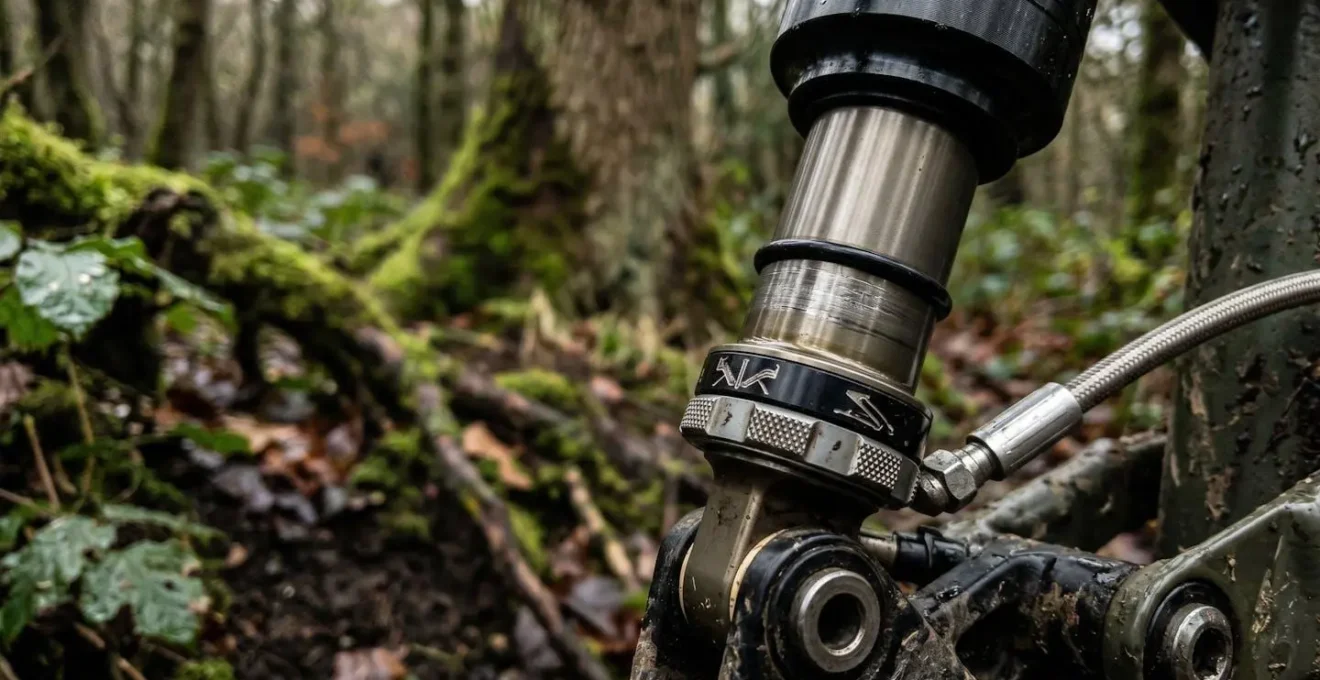
The key to conquering British trails isn’t chasing plushness, but achieving a balanced, supportive suspension that prioritises tyre contact and control over standard setup rules.
- Static sag is only a starting point; dynamic support from a slightly firmer setup often provides more grip and control on undulating, root-filled trails.
- Optimal rebound isn’t just ‘fast’ or ‘slow’; it’s about tuning the shock to let the tyre track the ground, preventing it from packing down or skipping over roots.
Recommendation: Start by reducing your sag by 2-3% from the manufacturer’s recommendation and slowing your rebound by two clicks. Then, focus on how the bike feels on a familiar rooty section, not just in the car park.
There’s a unique frustration every British mountain biker knows. You’ve set up your bike, you’ve read the guides, but out on the trail—a classic mix of slick roots, sudden compressions, and greasy mud—your bike feels all wrong. It’s either a “dead” sled that wallows and saps your energy, or a skittish, terrifying bronco that tries to throw you off at every obstacle. You’re left fighting the bike instead of flowing with the trail, losing confidence and speed where you should be having the most fun.
The common advice often revolves around hitting a magic number, usually 30% sag, and then fiddling with a rebound dial you don’t quite understand. These generic recommendations, often born from the dusty, fast trails of California, frequently miss the specific demands of UK riding. The constant undulations, the low-grip surfaces, and the need to generate speed from the terrain require a different philosophy. It’s about creating a platform that is supportive enough to ‘pop’ off features but supple enough to find grip where there seems to be none.
But what if the solution wasn’t to make your bike softer, but in some cases, strategically firmer? What if the secret to taming the bucking bronco wasn’t just slowing the rebound, but understanding precisely *why* you’re slowing it? This guide moves beyond the platitudes. We’re going to dive into the ‘why’ behind the adjustments, treating your bike’s suspension not as a set of isolated dials, but as a complete system—from shock and fork to tyres and even your own body position—to unlock control and confidence on the most challenging British trails.
This article will guide you through a holistic approach to suspension tuning specifically for the UK’s unique terrain. We’ll examine every component of the system, from initial setup to on-trail technique, to transform your ride from unpredictable to intuitive. The following sections provide a complete roadmap for mastering your machine.
Summary: A Complete System Guide to UK Trail Suspension Tuning
- Why 30% Sag Might Be Too Soft for Your Local Trail Centre Loops?
- Bucking Bronco: How to Tame Your Rebound for Controlled Landings?
- Lockout or Open: When Should You Actually Stiffen Your Suspension on Tech Climbs?
- Bar Width and Stem Length: Is Your Cockpit Killing Your Downhill Confidence?
- How Lower Tyre Pressures Can Fix Your Harsh Suspension Feel?
- Attack Position: Why Your Heels Should Be Down When the Trail Gets Rough?
- Zing-Zing-Zing: How to Straighten a Bent Rotor with an Adjustable Spanner
- How to Ride Steep, Slippery Chutes Without Locking Your Brakes?
Why 30% Sag Might Be Too Soft for Your Local Trail Centre Loops?
The first step in any suspension setup guide is always sag, and for good reason. It sets the bike’s ride height and determines the initial balance between positive and negative air chambers. The standard advice is almost gospel: set your rear shock to around 25-30% for trail bikes. For many riders and trails, this is a fantastic starting point. It provides a plush feel and allows the wheel to drop into holes, maintaining contact. However, on many of Britain’s man-made trail centre loops, this classic setting can be a trap.
These trails are often characterized by high-speed berms, pumpable rollers, and jump take-offs that require you to push into the bike to generate speed and air. With a soft, 30% sag setup, pushing into a berm or a takeoff can cause the bike to dive deep into its travel. This “wallow” saps your energy, makes the bike feel sluggish, and can upset the chassis balance, causing the front end to lift or the geometry to change at a critical moment. You lose the ‘pop’ that makes the trail fun.
The alternative is to think about dynamic support. By reducing your sag slightly—say to 25-28%—you create a firmer platform. The bike will ride higher in its travel, maintaining its geometry better under load. It will feel more responsive and ‘poppy’, rewarding an active riding style. You’ll be able to pump through rollers and generate speed more effectively. Yes, you sacrifice some initial plushness, but you gain a more efficient and playful bike that is better suited to the flow of a modern trail centre. The goal isn’t to use all the travel all the time; it’s to have the right amount of travel, available at the right time.
Bucking Bronco: How to Tame Your Rebound for Controlled Landings?
If your bike feels like it’s trying to eject you over the handlebars after a compression or a landing, the culprit is almost always your rebound damping. Rebound controls the speed at which your shock re-extends after being compressed. It’s the ‘taming’ force. Too fast, and the shock acts like a pogo stick, kicking back unpredictably. This is the “bucking bronco” feeling. Too slow, and the shock can’t recover in time for the next hit. This is called “packing down,” and on a classic British trail full of repeated root strikes, it will cause the bike to ride deeper and deeper into its travel, feeling harsh and losing traction.
The goal is to find the sweet spot where the rebound is as fast as possible without being uncontrolled. This allows the wheel to stay in contact with the ground, tracking every contour to generate maximum grip. This is where we move beyond simple car park tests. A shock that feels good when you push on the saddle might be completely wrong at trail speed. The best way to tune rebound is on a familiar, short section of trail with repeated hits, like a rooty traverse.
Start with the rebound fully open (fastest) and ride the section. The bike will likely feel wild and unstable. Then, add two clicks of rebound damping (slowing it down) and ride it again. Repeat this process. You are looking for the point where the bike stops feeling skittish and starts to feel calm and composed, with the rear tyre staying glued to the trail. You’ll know you’ve gone too far if the bike starts to feel dead and harsh, as if it’s losing its ability to recover between hits. Finding this balance is the key to unlocking control.
The Science of Tyre Contact
The importance of rebound is not just a feeling; it’s physics. Research shows that rebound damping directly dictates how well the tyre maintains contact with the trail. When it’s set too fast, the wheel bounces off the ground after a hit, losing all traction. When it’s too slow, the wheel can’t extend fast enough to drop into the next dip, effectively skipping over the trail surface. On a web of wet roots, where every moment of contact counts, optimal rebound allows the tyre to follow the ground’s contours precisely, maintaining the consistent grip needed for both climbing and descending.
The rebound cycle is a continuous, rhythmic motion. This visual helps to conceptualise the shock compressing and then extending in a controlled manner, much like natural elements absorbing and releasing energy.
As you can see, the goal is a controlled return to the neutral position, ready for the next impact. It’s this control that turns a bucking bronco into a confident, trail-hugging machine. The perfect rebound setting gives you the confidence that the bike will stick to the ground when you need it to, especially after a landing or through a high-speed, chattery section.
Lockout or Open: When Should You Actually Stiffen Your Suspension on Tech Climbs?
Most modern shocks come with a 3-position lever: Open, Pedal (or Trail), and Firm (or Lockout). The common logic is simple: use Open for descending, Firm for road climbs, and Pedal for everything in between. While this holds true for smooth fire roads, it’s a rule that needs to be broken on technical British climbs. The kind of ascent littered with wet roots, loose rocks, and off-camber steps requires traction above all else, and a locked-out rear end is the enemy of traction.
When you flick that lever to ‘Firm’, you’re essentially turning your full-suspension bike into a hardtail. On a smooth surface, this is great; it prevents the suspension from bobbing and wasting your pedal strokes. But on a technical, low-grip climb, this is a disaster. As your rear wheel encounters a root or a rock, a locked-out shock can’t absorb the impact. Instead of the wheel moving up and over the obstacle while maintaining contact with the ground, it bounces off it. This momentary loss of contact is all it takes for the tyre to spin out, forcing you to put a foot down in frustration.
In these scenarios, an active, open suspension is your best friend. A fully ‘Open’ setting allows the rear wheel to move freely, absorbing impacts and tracking the uneven ground. This keeps the tyre pressed firmly into the trail, maintaining the precious traction you need to clean the climb. If your bike’s ‘Open’ mode feels too soft and inefficient, the ‘Pedal’ or ‘Trail’ mode is the perfect compromise. It adds low-speed compression damping to reduce pedal-induced bob, but it’s designed to ‘blow off’ on impacts, allowing the shock to absorb hits and find grip.
On a slippery, technical UK climb full of wet roots and rocks, a locked-out or overly firm suspension causes the wheel to lose contact and spin out.
– Tweed Valley Bikes, Suspension 101: Damping Guide
So, the next time you’re faced with a greasy, root-infested climb, resist the urge to reach for the lockout. Keep the suspension active, focus on a smooth pedal stroke, and let your bike’s design do the work of finding grip for you.
Bar Width and Stem Length: Is Your Cockpit Killing Your Downhill Confidence?
Your suspension doesn’t work in a vacuum. It’s part of a system that includes you, the rider, and your primary contact points with the bike: the cockpit. Your handlebar width and stem length have a profound effect on your weight distribution, leverage, and steering, which in turn dictates how your suspension performs. The modern trend is towards ultra-wide bars and super-short stems, but blindly following this trend might be hindering your riding.
A wider bar provides more leverage for steering and can open up your chest for better breathing, offering a feeling of stability. However, a bar that is too wide for your body frame can force you into an awkward, strained position. It can pull your weight too far forward or make it difficult to lean the bike properly in turns. Conversely, a bar that’s too narrow can feel twitchy and unstable at speed. Similarly, modern mountain bikes typically use stems between 50-80mm, but the ideal length is tied to your bike’s reach and your preferred riding position.
Finding the right balance is a personal journey. The goal is to achieve a comfortable ‘attack position’ where your weight is balanced between the wheels, your elbows are bent, and you have the leverage to control the bike without feeling stretched or cramped. A well-fitting cockpit allows you to dynamically shift your weight, helping the suspension do its job. For example, if your front end is diving, a slightly longer stem or rolling your bars forward could shift your weight back, balancing the load on the fork and shock.
The Personalised Width Experiment
One rider’s journey to finding the perfect handlebar width shows the power of incremental testing. Starting with a trendy 800mm bar, the rider found it too cumbersome in tight trees. Over several weeks, they methodically cut the bar down, 2.5mm per side at a time. They found that 750mm felt too narrow and compromised control on fast descents. The sweet spot, discovered through patient experimentation rather than following a trend, was 765mm. This width provided the perfect balance of leverage for their strength and shoulder width, demonstrating that optimal setup is a highly individual process.
Don’t be afraid to experiment. If your bars have lock-on grips, try moving them in by 5mm on each side for a few rides. See how it feels. Small adjustments to your cockpit can make a huge difference to your confidence and control, allowing you to get the most out of your perfectly tuned suspension.
How Lower Tyre Pressures Can Fix Your Harsh Suspension Feel?
Before you spend money on volume spacers or a custom tune to fix a ‘harsh’ feeling suspension, you should look at the first and most tunable part of your suspension system: your tyres. Your tyre is the initial point of contact with the trail, and it provides a significant amount of small-bump compliance and damping. Often, a bike that feels harsh and chattery isn’t a problem with the shock, but a problem of over-inflated tyres.
Higher tyre pressures make a tyre roll fast on smooth surfaces, but on a rough trail, they do more harm than good. An over-inflated tyre can’t deform around small obstacles like roots and rocks. Instead, it pings and deflects off them, transmitting those harsh vibrations directly through the bike to you. This creates a chattery, uncontrolled ride and, crucially, reduces traction as the tyre skips across the surface rather than gripping it. It can easily be mistaken for a poorly performing shock.
This image perfectly illustrates how a correctly inflated tyre deforms, wrapping around the obstacle to maintain contact and absorb the impact. This is small-bump compliance in its purest form.
By lowering your tyre pressure, you allow the tyre casing to flex and conform to the trail. This dramatically increases the size of your contact patch, boosting grip. It also acts as a primary filter for high-frequency trail buzz, smoothing out the ride before those vibrations even reach your shock. For most trail riders running tubeless setups, pressures can often be dropped lower than you think. The key is to go low enough to gain compliance and grip, but not so low that you risk tyre roll in corners or pinch flats on sharp impacts. Experiment by dropping 1-2 PSI at a time from your usual pressure and see how it feels. You might be shocked at how much smoother and more controlled your bike becomes.
Attack Position: Why Your Heels Should Be Down When the Trail Gets Rough?
You can have the most expensive, perfectly tuned suspension in the world, but if your body position is wrong, the bike will never perform as it should. The single most important technique for descending rough, technical terrain is the ‘attack position’, and the cornerstone of this position is dropping your heels. It sounds simple, but it has a profound effect on your bike’s stability and your ability to absorb impacts.
When you stand on the pedals with your heels dropped, level with or slightly below the pedal axle, you achieve several things at once. First, it lowers your centre of gravity, making you and the bike more stable. Second, it drives your body weight directly down through the pedals and into the bottom bracket, the centre of the bike. This helps to weight the tyres evenly, maximising grip. If your toes are pointed down, your weight shifts forward, unweighting the rear wheel and making it more likely to skip and lose traction.
Most importantly, dropping your heels engages your entire body as a suspension system. With your heels down, your ankles, knees, and hips are flexed and ready to absorb impacts. As you hit a root or a rock, you can use your legs to soak up the force, working in harmony with your bike’s mechanical suspension. It prevents you from being a rigid passenger and turns you into an active pilot, able to react to the trail. A rider with stiff legs and pointed toes will be bounced around, whereas a rider in a good attack position with dropped heels will flow through the same section with composure.
This isn’t a static position but a dynamic state of readiness. It takes conscious practice to make it a habit, but it’s a non-negotiable skill for anyone looking to ride faster and safer on technical trails. Your body is the biggest and most intelligent part of the suspension system—learning to use it effectively is the ultimate upgrade.
Zing-Zing-Zing: How to Straighten a Bent Rotor with an Adjustable Spanner
A perfectly tuned bike can be instantly ruined by the infuriating “zing… zing… zing” of a bent brake rotor. It can happen from a crash, knocking the bike in transit, or even just from overheating. While a severely bent rotor needs replacing, a slightly warped one can often be trued on the trail with a simple tool: an adjustable spanner or a dedicated rotor truing tool. This essential trailside skill can save a ride from being cut short by incessant brake rub.
The key to success is patience and subtlety. The goal is to make very small, incremental adjustments rather than trying to force the rotor back into shape with one big heave. A heavy-handed approach will almost always make the warp worse or create a new bend elsewhere. By using a zip-tie as a guide, you can precisely locate the high spot and apply gentle, targeted pressure to nudge it back into alignment. It’s a process of feel and listening, making a tiny adjustment and then checking your work by spinning the wheel.
Don’t be discouraged if it takes a few tries. It’s a delicate operation. If the rotor has a very sharp kink or a wobble of more than a couple of millimetres, it’s often a sign of more significant damage. In this case, the safest option is to replace it. However, for the common minor warps that happen on the trail, knowing how to true a rotor is a mark of a self-sufficient rider. It’s a skill that ensures your bike’s components are not only well-tuned but also well-maintained, even when far from the workshop.
Action Plan: On-the-Fly Rotor Truing
- Isolate the Bend: Attach a zip-tie to your fork leg or seatstay, with the end almost touching the rotor. Spin the wheel slowly to find the exact high spot where the rotor makes contact.
- Apply Gentle Pressure: Using a rotor truing tool or a clean adjustable spanner, grip the rotor at the identified high spot and apply a very gentle bend in the opposite direction of the warp.
- Check and Repeat: Spin the wheel again to see if the rub is gone. The secret is making tiny, incremental adjustments. It’s a process of finessing, not forcing.
- Correct an Over-Correction: If you bend it too far, don’t panic. Simply repeat the process on the newly created high spot, bending it back with the same gentle pressure.
- Know When to Stop: If the rotor has a severe wobble or you can’t get it straight within five minutes, it’s safer to replace it. A compromised rotor can fail under braking force.
Key Takeaways
- UK-specific tuning prioritises dynamic support and tyre contact over generic sag percentages.
- Your suspension is a system: shock settings, tyre pressure, cockpit setup, and body position all work together to create grip and control.
- Small, methodical adjustments on a familiar trail section are far more effective than big changes in a car park.
How to Ride Steep, Slippery Chutes Without Locking Your Brakes?
Steep, slippery, root-filled chutes are the ultimate test of bike setup and rider confidence. This is where every element we’ve discussed comes together. It’s a situation where locking your brakes is a one-way ticket to the ground. The key to navigating these features is not avoiding the brakes entirely, but using them intelligently, supported by a bike that is set up to help you, not fight you.
First, your suspension must be active. A shock with too much compression damping or rebound that is too slow will cause the wheel to skip and lose traction under braking. As BikeRadar’s technical team notes, a shock that is “packing down” is a primary cause of the wheel locking up on steep sections. The suspension needs to be able to react quickly to the terrain to keep the tyre pressed into the ground, generating the grip you need for your brakes to be effective.
A shock that is packing down (rebound too slow) or is too firm (too much compression) will cause the wheel to skip and lock up easily on steep sections.
– BikeRadar Technical Team, Compression and Rebound Adjustment Guide
However, the most significant factor is technique. The expert approach is counter-intuitive: do most of your braking *before* you enter the chute. Scrub your speed on the flatter, grippier approach. Once you commit to the steep section, your goal is to use your brakes only for subtle modulation, not for heavy deceleration. This is ‘feathering’—light, controlled pulls on the levers to keep your speed in check without ever locking the wheel. Your primary speed control in the chute should come from your body position (heels down!) and allowing the bike to roll. Trusting this process is key.
The “Brake Before, Feather In” Strategy
The expert technique for steep terrain involves a pre-emptive braking strategy. Riders scrub 80% of their speed on the approach, where traction is plentiful. Once in the steep chute itself, where grip is minimal, the brakes are used with an incredibly light touch, purely for fine-tuning speed, not for hard braking. This prevents the wheel lockup that is so common on wet or loose surfaces. In this phase, body position—with weight driven through dropped heels—becomes the main tool for controlling speed and maximising tyre contact, fundamentally shifting reliance away from the brakes and onto bike-body balance.
By combining a correctly tuned, active suspension with a strategy of pre-emptive braking and in-chute feathering, you can conquer the most intimidating features your local woods have to offer. It’s the ultimate expression of a rider and machine working in perfect harmony.
Now that you have the knowledge to fine-tune your bike’s suspension, the next logical step is to apply these principles methodically and transform your ride. Start with one adjustment at a time and feel the difference on your favourite trails.