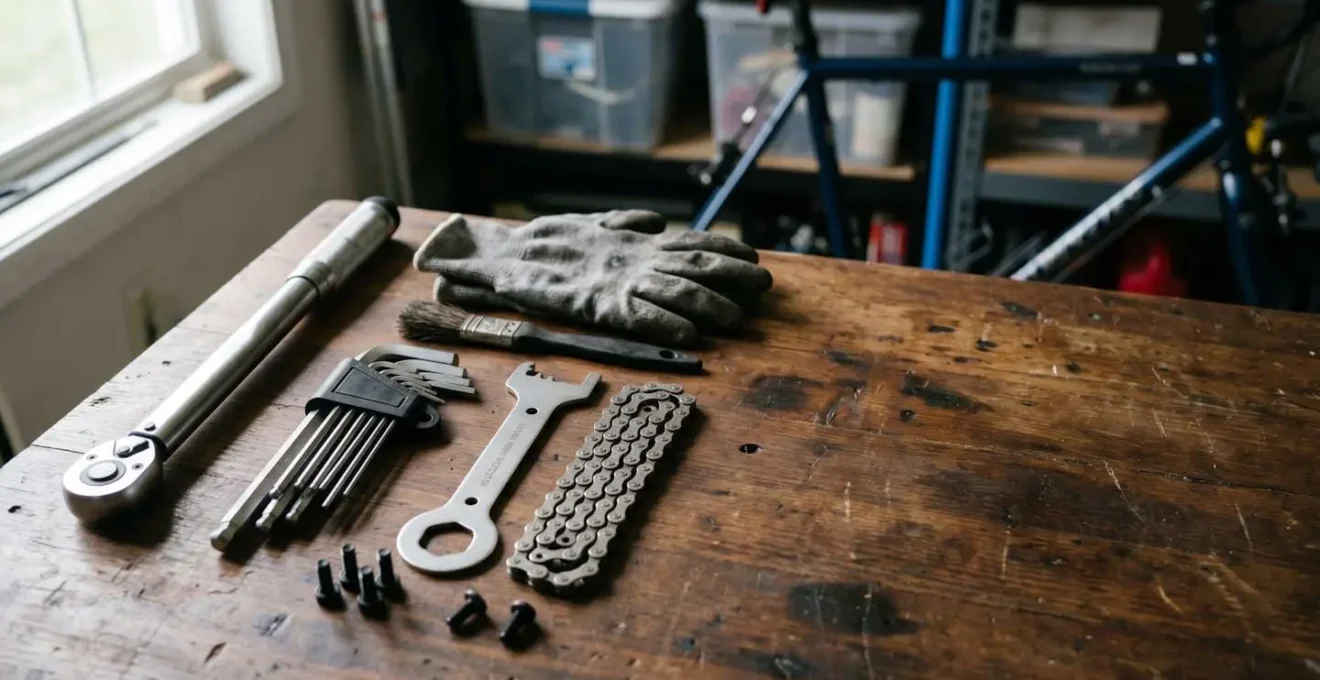
In summary:
- Becoming self-sufficient is not about a big toolkit, but buying the *right* tools to solve the most common and costly problems.
- A torque wrench is non-negotiable for modern bikes to prevent catastrophic frame damage.
- Your first and most important investment should be a workstand to save your back and eliminate frustration.
- Focus on preventative checks, especially chain wear, to dramatically extend the life of your expensive drivetrain components.
- Mastering a few key skills for fixing stuck bolts and diagnosing noises builds confidence and saves the most money.
Every cyclist reaches a point where the constant drip of shop labour fees for simple jobs feels unsustainable. The temptation is to buy a cheap, all-in-one “100-piece” toolkit, believing it’s the ticket to self-sufficiency. But this is the first mistake. In the workshop, we see the results of this approach every day: rounded bolts, frustrated owners, and bikes in worse shape than when they started. The truth is, you don’t need a hundred tools. You need a handful of the *right* ones and the knowledge to use them with precision.
The real secret to saving money isn’t just about avoiding labour costs; it’s about preventing the catastrophic failures that come from guesswork. The days of tightening bolts by “feel” are over, thanks to lightweight carbon and alloy components. A simple adjustment made with the wrong tool or the wrong technique can turn a £20 fix into a £500 replacement. This guide is built on that principle. We’re not just going to list tools. We’re going to reframe your entire approach to maintenance, focusing on the key areas where a small investment in equipment and knowledge provides the biggest return, saving you from the most common and expensive pitfalls.
This guide moves beyond a simple shopping list. It’s a strategic plan to build your competence and confidence as a home mechanic. We will explore why precision is now more important than force, how the right setup can eliminate the frustration of repair work, and which preventative checks will save your most expensive components from premature failure. Follow these steps, and you’ll not only save money but also build a deeper connection with your machine.
Summary: The £50 Tool Kit: Key Essentials to End Shop Labour Fees
- Cracked Carbon: Why You Cannot Tighten Bolts by “Feel” Anymore
- Back Pain and Frustration: Why a Workstand Is the First Tool You Should Buy
- The Ticking Sound: A Step-by-Step Guide to Finding That Annoying Noise
- Preventative Medicine: What Parts Must Be Checked Every 6 Months to Avoid Failure?
- Rounded Heads: How to Remove a Stuck Bolt Without Drilling the Frame?
- Chain Wear on Mid-Drives: Why You Might Need a New Chain Every 1,000 Miles
- Saving the Drivetrain: How Waxing Doubles the Life of Your Chain and Cassette
- Hot Wax vs. Drip Wax: Is the “Silent Chain” Worth the Kitchen Hassle?
Cracked Carbon: Why You Cannot Tighten Bolts by “Feel” Anymore
If there’s one change in bike technology that has made home maintenance more perilous, it’s the widespread use of carbon fibre. This material is incredibly strong under the forces it’s designed for, but dangerously fragile when it comes to clamping pressure. The old-school mechanic’s “feel” for tightness is now a liability. A little too much force on a stem or seatpost bolt won’t just strip a thread; it can create a hairline crack that leads to a catastrophic failure on your next ride. This isn’t an exaggeration; over-tightening is the biggest cause of carbon component failure, turning a simple adjustment into a frame-destroying mistake.
The fundamental principle you must adopt is precision over feel. Carbon components and lightweight alloys have specific torque specifications for a reason. These values, measured in Newton-metres (Nm), are the result of extensive engineering to find the perfect clamping force—enough to hold securely without crushing the material’s structure. As the experts at Durham Cycles note, this is a critical distinction.
Carbon fiber doesn’t handle clamping force as well as other frame materials. A carbon fiber seat post may easily handle the rigors of Paris Roubaix, but will crack on a ride to the coffee shop if it’s been over-tightened at the clamp.
– Durham Cycles, Understanding Torque on Bikes
This is why a torque wrench is no longer an optional luxury; it is the most crucial tool for anyone working on a modern bike. A basic beam-style or pre-set torque key that covers the common 4-6 Nm range can be found for under £30. It’s the single best investment you can make to protect your expensive components. Always check for the torque spec printed on the part itself and adhere to it without exception. This simple habit separates a competent home mechanic from someone taking a huge financial risk.
Back Pain and Frustration: Why a Workstand Is the First Tool You Should Buy
Before you even think about Allen keys or chain whips, your first purchase should be a workstand. Most beginners skip this, thinking it’s an unnecessary expense, and instead end up flipping their bike upside down or leaning it against a wall. This is the root cause of what I call the “frustration threshold”—the point where a simple 10-minute job turns into an hour of awkward crouching, back pain, and dropping tools. Working on a bike on the floor is ergonomically disastrous and makes every single task ten times harder.
A workstand elevates the bike to a comfortable working height, allowing you to stand upright, see what you’re doing clearly, and apply force correctly without fighting gravity. You can spin the pedals freely to adjust gears, access the bottom bracket without obstruction, and clean the drivetrain without making a mess on your floor. As Road Cycling UK aptly puts it, its impact is monumental: “The ability of a workstand to transform your experience of maintaining a bike is hard to overstate.” It turns a chore into a calm, controlled process.
The idea that a stand is a pro-level tool is a myth. You don’t need a £300 professional model. As highlighted in BikeRadar’s comprehensive buyer’s guide, a perfectly usable workstand can be had for as little as £50, with good models starting around the £100 mark. This single purchase does more for your ability and willingness to do your own maintenance than any other tool. It’s the foundation of your home workshop, enabling you to perform every other task with efficiency and precision. Don’t see it as a tool for your bike; see it as a tool for your body and your sanity.
The Ticking Sound: A Step-by-Step Guide to Finding That Annoying Noise
There is nothing more maddening than a persistent tick, creak, or click on an otherwise silent bike. Hunting down these noises is a rite of passage for every home mechanic, and it’s an exercise in patience and logical diagnosis. The first rule of noise-hunting is simple: the sound is almost never coming from where you think it is. Carbon and alloy frames are incredible echo chambers, transmitting vibrations from one end of the bike to the other. This acoustic trickery is the primary source of frustration.
As the team at Bike Reviews Pro points out, this misdirection is the core of the problem. A noise that perfectly syncs with your pedalling and sounds like it’s under your saddle could easily be a dry pedal thread or a loose bottom bracket.
A clicking or creaking bike is one of the most frustrating problems to diagnose because the sound rarely comes from where you think it does. A creak that sounds like it’s coming from your seatpost might actually be your bottom bracket.
– Bike Reviews Pro, Bike Making Clicking or Creaking Noise? Here’s What’s Causing It
To avoid going insane, you need a systematic approach. Start with the easiest-to-check components and work your way to the most complex.
- The Rider/Kit: First, ensure it’s not you. Check for rattling helmet buckles, zips, or contents of a saddle bag. Try riding in different shoes or shorts.
- Contact Points (Seated): If the noise only happens when seated, the culprit is likely the seatpost or saddle. Remove the seatpost, clean it and the inside of the frame, apply carbon gripper paste (for carbon) or grease (for metal), and reinstall to the correct torque. Check saddle rail clamps for tightness.
- Contact Points (Standing): If the noise persists when you stand up and pedal, focus on the “front end.” Check the headset for play, and ensure stem bolts and handlebar clamp bolts are at the correct torque.
- Drivetrain: The most common source. Check for a stiff chain link, loose chainring bolts, or play in the cassette. The number one culprit is often the pedal threads. Remove the pedals, clean the threads on both the pedal and the crank arm, apply a fresh layer of grease, and reinstall firmly.
This methodical process transforms you from a frustrated guesser into a patient diagnostician.
Preventative Medicine: What Parts Must Be Checked Every 6 Months to Avoid Failure?
Effective home mechanics don’t just fix what’s broken; they practice preventative diagnosis to stop problems before they start. A bike is a system of wearing parts, and ignoring them until they fail is the most expensive way to maintain it. A worn chain, for example, will rapidly wear out your much more expensive cassette and chainrings, turning a £20 problem into a £200+ disaster. A simple, regular inspection schedule is your best defence.
You can break this down into a simple tiered system:
- Pre-Ride Check (Every Ride): A 2-minute safety check. Squeeze your tyres to check pressure, test your brakes, and give the chain a quick visual check.
- Weekly Wash & Lube (Every ~100 miles): Clean your drivetrain to remove grit, which acts like grinding paste. Apply a fresh coat of lubricant to the chain.
- Monthly Inspection (Every ~400 miles): Go deeper. Check your brake pads for wear. Inspect cables for fraying. Check your chain for wear using a chain checker tool—this is non-negotiable.
The most critical of these is the chain wear check. A chain checker is a simple, £10 tool that tells you when your chain has “stretched” beyond a certain tolerance (typically 0.5% to 0.75% wear). Replacing it at this point saves the rest of your drivetrain.
Every six months, it’s time for a deeper dive. This is where you look at bigger-picture items. Check suspension components if you have them, inspect the frame for any damage (especially around the bottom bracket and head tube), and consider replacing gear and brake cables if they feel sluggish. This proactive approach is the essence of smart maintenance. It keeps your bike running smoothly, ensures your safety, and is ultimately the cheapest way to own a bicycle.
Rounded Heads: How to Remove a Stuck Bolt Without Drilling the Frame?
Sooner or later, it happens to everyone. You go to loosen a bolt, and your Allen key slips with a sickening, hollow ‘thwack’. You’ve just rounded the head of the bolt. This is a classic “frustration threshold” moment where many home mechanics give up and book a trip to the shop. But with the right technique, you can often save the situation without resorting to drilling, which risks damaging your frame permanently.
The key is to have a structured escalation ladder, moving from the least destructive to the most aggressive method. Rushing to the most extreme option is how parts get destroyed. As the legendary Sheldon Brown wisely noted, addressing small problems early prevents major damage later. A stuck bolt is often the result of corrosion that could have been prevented with grease.
If your bike makes other noises, or clunks or lurches, it is a sign of a problem. Many of these problems can be cured easily at an early stage, just by tightening up a nut or bolt…but if you ignore the warning, serious damage to parts of your bike may result.
– Sheldon Brown, Creaks, Clicks & Clunks
Before you even get to this point, prevention is everything. Always use a high-quality hex key (not a worn-out multi-tool bit) and ensure it’s fully seated in the bolt head before applying force. If you do find yourself with a rounded bolt, don’t panic. Work your way through the following steps methodically.
Your Action Plan: The Stuck Bolt Escalation Ladder
- Prevention First: Always use the correct size, high-quality hex key. Insert it straight, not at an angle. Avoid cheap multi-tools for any high-torque applications to prevent rounding in the first place.
- First Attempt – Penetrate & Tap: Apply a generous amount of penetrating oil to the bolt head and threads. Let it soak for at least 15-30 minutes. Gently tap the head of the bolt with a hammer to help break the corrosion’s bond.
- The Torx Trick – Get a New Grip: Find a Torx bit that is slightly larger than the rounded hex socket. Carefully hammer it into the bolt head. The star-shaped splines will cut into the soft metal and create a new, fresh surface for you to grip and turn.
- The Dremel Slot – Last Resort: If the Torx trick fails, use a Dremel with a cutting disc to carefully cut a straight, shallow slot across the top of the bolt head. This effectively turns it into a large flathead screw, which you can then turn with a large, sturdy screwdriver.
- Know When to Fold: If the bolt is on a delicate part, near carbon fibre, or if the metal is very thin, stop. At this point, the risk of causing expensive damage outweighs the potential saving. It’s time to consult a professional.
Chain Wear on Mid-Drives: Why You Might Need a New Chain Every 1,000 Miles
The rise of e-bikes has introduced a new variable into the maintenance equation: motor torque. A mid-drive motor applies its force directly through your drivetrain—the same chain, cassette, and chainrings you power with your legs. This combined force is significantly higher than what a traditional bike’s components are designed to handle. The result is dramatically accelerated wear, especially on the chain. While a regular cyclist might get 2,000-3,000 miles from a chain, an e-bike rider might be lucky to get 1,000.
This isn’t just theory; it’s a reality confirmed by e-bike maintenance research showing that the added torque from motors leads to faster wear on all drivetrain components, from the bottom bracket outwards. Ignoring this fact is a fast track to a huge repair bill. A worn e-bike chain will annihilate an expensive e-bike-specific cassette in a fraction of the normal time. For an e-bike owner, proactive chain checking is not optional, it’s essential financial management.
You must adjust your maintenance schedule accordingly. Check your e-bike chain for wear every 300-500 miles. There are also techniques you can use to extend its life:
- Spin, Don’t Grind: Stay in lower gears and maintain a higher cadence. Grinding in a high gear at low speed puts the maximum possible torque on the chain.
- Shift Smart: Anticipate hills and shift into an easier gear *before* you’re under full load. Shifting while the motor is pushing hard is extremely stressful for the chain and derailleur.
- Use E-Bike Specific Parts: Many manufacturers now offer chains specifically designed to handle the higher torque of e-bikes. They are slightly more expensive but last significantly longer.
The return on investment here is huge. A £30 e-bike chain replaced every 1,000 miles is far cheaper than a £300 complete drivetrain replacement (chain, cassette, and chainrings) needed at 3,000 miles because of neglect.
Saving the Drivetrain: How Waxing Doubles the Life of Your Chain and Cassette
Once you’ve mastered the basics of cleaning and lubricating, you might be ready for the next level in drivetrain maintenance: immersive waxing. While it sounds complex, chain waxing is a technique that can realistically double the life of your chain and cassette, offering enormous long-term savings. Unlike traditional wet or dry lubes that sit on the outside of the chain and attract dirt, hot wax penetrates deep into the rollers and pins, then hardens into a dry, super-slick coating.
This solid barrier of wax means there’s no sticky surface for grit and grime to cling to. Your drivetrain stays remarkably clean, which is the primary reason for its longevity. Dirt mixed with oil creates a “grinding paste” that wears down metal surfaces. With wax, this abrasive element is almost entirely eliminated. The result is a virtually silent, incredibly efficient, and long-lasting drivetrain. While a premium drip lube might get you 150-200 miles between applications, a good hot wax treatment can last for hundreds of miles, even in poor conditions.
The process involves a few one-time setup steps, but becomes quick and easy with practice.
- Strip the Chain: This is the most important step. A new chain must be completely stripped of its factory grease using a degreaser until the metal is perfectly clean and dry.
- Melt the Wax: A dedicated mini slow-cooker is the best tool. Melt a block of paraffin wax (with additives like PTFE if desired) at a low, controlled temperature.
- Submerge and Soak: Immerse the clean, dry chain in the molten wax. Let it sit for 10-15 minutes, agitating it occasionally to ensure wax penetrates every roller and pin.
- Cool and Harden: Carefully remove the chain and hang it to cool. The excess wax will drip off, leaving a perfect coating.
- Reinstall and Ride: Once cool, the chain links will be stiff. Break them free by hand, reinstall the chain, and enjoy hundreds of miles of clean, silent riding.
This is the ultimate expression of preventative maintenance, saving you significant money on replacement parts over the life of your bike.
Key takeaways
- The single most important tool for a modern bike is a torque wrench; “feel” is a recipe for disaster with carbon parts.
- A workstand is not a luxury. It’s a foundational investment in ergonomics that makes every maintenance task easier and more enjoyable.
- A methodical, step-by-step diagnostic process is the only way to find annoying clicks and creaks, which rarely originate where you think they do.
Hot Wax vs. Drip Wax: Is the “Silent Chain” Worth the Kitchen Hassle?
The decision to switch to wax often comes down to one question: is the performance benefit worth the perceived effort? The answer depends on where you sit on the convenience-to-performance spectrum. For many, a high-quality “drip-on” wax offers a fantastic middle ground, providing much of the cleanliness of hot wax without the need for a slow cooker. For the purist focused on maximum longevity and efficiency, however, full immersive hot waxing is the undisputed king.
The best way to decide is to look at the trade-offs in terms of cost, time, and results. Drip-on wax is applied like a regular lube to a clean chain and needs to dry, while hot wax requires the initial stripping and melting process. However, the reapplication intervals are vastly different; a drip wax might need a top-up every 200-300km, whereas a hot wax treatment can last for 1,000km or more under the right conditions. This comparative table breaks it down clearly, using data from professional maintenance schedules.
| Method | Initial Cost | Reapplication Frequency | Cleanliness | Drivetrain Lifespan | Time Investment |
|---|---|---|---|---|---|
| Basic Wet Lube | £5-10 | Every 100-150 miles | Low (attracts dirt) | Baseline (1x) | 5 mins per application |
| Premium Drip Lube | £15-25 | Every 150-200 miles | Medium | 1.2-1.5x baseline | 10 mins (clean + lube) |
| Drip-on Wax | £20-30 | Every 300 km | High (minimal dirt) | 1.5-1.8x baseline | 15 mins per application |
| Hot Immersive Wax | £30-60 (inc. slow cooker) | Every 1,000 km | Very High (no grime) | 2x baseline or more | 45 mins initial, 30 mins rewax |
The “kitchen hassle” of hot waxing can also be overstated and done on a tight budget. You don’t need a £200 dedicated system. A super-effective setup can be assembled for less than the cost of a single high-end cassette: find a £10-15 second-hand slow cooker, buy a £10 block of food-grade paraffin wax, and bend an old coat hanger into a hook. This ultra-low-cost approach puts the pinnacle of drivetrain performance within reach of any dedicated home mechanic.
Ultimately, becoming a self-sufficient mechanic is a journey of building confidence. Start with the basics: get a workstand and a torque wrench. Learn to diagnose problems systematically and perform preventative checks. As you grow in skill, you can explore advanced techniques like waxing. The goal is to transform maintenance from a dreaded chore into a satisfying part of the cycling experience.