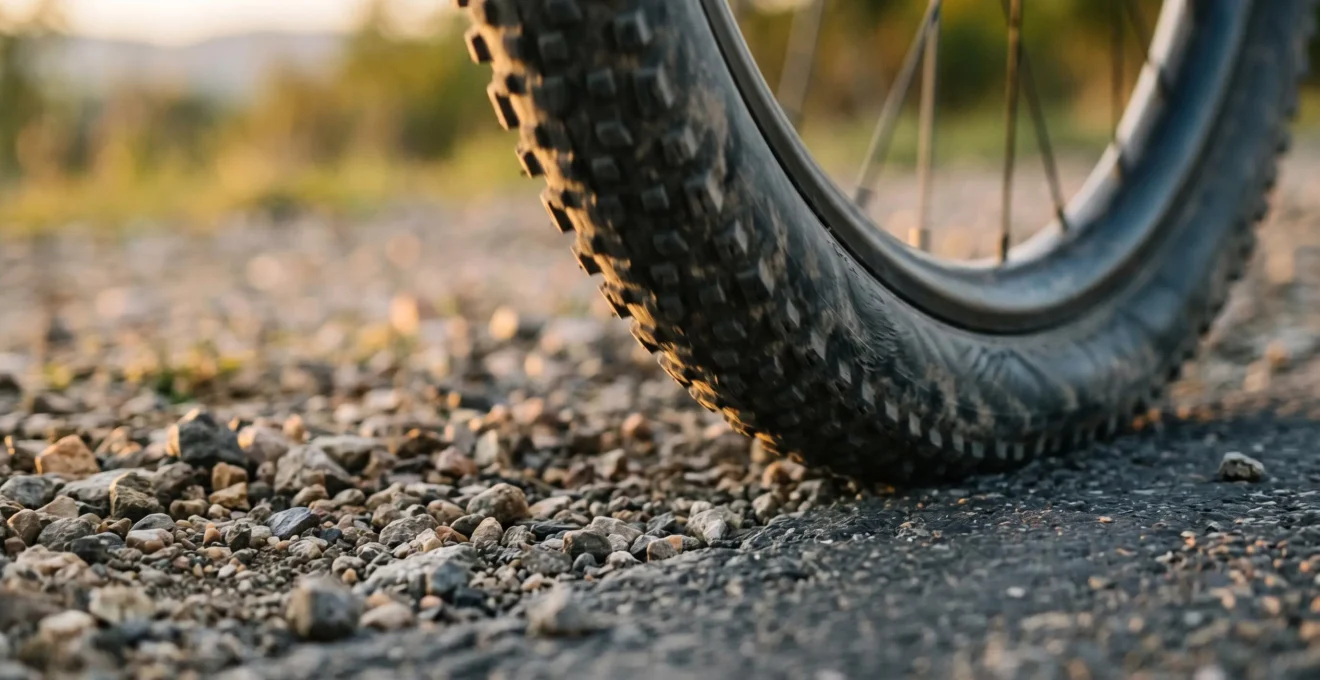
The fastest tyre is not the hardest; it’s the one that minimizes energy loss from vibration (impedance) on real-world surfaces.
- Losses from the bike and rider bouncing over imperfections (impedance) far outweigh losses from tyre flex (casing hysteresis).
- Wider tyres at lower pressures act as your primary suspension, absorbing bumps instead of lifting the entire system over them.
Recommendation: Stop inflating to the maximum pressure listed on the sidewall. Use a physics-based calculator to find your optimal pressure, which will almost certainly be lower—and faster—than you expect.
For decades, the gospel of road cycling was simple: narrow tyres pumped to rock-hard pressures equalled free speed. The logic felt intuitive—a harder tyre should roll with less effort, right? Many of us, trained in this old school of thought, still feel a visceral unease letting air out. The idea of running a plush 45mm tyre at a seemingly squishy 25 PSI (around 1.7 bar) feels slow, inefficient, and counter-intuitive. It challenges everything we thought we knew about performance.
This traditional mindset, however, mistakes firmness for efficiency. It focuses on only one half of the rolling resistance equation while completely ignoring the dominant, energy-sapping force at play on any surface that isn’t a perfectly smooth velodrome track: vibration. The real battle for speed isn’t fought against the minuscule drag of tyre flex, but against the colossal energy wasted by lifting the entire bike-and-rider system over every tiny imperfection in the road. This is the contact patch revolution.
The truth is, your tyres are the most effective and important part of your bicycle’s suspension system. By allowing them to deform and absorb bumps, you keep the bike moving forward instead of wasting energy on vertical motion. This article is for the rider who has heard the buzz about lower pressures but remains skeptical. We will move beyond opinion and dive into the quantifiable science of impedance, casing hysteresis, and system compliance to demonstrate why a softer, wider tyre is not just more comfortable, but objectively faster on the variable surfaces we all ride.
This guide will deconstruct the physics, explore the necessary equipment and safety protocols for modern wide-tyre systems, and provide a practical framework to help you find your personal—and faster—low-pressure sweet spot. Get ready to reconsider everything you thought you knew about tyre pressure.
Summary: The Science and Practice of Modern Tyre Pressure
- The Silca Algorithm: How to Calculate Your Perfect Pressure Based on Weight?
- Blowout Risk: Why You Must Check Tyre Compatibility with Hookless Rims?
- Foam Noodles: Do You Need Inserts for Gravel Riding or Is It Overkill?
- Center Strip vs. Full Knobbly: Matching Tread to Your Local Terrain
- The Tarmac Drag: How Much Speed Do You Really Lose with 50mm Tyres?
- Tubular vs. Tubeless: Which Is Actually Faster at 100psi?
- How Lower Tyre Pressures Can Fix Your Harsh Suspension Feel?
- Tubeless Setup Guide: How to Seat a Tyre Without an Air Compressor?
The Silca Algorithm: How to Calculate Your Perfect Pressure Based on Weight?
To understand why lower pressures are faster, we must redefine rolling resistance. It is not a single force, but a composite of two opposing energy losses: casing hysteresis and impedance (or suspension loss). Casing hysteresis is the energy lost as the tyre deforms against the ground; this is what traditional wisdom focused on, assuming a harder tyre deforms less and is therefore faster. Impedance, however, is the energy lost as the bike and rider are lifted over surface imperfections. On any real-world surface, this vibration-induced loss is by far the larger component of the equation.
As you increase tyre pressure, hysteresis losses decrease, but only to a point. There is a critical “impedance breakpoint” where the tyre becomes too rigid to absorb bumps. Beyond this pressure, impedance losses skyrocket as the tyre starts transmitting impacts directly into the bike and rider, wasting massive amounts of forward energy on vertical movement. The fastest pressure is the one that strikes the perfect equilibrium between these two forces, just before this breakpoint. Indeed, research from Silca demonstrates that performance declines sharply once this optimal pressure is exceeded.
Case Study: The Silca Pressure Calculator’s Methodology
To quantify this balance, we can examine the methodology behind the Silca tyre pressure calculator. Their algorithm doesn’t just guess; it models the physics. According to their published explanation, the calculator’s goal is to identify the exact pressure at which impedance begins to increase rolling resistance. It does this by modeling the complex interaction between internal tyre friction (hysteresis) and the energy lost to vibration (suspension losses). By factoring in total system weight, measured tyre width (which differs from labeled width), internal rim dimensions, and a value for surface roughness, the algorithm calculates the precise point where these forces reach equilibrium. This is your scientifically determined optimal pressure, a number engineered to minimize total energy loss and maximize speed.
Therefore, calculating your perfect pressure is not about preventing pinch flats or aiming for a generic number. It is a scientific process of finding the pressure that allows the tyre to function as an efficient suspension system for your specific weight and equipment on a given surface. This is the fundamental principle of modern tyre performance.
Blowout Risk: Why You Must Check Tyre Compatibility with Hookless Rims?
The move to wider tyres and lower pressures has been enabled by two key technologies: tubeless and hookless rims. While tubeless technology is relatively mature, hookless rims represent a more significant engineering shift with critical safety implications. A traditional “crochet” or hooked rim uses a physical hook to help retain the tyre bead under pressure. A hookless rim, as the name implies, has a straight-sided profile. This design is simpler and cheaper to manufacture, particularly with carbon fiber, and can result in a stronger, lighter rim.
However, this design fundamentally changes how the tyre is secured. As Continental Tyres explains in their technical guide, the security of the system relies entirely on a precise dimensional fit and the resulting friction between the tyre bead and the rim flange. There is no mechanical hook as a failsafe. This makes tyre and rim compatibility absolutely non-negotiable. Using a non-hookless-compatible tyre on a hookless rim can lead to the tyre blowing off the rim, even at seemingly moderate pressures, resulting in a catastrophic loss of control.
On hookless rims, the tyre is only held in place by the tyre bead and the frictional forces between the tyre and the rim flange.
– Continental Tyres, Continental Tyre Rim Combinations Technical Guide
To standardize safety, the European Tyre and Rim Technical Organisation (ETRTO) has established clear guidelines. For road use, industry standards specify that the maximum pressure for any hookless rim and tyre combination is 73 PSI (5 bar). Exceeding this, or using an incompatible tyre, is courting disaster.
Before installing any tyre on a hookless rim, you must perform two checks. First, confirm the tyre is explicitly marked as “hookless compatible” or “TSS” (Tubeless Straight Sidewall) by the manufacturer. Second, verify that the rim manufacturer’s maximum pressure limit is respected. This diligence is not optional; it is a fundamental aspect of safe riding in the modern era.
Foam Noodles: Do You Need Inserts for Gravel Riding or Is It Overkill?
One of the primary concerns for riders experimenting with very low pressures, especially on rough gravel or singletrack, is the risk of rim damage from a hard impact or “bottoming out” the tyre. This is where tyre inserts, often called “foam noodles,” enter the conversation. These closed-cell foam rings sit inside the tyre, occupying a portion of the air volume. Their primary function is to provide a physical cushion, protecting the rim from high-force impacts that could cause dents or cracks.
However, their benefits extend beyond simple protection. By damping vibrations and providing progressive support, inserts can transform the behaviour of a tyre. A common concern is that adding material inside the tyre will increase rolling resistance. While this is technically true, the penalty is often surprisingly small. For example, independent testing reveals that lightweight inserts add as little as 1-3 watts of rolling resistance per wheel, a negligible cost for the benefits they provide.
In-depth analysis from labs like Bicycle Rolling Resistance on products like the Vittoria AirLiner and CushCore CX.Gravel reveals a more nuanced picture. Their tests show that inserts have minimal effect on rolling resistance down to pressures around 27 PSI. Below that, they begin to add resistance, but they also enable you to run these pressures safely. The insert effectively turns your tyre into a progressive-rate air spring. Under normal riding, it’s just the tyre doing the work. During a large, fast compression event (like hitting a rock), the insert engages to provide a sharp increase in support, preventing a harsh bottom-out. This allows you to reap the traction and comfort benefits of very low pressure without the constant fear of rim destruction.
So, are they overkill? For a rider on pavement or light, smooth gravel, likely yes. But for anyone pushing the limits on chunky terrain, wanting to run sub-30 PSI pressures for maximum grip and compliance, an insert is a highly logical piece of performance-enhancing and protective equipment.
Center Strip vs. Full Knobbly: Matching Tread to Your Local Terrain
Once you have dialed in your optimal pressure, the next factor in maximizing efficiency is tread pattern. The ideal tread is a compromise, engineered to provide low rolling resistance on smoother surfaces while offering predictable grip when the terrain gets loose or you lean into a corner. This is where the design philosophy of modern gravel tyres becomes apparent, with two main approaches: the slick center strip and the full, low-profile knobbly.
Tyres with a smooth or file-tread center strip and more aggressive shoulder knobs are designed for “all-road” or mixed-surface riding. The concept is simple: when riding upright on pavement or hardpack, you are primarily rolling on the fast, low-resistance center section. This minimizes drag and noise. As you lean the bike into a gravel corner, the contact patch shifts, engaging the larger, more aggressive side knobs. These knobs then provide “mechanical keying,” physically digging into the loose surface to generate cornering grip.
Conversely, a tyre with a consistent pattern of small, tightly-packed knobs across its entire width offers more predictable and consistent grip across a wider range of lean angles. This can be beneficial on routes that are predominantly off-road, where you may encounter loose surfaces even when riding in a straight line. The key to making these tyres fast is the design of the knobs themselves—they are often ramped on the leading edge to reduce rolling resistance and have sharp braking edges on the trailing edge.
The choice between these designs depends entirely on the composition of your typical routes. If your rides involve significant stretches of tarmac connecting gravel sectors, a tyre with a fast center strip is a logical choice. If you spend over 70% of your time on dirt, a more consistent tread pattern might provide more confidence. In both cases, your now-optimized lower pressure plays a crucial role, allowing the casing to conform to the ground and letting the knobs do their work effectively without squirming or folding on harder surfaces.
The Tarmac Drag: How Much Speed Do You Really Lose with 50mm Tyres?
This is the question that keeps the traditional rider awake at night: “I understand the benefits on gravel, but won’t I be painfully slow on the paved sections connecting the trails?” The fear is that the gains made off-road will be completely erased by the drag of wide, low-pressure tyres on the tarmac. While a wider tyre does have a larger aerodynamic frontal area, the actual performance penalty is far smaller than most cyclists imagine, especially when viewed through the lens of total system efficiency.
The key is to remember that no road is perfectly smooth. Even fresh tarmac has a texture that generates high-frequency vibrations, which, as we’ve established, is the primary source of rolling resistance (impedance). A wider, more compliant tyre at an optimal lower pressure is simply better at absorbing these vibrations, saving you energy even on pavement. The penalty in casing hysteresis from the wider tyre is more than offset by the savings in suspension losses.
But what does the data say? Recent wind tunnel and roller testing that combines both aerodynamic drag and rolling resistance provides a clear answer. For example, recent combined aero and rolling resistance testing found that for 45mm tyres on a rough “Belgian cobble” surface simulation at 35km/h, the total power difference between running 30 PSI and 50 PSI was a mere 8 watts, with the fastest time actually being set at 40 PSI. This demonstrates that even on very rough surfaces, the pressure window for optimal performance is wide, and the penalties for being slightly off are minimal.
When you ride on tarmac, the aerodynamic penalty of a 50mm tyre versus a 28mm tyre is real, but it’s a matter of a few watts, not dozens. For any rider who isn’t a professional racer trying to win a time trial, these small losses are a tiny price to pay for the massive improvements in speed, comfort, and control gained on the unpaved portions of a ride. The wider tyre makes the entire ride faster and more enjoyable, not just one segment of it.
Tubular vs. Tubeless: Which Is Actually Faster at 100psi?
The question itself contains a flawed premise common among traditionalists. For decades, the professional peloton’s choice of tubular tyres inflated to 100 PSI or more was seen as the pinnacle of performance. Tubulars were prized for their supple casings and superior road feel. However, comparing them to modern tubeless systems at an arbitrarily high pressure misses the entire point of the tubeless revolution: optimal pressure.
A tubular tyre is essentially a tyre casing sewn around an inner tube, which is then glued to the rim. A tubeless tyre creates an airtight seal directly with the rim. This elimination of the inner tube is the key to its performance advantage. An inner tube, even a lightweight latex one, introduces an extra layer of material that must deform, creating internal friction (inter-material hysteresis) that adds to the overall rolling resistance. Removing it makes the entire system more efficient. Furthermore, the absence of a tube to “pinch” between the tyre and rim during an impact is what allows tubeless systems to run at significantly lower pressures. In fact, tyre pressure research indicates that tubeless setups can typically be run at 10-15% lower pressures than an equivalent clincher with an inner tube without risking a pinch flat.
So, which is faster at 100 PSI? At that pressure, a high-end tubular with a 320 TPI (threads per inch) cotton casing might just edge out a tubeless tyre due to its exquisitely supple construction. But this is the wrong comparison. The tubeless tyre isn’t designed to be fastest at 100 PSI; it’s designed to be fastest at its *optimal* pressure, which might be 60 PSI. At that optimal pressure, the tubeless system’s lower impedance losses will make it significantly faster on any real-world road surface than the rock-hard tubular.
The following table illustrates why focusing on a single high pressure is misleading and how the systems compare across characteristics that truly matter for real-world speed.
| Characteristic | Tubular (High Pressure) | Tubeless (Optimal Pressure) |
|---|---|---|
| Typical Pressure Range | 90-120 psi | 50-75 psi (wider tyres) |
| Pinch Flat Risk | Low (no tube) | Zero (no tube) |
| Suspension Losses | Higher (rigid at high pressure) | Lower (compliant at optimal pressure) |
| Rolling Resistance | Excellent (supple casing) | Excellent (supple casing + optimal pressure) |
| Failure Mode | Predictable gradual deflation | Sudden air loss possible (burp/tear) |
| Wheel Change Speed | Fast (full wheel swap) | Slower (roadside repair difficult) |
| Casing Suppleness Factor | Depends on TPI (120-320) | Depends on TPI (120-320) |
How Lower Tyre Pressures Can Fix Your Harsh Suspension Feel?
Many riders invest significant sums in suspension forks, flexible seatposts, or even full-suspension gravel bikes to mitigate a harsh ride feel, without realizing the most powerful and cost-effective suspension component they own is their tyres. If your bike feels chattery and transmits every single road imperfection directly into your hands and body, the problem is almost certainly not a lack of mechanical suspension; it’s excessive tyre pressure.
When a tyre is overinflated, it becomes too rigid to deform. When it encounters a bump, it cannot absorb the impact. Instead, the entire wheel, bike, and rider mass must be lifted up and over the obstacle. This constant vertical movement is not only uncomfortable, it is a catastrophic waste of energy that could be propelling you forward. You are paying a “suspension loss” penalty on every pebble and crack in the road. This is the source of that harsh, inefficient feeling.
By lowering the pressure to its optimal point, you transform the tyre from a rigid roller into a highly effective pneumatic spring. The tyre casing can now flex and conform around the obstacle, absorbing the impact energy within its structure. The bike and rider continue to move forward in a relatively straight line, isolated from the high-frequency vibrations of the road surface. This is the essence of system compliance.
This principle is elegantly summarized by the experts at Roadman Cycling, who focus on the practical outcome of this physical process. Their insight cuts to the heart of why a compliant tyre is a faster tyre.
The tyre absorbs the imperfection rather than transmitting it through the bike and into your body. The result: less energy wasted bouncing, more energy going into forward motion.
– Roadman Cycling, Cycling Tyre Pressure Guide — Optimal PSI for Every Surface
Before you consider expensive component upgrades to improve comfort, perform a simple experiment: lower your tyre pressure by 10-15 PSI. The result is often a revolutionary improvement in ride quality and a noticeable decrease in fatigue, as your body is no longer forced to act as the primary suspension damper.
Key Takeaways
- The greatest enemy to speed on real-world roads is not tyre flex, but energy wasted lifting the rider over bumps (impedance).
- A wider tyre at a lower, optimal pressure acts as your primary suspension, absorbing vibrations and saving massive amounts of energy.
- The performance penalty of wider tyres on tarmac is minimal and far outweighed by the speed and control gains on rougher surfaces.
Tubeless Setup Guide: How to Seat a Tyre Without an Air Compressor?
Embracing the benefits of lower pressures and wider tyres means embracing tubeless technology. For many traditional riders, the setup process can seem intimidating, especially the critical step of “seating” the tyre bead onto the rim. The myth persists that you need an expensive air compressor to generate the necessary blast of air. While a compressor makes the job trivial, it is entirely possible to seat even the most stubborn tyre with a standard floor pump and the right technique.
The secret is not about generating extreme pressure, but about achieving a high *volume* of airflow in a short burst, combined with minimizing air leakage. By removing the primary restriction in the system (the valve core) and using a lubricant to create a temporary seal, you can get the tyre to “pop” into place with rapid, full strokes of your pump. This method transforms a potentially frustrating experience into a controlled and repeatable process, putting tubeless setup within reach of any home mechanic.
Mastering this skill is empowering. It removes a key barrier to entry for tubeless, allowing you to experiment with different tyres and pressures without needing to visit a bike shop. The following checklist breaks down the professional mechanic’s technique into five simple, actionable steps.
Your Action Plan: Seating a Tubeless Tyre with a Floor Pump
- Pre-seat the bead: Use a tyre lever or your thumbs to methodically push one side of the tyre bead into the rim’s deep center channel, then work the bead up onto the bead shelf on the opposite side. This creates initial tension and a partial seal.
- Apply soapy water liberally: Mix a few drops of dish soap into a cup of water. Using a brush or sponge, generously coat the entire circumference of both tyre beads and the rim’s bead shelves. This viscous liquid temporarily fills micro-gaps, preventing air from escaping during initial inflation.
- Remove the valve core: Using a valve core tool, completely unscrew and remove the Presta valve core. This is the most crucial step, as it removes the main airflow restriction and allows your pump to deliver maximum volume.
- Execute rapid pumping: Attach your floor pump head securely to the valve stem. Position the pump vertically for maximum leverage and execute 10-15 fast, powerful, full-stroke pumps. The goal is a high-volume blast of air, not high pressure.
- Listen for the ‘pop’: You will hear one or two loud, distinctive “pops” as the tyre beads snap into place on the rim’s bead shelves. Once seated, immediately remove the pump, reinstall the valve core, and inflate to your target pressure before adding sealant.
Now that the science is clear and the practical steps are laid out, the only remaining action is to experiment. Begin by using a reliable online calculator to find your theoretical starting pressure. Then, go out and ride. Adjust by 2-3 PSI up or down on your next ride and pay attention to the feedback. The data has proven the theory; it is now time to discover for yourself how the contact patch revolution can transform your speed, comfort, and control.