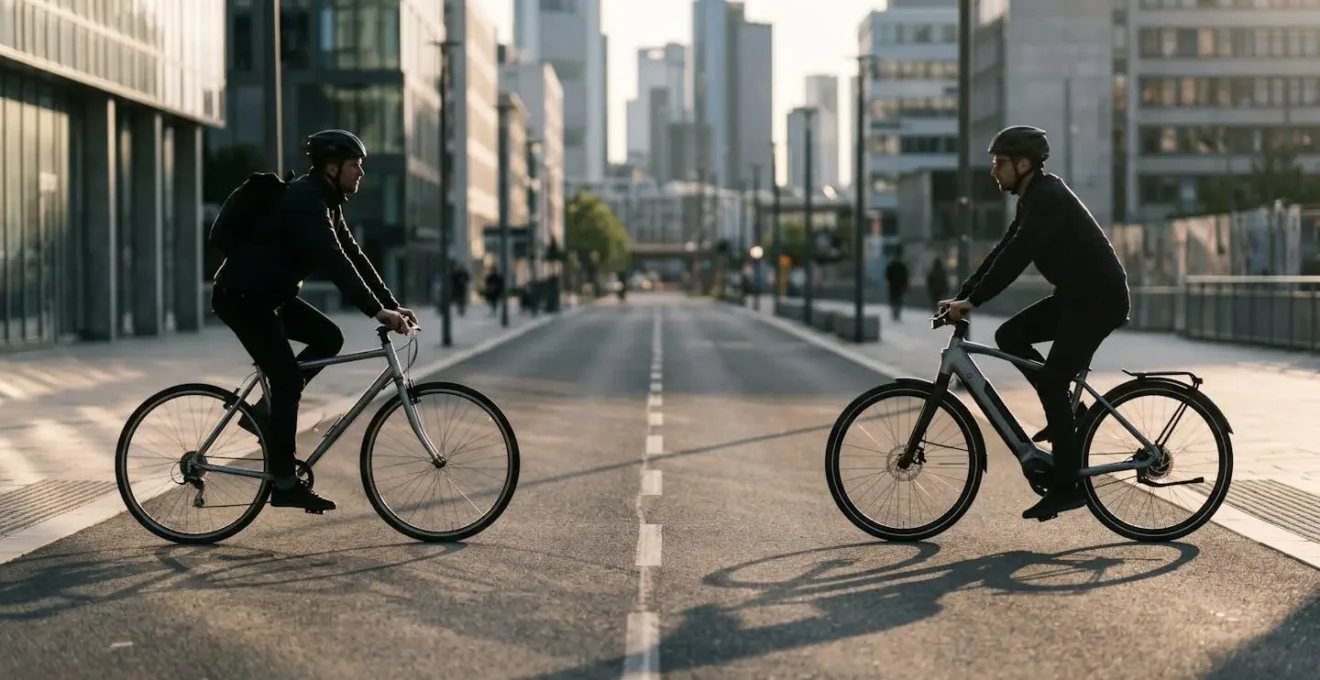
The decision to replace your car isn’t about speed vs. cost; it’s about solving the real-world logistical headaches of daily life.
- An e-bike excels at neutralizing “logistical friction” like hills, headwinds, and heavy cargo, making the journey consistently low-effort.
- A hybrid bike wins on simplicity, with lower upfront costs, significantly less depreciation, and easier maintenance, representing a lower long-term financial risk.
Recommendation: If your biggest barrier is physical effort and carrying capacity for a true car-like experience, the e-bike is the superior tool. If budget, storage space, and long-term value are your primary concerns, the hybrid remains the pragmatic choice.
The 10-mile commute is a fascinating battleground. It’s long enough that a traditional bike can feel like a serious commitment, especially with groceries to haul or hills to climb. Yet, it’s short enough that using a car often feels like overkill, a frustrating cycle of traffic jams and parking hunts. This is the exact scenario where the promise of a modern bicycle as a car replacement shines brightest. But the choice between a nimble hybrid and a powerful e-bike is more complex than a simple comparison of price tags and motor specs.
Many discussions stall on the obvious: e-bikes make pedalling easier, while hybrids are lighter and cheaper. But to truly replace a car, a bike must do more than just get you from A to B. It has to handle the unglamorous, everyday realities—the weekly shop, the sudden downpour, the awkward dance of storing it in a small flat, and the long-term financial implications. The real question isn’t just “which is better?”, but “which is better at solving the daily logistical friction that makes you reach for your car keys?”
This guide moves beyond the spec sheets. As an urban mobility consultant who tests bikes in real city conditions, we’ll dissect the practical trade-offs. We will analyse how each type of bike performs not just on the road, but as an integrated part of your daily life. From range anxiety and storage nightmares to the real-world impact of torque on a steep, rain-slicked hill, we will determine which machine is truly up to the task of becoming your primary vehicle.
This article breaks down the eight critical logistical and financial questions you must answer before committing to a car-free commute. By examining each factor through the lens of real-world usability, you can make a choice that fits not just your route, but your entire lifestyle.
Summary: Deciding on the Ultimate Car-Replacement Commuter Bike
- Range Anxiety: Will a 400Wh Battery Really Last a Week of Commuting?
- Balcony or Hallway: How to Store a Heavy E-Bike in a Small Flat?
- Panniers vs. Backpack: Which Saves Your Back on the Weekly Shop?
- Investing in Tech: How Fast Does an E-Bike Lose Value Compared to a Hybrid?
- Mudguards: The Non-Negotiable Accessory for UK All-Season Riding
- Nm vs Watts: Why High Torque Matters More Than Power on Steep Climbs
- Hub vs. Mid-Drive Motors: Which Is Best for Hilly UK Cities like Sheffield or Bristol?
- The Calculator: How Much Money Do You Actually Save by Ditching the Second Car?
Range Anxiety: Will a 400Wh Battery Really Last a Week of Commuting?
The number one fear for prospective e-bike owners is the screen blinking to zero halfway up a hill. For a 10-mile (20-mile round trip) daily commute, is a standard 400Wh battery enough to last the working week without a daily charge? The short answer is: probably not for a full five days, but comfortably for two or three. Real-world range is a product of many variables: rider weight, terrain, tyre pressure, and, most importantly, the level of assistance you use. While manufacturers often quote optimistic figures, a more realistic expectation is crucial.
Under typical urban conditions with moderate hills and a sensible use of eco or tour modes, you can reliably expect a certain performance. In fact, comprehensive e-bike battery research confirms that a 400Wh battery provides 25-30 miles of range, making it perfectly adequate for a daily 20-mile round trip with a buffer. This means you could commute for a day, pick up groceries on the way home, and still have power for the next morning. The “point of failure” isn’t the daily range, but the weekly one. You simply need to adopt the habit of charging your bike every two days, much like a smartphone.
The other side of range anxiety is battery longevity. A battery is a consumable with a finite lifespan. The good news is that modern lithium-ion batteries are robust. According to industry data, e-bike batteries typically retain 80-90% of their capacity after 3 years of normal use, with a total lifespan of 500-1,000 full charge cycles. For a daily commuter, this translates to several years of reliable service before a noticeable drop in performance, making it a predictable part of the bike’s total cost of ownership.
Balcony or Hallway: How to Store a Heavy E-Bike in a Small Flat?
This is where the do-it-all dream meets the logistical friction of urban living. A standard hybrid bike is relatively light and can be hung on a wall or carried up a flight of stairs. An e-bike, often weighing 20-25kg, is a different beast entirely. Getting it into a small apartment becomes a daily workout and a significant spatial challenge. This weight isn’t just an inconvenience; it dictates where and how you can store the bike, which has serious safety implications.
The weight and the presence of a large lithium-ion battery make indoor storage the most common solution, but it requires careful planning. You can’t simply leave it blocking a fire escape or a narrow hallway. As an urban mobility consultant, I see this as a primary point of failure for many would-be e-bike commuters; if getting the bike in and out of your home is a struggle, you’ll be less likely to use it.
The battery itself is the most critical element. Charging should always be done in a clear, open space on a hard, non-flammable surface, away from flammable materials. The rise in e-bike-related fires is almost always linked to improper charging, uncertified equipment, or damaged batteries. For this reason, official guidance is uncompromisingly clear. As Massachusetts State Fire Marshal Jon Davine stated in the Massachusetts Department of Fire Services Official Safety Guidelines:
If you must store it indoors, keep it away from doors, windows and stairways.
– Massachusetts State Fire Marshal Jon Davine, Massachusetts Department of Fire Services Official Safety Guidelines
This advice underscores the responsibility that comes with e-bike ownership. The convenience of the motor is paid for with the logistical burden of its weight and the diligence required for safe storage and charging.
Panniers vs. Backpack: Which Saves Your Back on the Weekly Shop?
A true car replacement must be able to carry things—laptops, gym gear, and most importantly, groceries. Relying on a backpack is a recipe for a sweaty back, strained shoulders, and an unstable riding position. The solution is to let the bike carry the load. This is where the debate between hybrid and e-bike becomes less about the motor and more about the frame’s ability to handle a practical payload. The answer, unequivocally, is a set of high-quality, waterproof panniers mounted to a sturdy rear rack.
On a traditional hybrid, loading up panniers with 15kg of groceries noticeably affects the bike’s handling. Starting from a standstill is harder, and climbing hills becomes a grind. This is where an e-bike’s primary advantage truly shines. The motor doesn’t just help you; it helps you *and your cargo*. A recent cargo solution analysis reveals that an e-bike’s motor can effectively neutralize the weight, making a heavy load feel significantly lighter and preserving the bike’s stability. Suddenly, carrying a week’s worth of shopping is not a daunting task but a simple errand.
However, simply owning panniers is not enough. They must be compatible with your bike’s frame and rack. This is a common point of failure for many new cyclists who buy accessories online only to find they don’t fit. Before investing, a physical check is essential to avoid frustration.
Your Action Plan: Pannier Compatibility Check
- Frame Mounts: Verify your bike frame has integrated rear rack mounting points (eyelets near the rear axle and on the seat stays).
- Rack Tubing: Confirm your rack’s tubing diameter is compatible with the pannier’s hook system (most are standard 8-16mm, but check).
- Heel Clearance: Check that your bike’s geometry allows enough space for the panniers without your heels striking them as you pedal.
- E-Bike Specifics: If you have an e-bike with a rear-rack battery, ensure it doesn’t block the pannier mounting rails or positions.
- Stabilizer Hook: Test that the pannier’s lower stabilizing hook can be adjusted to securely clip onto your specific rack’s vertical strut.
Investing in Tech: How Fast Does an E-Bike Lose Value Compared to a Hybrid?
When you buy a car, depreciation is a major factor in the total cost of ownership. The same logic applies to a high-value bicycle. While a hybrid bike is a relatively simple mechanical device, an e-bike is a piece of consumer electronics on wheels. This distinction has a profound impact on its long-term value. Like smartphones and laptops, e-bike technology evolves rapidly. A top-of-the-line motor or battery from three years ago may be considered standard or even outdated today. This technological churn accelerates depreciation.
A quality hybrid bike, on the other hand, depreciates much more slowly. Its value is tied to the quality of its frame and mechanical components (like gears and brakes), which do not become obsolete nearly as quickly. This makes a used hybrid a much safer financial bet. As a GYROOR Electric Bike Commute Comparison Study notes, “Hybrid bikes are simpler in design, which often translates to lower maintenance costs and easier repairs.” This simplicity is key to retaining value.
The e-bike’s battery is the single component with the most significant impact on its resale value. As established, it’s a consumable item with a finite lifespan of 3-6 years. A potential buyer of a used e-bike will immediately factor in the likely cost of a battery replacement, which can be several hundred pounds, and will reduce their offer accordingly. A hybrid has no such single, high-cost consumable item, making its value proposition over a 5-year period much more stable.
Mudguards: The Non-Negotiable Accessory for UK All-Season Riding
In the fantasy of car-free commuting, the sun is always shining. The reality, especially for anyone in the UK, involves drizzle, downpours, and perpetually damp roads. In these conditions, the single most important accessory that separates a toy from a tool is a set of full-length mudguards (or fenders). Riding without them on a wet day means arriving at your destination with a tell-tale spray of gritty road water up your back and all over your drivetrain. It’s uncomfortable, unprofessional, and a major source of logistical friction.
A hybrid bike designed for commuting will often come with mudguards fitted as standard or at least have the necessary eyelets on the frame and fork to easily add them. This is a sign that the manufacturer understands the bike’s intended purpose. An e-bike, particularly those styled after mountain bikes, may lack these fittings, forcing you into less effective clip-on solutions. This is a critical detail to check before purchase. For all-season, all-weather car replacement, the ability to fit proper, full-coverage mudguards is not a feature—it’s a fundamental requirement.
The cycling industry itself is unequivocal on this point, especially in climates where “weather” is a daily variable. As BikeRadar presenter and cycling industry veteran Liam Cahill puts it simply:
If you live somewhere with a climate like the UK’s, any commuting bike worth its salt will have mudguards.
– Liam Cahill, BikeRadar
This isn’t about snobbery; it’s about practicality. Mudguards not only keep you cleaner and drier, but they also protect your bike’s components. By shielding the chain, gears, and bottom bracket from a constant barrage of water and grit, you significantly reduce wear and tear and lower your maintenance costs over the long term. They are the unsung heroes of reliable, year-round commuting.
Nm vs Watts: Why High Torque Matters More Than Power on Steep Climbs
When comparing e-bike motors, it’s easy to get fixated on the power figure, typically 250 Watts (W) for road-legal bikes in the UK. However, for a rider in a hilly city looking to replace their car, a different number is far more important: torque, measured in Newton-metres (Nm). While power determines your top assisted speed (capped at 15.5 mph), torque determines the rotational force, or the ‘shove’ the motor gives you from a standstill and on inclines. It’s the difference between effortlessly gliding up a hill and having to strain.
Imagine trying to start your car on a steep hill. Torque is what gets you moving without rolling backwards. On an e-bike, high torque (typically 60-85 Nm) means the motor provides strong assistance from the very first pedal stroke, even when you’re in a low gear and carrying a heavy load. It flattens hills, allowing you to maintain a comfortable pedalling cadence without breaking a sweat. For someone commuting to an office, this is the magic ingredient for arriving fresh and ready for the day. A low-torque motor (30-40 Nm) will still help, but you’ll need to provide much more physical effort on steep gradients.
This ability to conquer hills with minimal effort is a game-changer for consistency. A challenging climb on a hybrid might be a fun workout on a sunny weekend, but it becomes a significant barrier on a rainy Tuesday morning when you’re just trying to get to work. As performance data demonstrates, high-torque motors are crucial for steep ascents, allowing riders to maintain a low heart rate and cruise up inclines. This isn’t about being lazy; it’s about making the bike a reliable and predictable tool, just like a car.
Hub vs. Mid-Drive Motors: Which Is Best for Hilly UK Cities like Sheffield or Bristol?
Once you appreciate the importance of torque, the next question is where the motor should be located. This choice between a hub-drive (in the centre of the front or rear wheel) and a mid-drive (at the pedals) has a huge impact on ride feel and performance, especially in topographically challenging cities like Bristol, Sheffield, or Bath. While hub drives are often cheaper and simpler, mid-drive motors are the superior choice for serious, hilly commuting.
A mid-drive motor applies power to the crank, directly leveraging the bike’s existing gears. This is a massive advantage. It means the motor operates more efficiently, allowing you to select a low gear for a steep climb, which lets the motor spin at its optimal RPM, providing maximum torque without overheating. As BikeRadar’s technical analysis points out, “Mid-mounted motors are a popular choice for electric commuter bikes… It’s a position that provides plenty of stability because it puts the motor’s weight low down and centrally on the frame.” This central, low-slung weight dramatically improves the bike’s balance and handling, making it feel more stable and natural, particularly when navigating descents or tight corners.
In contrast, a rear hub motor places a significant amount of weight at the very back of the bike. While fine on flat ground, this can make the bike feel unbalanced on steep descents and can cause the rear wheel to lose traction on loose or wet climbs. Furthermore, because a hub motor is not connected to the bike’s gears, it can struggle and become inefficient on slow, grinding ascents. For the stop-start, up-and-down nature of UK city riding, the efficiency and superior balance of a mid-drive system make it the clear winner for a true car replacement.
Key Takeaways
- An e-bike’s primary role is to eliminate “logistical friction” like hills and cargo weight, making daily use more consistent.
- A hybrid bike offers a lower total cost of ownership due to minimal depreciation and simpler, cheaper maintenance.
- For a true, all-weather car replacement in the UK, non-negotiable features include full-length mudguards and a robust pannier rack system.
The Calculator: How Much Money Do You Actually Save by Ditching the Second Car?
Ultimately, a key driver for replacing a car is the potential for significant financial savings. The upfront cost of a quality e-bike (£2,000-£4,000) or hybrid (£500-£1,500) can seem high, but it pales in comparison to the total cost of ownership of a car. When you factor in fuel, insurance, tax, servicing, depreciation, and parking, a second car can easily cost several thousand pounds per year, even if it’s not used daily. The bicycle, in contrast, costs pennies to run.
An e-bike’s electricity cost is negligible—typically less than 10p for a full charge. The main ongoing costs are consumables like brake pads, tyres, and chains, plus an annual service. For a hybrid, the costs are even lower. While the initial investment for an e-bike is higher, the savings compound quickly. A commuter who switches from car to bike can realistically save over £1,500 per year. Over the 3-5 year lifespan of the bike, this adds up to a substantial sum that more than justifies the initial outlay.
As a BikeRadar analysis on the topic concludes, “Switching to a bike is very likely to save you money in the long run. While initial costs can be high, finance or the Cycle to Work scheme can help spread the load.” These schemes can make the initial investment much more manageable, allowing you to start reaping the financial benefits immediately. The calculation is clear: the most expensive bike is still dramatically cheaper than the cheapest car.
By weighing these practical, real-world factors, you move from a simple product comparison to a true logistical analysis. The best choice is the one that seamlessly integrates into your daily life, consistently solves your transportation problems, and makes leaving the car at home the easiest decision you’ll make all day.