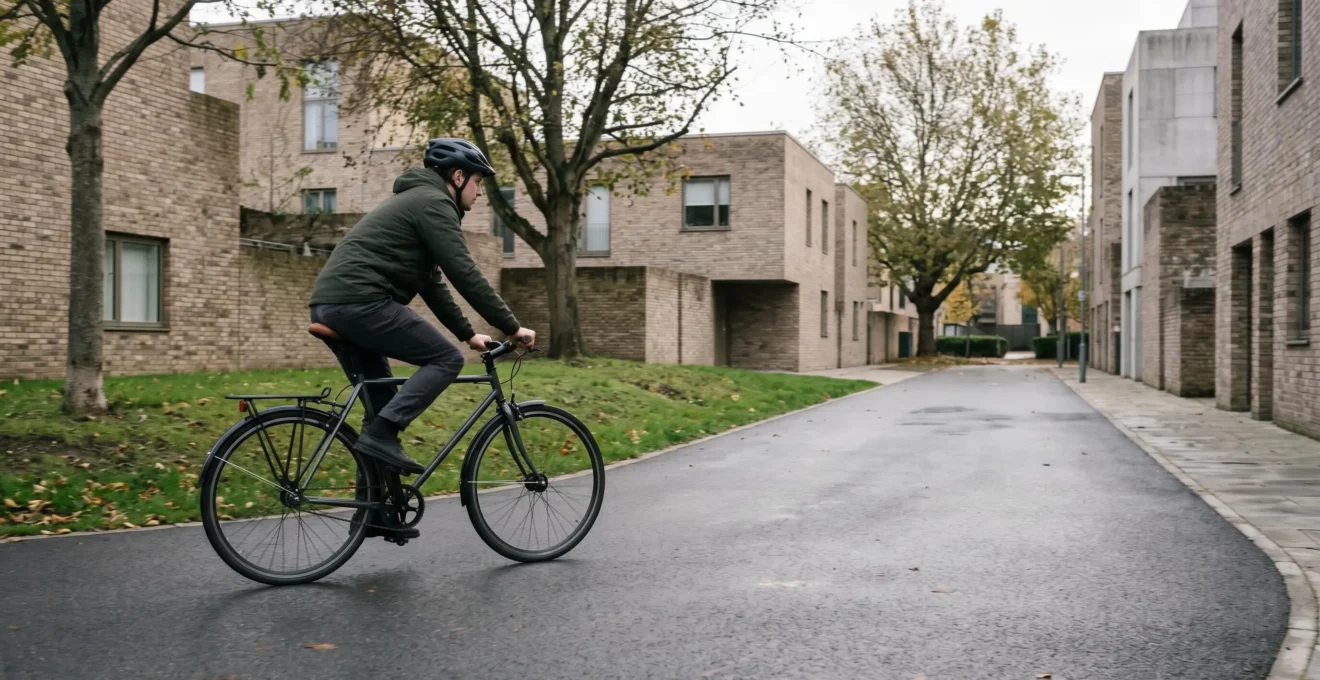
A single-speed bike’s true genius isn’t its simplicity, but its strategic elimination of the parts that are guaranteed to fail in the UK’s wet, gritty urban environment.
- Geared bikes use derailleurs, which are magnets for road salt and grit, leading to constant adjustment and expensive wear.
- The straight, robust chainline of a single-speed is more mechanically efficient and vastly more durable through a typical British winter.
Recommendation: For a reliable, year-round commuter bike in a predominantly flat city, ditch the complex gears and embrace the robust efficiency of a single-speed.
That grinding sound. The chain skipping on a cold, wet Tuesday morning in Manchester. If you’re a year-round UK city cyclist, you know the feeling. You bought a bike with 21 speeds, promising effortless riding, but what you got was a high-maintenance relationship with a delicate machine that despises winter. The constant cleaning, the endless adjustments, the derailleur hangar that looks at you funny and bends – it’s a hidden cost of commuting, a ‘grime tax’ paid in frustration and shop labour fees.
The common solution is to throw more technology at the problem: internal hub gears, belt drives, complex cleaning rituals. But what if the smartest solution isn’t more complexity, but less? What if the most advanced piece of engineering for the reality of London or Liverpool’s streets is one that has been around for over a century? This is the core argument for the single-speed. It’s not a step backwards; it’s a deliberate choice. It’s a purpose-built system designed to outlast and outperform complex drivetrains by eliminating the most common points of mechanical failure in a uniquely grinding, wet, and flat environment.
In this guide, we’re not just going to tell you single-speeds are ‘simple’. We’re going to show you, from a mechanic’s perspective, why that simplicity translates into a superior tool for the job. We’ll break down the ideal setup, the essential tools you need to become self-sufficient, and the techniques that separate a seasoned rider from a novice. We will explore why this ‘basic’ machine is, in fact, a masterclass in engineering for the real world.
Contents: Why a Single-Speed Is a Mechanic’s Choice for Urban Warfare
- 44×16 or 48×18:The £50 Tool Kit: What Essentials Do You Need to Stop Paying Shop Labour Rates?
- Grinding vs. Walking: How to Tackle Steep Climbs Without Destroying Your Knees?
- The Dropped Chain: How to Tension a Horizontal Dropout Wheel Correctly?
- Rim Wear: Why Single-Speed Riders Go Through Brake Pads Twice as Fast
- Fixed vs. Free: Should You Ride Fixed Gear for Better Winter Training?
- Chain Wear on Mid-Drives: Why You Might Need a New Chain Every 1,000 Miles
- The Card Trick: Centering Your Caliper Perfectly in 60 Seconds
- The £50 Tool Kit: What Essentials Do You Need to Stop Paying Shop Labour Rates?
44×16 or 48×18:The £50 Tool Kit: What Essentials Do You Need to Stop Paying Shop Labour Rates?
Before you even think about tools, you have to get the heart of the single-speed right: the gear ratio. Numbers like 44×16 (a 44-tooth chainring and a 16-tooth cog) translate to “gear inches,” a measure of how far the bike moves with one pedal revolution. For a flat city commute, you’re not looking for mountain-climbing gears or track-sprinting speed. You want the sweet spot for acceleration away from lights without spinning your legs frantically to keep up with traffic. In the UK’s urban landscape, most commuters land between 65 and 78 gear inches, which is typically achieved with a 44×16 or 48×18 setup. Start there. It’s your baseline for mechanical harmony.
Once your ratio is set, the beauty of this machine is that you can maintain almost everything yourself with a surprisingly small and affordable set of tools. The goal is to eliminate your dependency on bike shops for 90% of jobs. Paying a mechanic £15 to adjust something you could do in two minutes is the very definition of the ‘grime tax’. This isn’t about being cheap; it’s about being self-sufficient. For a commuter fed up with bills, a modest investment in tools pays for itself almost immediately.
Your Action Plan: Building the Self-Sufficient Tool Kit
- Level 1 – Get-You-Home Kit (£15): Start with the bare essentials that live on your bike. This includes a portable multi-tool with common hex keys (4, 5, 6mm), a compact pump that matches your valve type, a spare inner tube, and a set of tyre levers. This kit is your insurance against a long walk home.
- Level 2 – Weekend Adjuster Kit (£50): This is where you gain real independence. Add a quality track pump with a pressure gauge. A chain tool for repairs, basic cleaning supplies (degreaser, lube), and cable cutters are also key. The track pump is non-negotiable; precise tyre pressure is vital for comfort and puncture prevention on poorly-surfaced UK roads.
- Level 3 – Full Maintenance Arsenal: For the truly committed, a chain whip and freewheel remover tool are next. These allow you to change your cog to fine-tune your ratio. A bottom bracket tool, spoke key, and torque wrench complete the home workshop.
- The Force Multiplier Tool: If you buy one quality item, make it a track pump with a pressure gauge. Running tyres at the correct pressure (often 85-110 PSI for road use) is the single most effective way to prevent punctures and improve ride quality.
- Plan for Integration: Don’t just buy tools. Watch videos, read guides. The first time you use your chain tool shouldn’t be on a rainy roadside. Practice at home until it’s second nature.
Grinding vs. Walking: How to Tackle Steep Climbs Without Destroying Your Knees?
The single biggest fear for potential single-speed converts is the hill. In a city like London or Manchester, you’re not tackling alpine passes, but short, sharp ramps like Highgate West Hill or the approach to a canal bridge can feel daunting. The common misconception is that you just have to “grind” it out, putting immense strain on your knees. This is the novice approach. The experienced rider knows it’s not about brute force; it’s a full-body technique.
You cannot simply remain seated and push harder as you would on a geared bike. This is the fastest way to come to a halt and risk knee injury. The secret is to use your body weight and upper body strength to maintain momentum, transforming the climb from a leg exercise into a full-body workout. It’s a technique that, once mastered, is surprisingly efficient and powerful.
The Single-Speed Hill Attack: A Biomechanical Breakdown
The approach is best described as a slow-motion sprint out of the saddle. As detailed in an analysis of professional single-speed racing technique, the key is leveraging your upper body. Get out of the saddle early, before you lose momentum. Shift your weight forward to keep the front wheel planted. Your hands should be wide on the bars for leverage. As you push down with one foot, you pull up hard on the corresponding handlebar. This creates a powerful, rhythmic rocking motion that drives the bike forward. It requires strong arms and a solid core, turning your whole body into the engine. This is why many seasoned single-speed riders prefer wider riser bars and bar-ends—they are functional levers, not just fashion accessories.
As you can see, this technique is a controlled, dynamic movement. It’s about working *with* the bike, not fighting against it. Your cadence drops, but the power input from your arms and core compensates. The goal is to find a rhythm, a steady “stomp and pull” that you can hold until the gradient eases. It’s tough, but it’s a skill, and like any skill, it gets easier with practice. It also builds incredible functional strength that transfers back to all aspects of your cycling.
The Dropped Chain: How to Tension a Horizontal Dropout Wheel Correctly?
The Achilles’ heel of a poorly set up single-speed is a dropped chain. It’s messy, frustrating, and usually happens at the worst possible moment. Unlike a geared bike, where a derailleur maintains tension, a single-speed relies on the position of the rear wheel in the frame. Most single-speed frames use horizontal dropouts—slits in the frame where the axle sits. As a Wikipedia entry on bicycle forks notes, “Horizontal dropouts allow adjustment of chain tension”. This elegant design is the key to everything, but it requires a ‘just right’ approach to tensioning. Too loose, and the chain will fall off. Too tight, and you create excessive friction, noise, and accelerated wear on your drivetrain—a cardinal sin for any mechanic.
Getting this “Goldilocks” tension is a fundamental skill. It’s a matter of feel, but there’s a reliable method to get you 99% of the way there without any special tools. It’s about learning to listen to the machine and understanding what it needs.
Checklist: The Goldilocks Chain Tension Method
- Points of contact: The Half-Inch Rule: Start by loosening the rear axle nuts. Slide the wheel back in the horizontal dropouts until the chain has approximately 1/2 inch (about 12mm) of vertical play. You should be able to push it up and down by this amount at its midpoint.
- Collecte: Walk the Wheel: To centre the wheel and fine-tune tension, tighten the right-side axle nut first. Now, pull the left side of the wheel back to take up any remaining slack, then tighten the left axle nut. This “walking” process ensures the wheel is pulled back evenly.
- Cohérence: The Pub Test Check: This is the crucial final check. With the bike on the ground, press down firmly on the top run of the chain with your finger. It should move about half an inch. If it’s rigid like a guitar string, it’s too tight. If it sags noticeably, it’s too loose. Remember, in wet UK conditions, a chain with correct tension sheds grit better than an over-tight one.
- Mémorabilité/émotion: Alignment Verification: Look at the tyre’s clearance between the chainstays. Is the gap equal on both sides? A crooked wheel will cause uneven tyre wear and can affect handling. Adjust as needed before fully tightening the nuts.
- Plan d’intégration: The Final Torque: Once you’re happy with the tension and alignment, give the axle nuts their final tightening. They need to be secure, but you don’t need to stand on the wrench. Firm and tight is the goal.
Rim Wear: Why Single-Speed Riders Go Through Brake Pads Twice as Fast
There’s an unwritten rule among year-round single-speed commuters: buy brake pads in bulk. It might seem counter-intuitive for such a low-maintenance machine, but the same simplicity that saves your drivetrain is what punishes your brakes. On a geared bike, you can “engine brake” by shifting to a lower gear, using drivetrain resistance to control your speed on descents. On a single-speed, you have two choices: spin your legs at a frantic pace or use your brakes. A lot.
This is directly linked to cadence. The typical comfortable cadence range for cyclists is 85-110 RPM. On a single-speed, once you exceed the top end of this on a slight descent, your legs can’t keep up. This is called “spinning out.” To maintain control and a safe speed, you have no choice but to feather your brakes. Do this dozens of times on a commute, in the wet, with road grit acting as a grinding paste, and your brake pads will wear down at an astonishing rate. It’s not a flaw in the design; it’s a predictable outcome of the physics involved.
This is why pad choice is critical. Cheap, hard-compound pads might last longer, but they offer poor performance in the wet and can accelerate wear on your wheel rims—a much more expensive component to replace. Softer-compound pads designed for wet conditions offer far superior stopping power and are kinder to your rims, but they will wear faster. For a UK commuter, this is an easy choice. Always prioritise stopping power over pad longevity. A good set of dual-compound pads is a wise investment. Consider brake maintenance a routine, non-negotiable part of your weekly check. A five-minute job can save you from a very dangerous situation.
Fixed vs. Free: Should You Ride Fixed Gear for Better Winter Training?
Every single-speed rider eventually faces the question: fixed or free? A standard single-speed uses a freewheel, a mechanism in the rear hub that allows you to coast. A “fixie,” or fixed-gear bike, does not. If the wheel is turning, the pedals are turning. As Wikipedia contributors note, a standard single-speed is “easier to ride downhill and around corners (the inside pedal can be kept up to avoid grounding).” For daily commuting, especially for those new to the single-speed world, the ability to coast is a massive safety and comfort advantage. It’s the default, sensible choice.
However, the fixed gear has a dedicated following, particularly for winter training. The constant pedalling motion is said to develop “souplesse,” a smooth and efficient pedal stroke, because you can’t be lazy. You’re forced to control the bike with your legs on both the power and recovery phases of the pedal stroke. While this can be a powerful training tool, it introduces significant risks for a commuter, especially on icy UK roads. The inability to stop pedalling instantly and the risk of the rear wheel locking up during a leg-braking manoeuvre make it a choice for experts only in treacherous conditions.
The following table, based on information from established cycling principles and community knowledge, breaks down the practical differences for a UK commuter.
| Characteristic | Freewheel (Single-Speed) | Fixed Gear |
|---|---|---|
| Primary Use Case | Daily commuting, all-weather reliability | Winter training, pedal stroke development |
| Cornering | Easy – inside pedal can stay up | Requires skill – pedals always rotating |
| Descending | Can coast freely | Legs forced to spin at high cadence |
| Winter Safety | Safer on ice – can stop pedaling | Risky on ice – rear wheel lockup risk |
| Maintenance | Freewheel pawls can clog with UK grime | No freewheel mechanism to maintain |
| Training Benefit | Moderate fitness maintenance | Develops souplesse and smooth pedaling |
| Speed Control | Brakes only | Leg braking plus rim brakes |
| Winter Hack Bike | Ideal for protecting expensive road bike | Also suitable with safety awareness |
For 99% of commuters, a freewheel is the right answer. It provides all the low-maintenance benefits of a single-speed drivetrain without the steep learning curve and added risks of riding fixed. A fixed gear is a tool for training; a freewheel is a tool for transport. Don’t confuse the two when your safety is on the line during a dark, wet commute.
Chain Wear on Mid-Drives: Why You Might Need a New Chain Every 1,000 Miles
You might see this title and think it’s an error. You’re riding a simple, human-powered bike, so what does e-bike chain wear have to do with you? Everything. This is a section about a problem you will *never have*, and understanding why is key to appreciating the genius of your single-speed’s design. A mid-drive e-bike puts a powerful motor right at the cranks, and when combined with a multi-gear cassette at the back, it creates a recipe for extreme chain wear.
The primary issue is the chainline. When the rider of a geared bike (or e-bike) shifts to the largest or smallest cogs on the cassette, the chain runs at an extreme angle. This “cross-chaining” puts immense lateral stress on the chain’s links and rollers. Add the high torque of a motor, and you have a perfect storm that literally grinds chains to dust, often requiring replacement in as little as 1,000 miles. It’s a constant, expensive maintenance issue.
Now, look at your single-speed. The chain runs in a perfectly straight, beautiful line from the chainring to the cog. There is zero lateral stress. Every link, every roller, is engaged exactly as its designers intended. This is drivetrain purity. This is why the chain on a well-maintained single-speed can last for thousands upon thousands of miles, often outlasting several chains on a geared bike. You have consciously eliminated the primary cause of drivetrain wear. You have chosen a system that is not only simpler but fundamentally more robust and efficient in its transfer of power. This isn’t an accident; it’s superior engineering for longevity.
The Card Trick: Centering Your Caliper Perfectly in 60 Seconds
The “card trick” is a well-known mechanic’s hack for centering a disc brake caliper. You loosen the bolts, slide a business card between the pad and the rotor, squeeze the brake lever, and tighten the bolts. It works brilliantly. But for your single-speed, it’s another example of a clever solution to a problem you shouldn’t have. Our philosophy is about choosing components that are so simple and transparent that they don’t require “hacks.”
Most single-speed city bikes use simple, effective dual-pivot rim brake calipers. These are a marvel of mechanical simplicity. They have one primary adjustment: a single bolt that mounts them to the frame or fork. Centering them requires no business cards, just your eyes and a 5mm Allen key. If the pads are rubbing on one side, you simply nudge the entire caliper with your hand until it’s centered, then tighten the mounting bolt. It takes 10 seconds.
This is mechanical empathy in action. You can see every moving part. You can understand how it works at a glance. There are no sealed hydraulic systems, no risk of air in the lines, no tiny adjustment screws that require a watchmaker’s touch. When it’s time to replace the pads, you slide the old ones out and the new ones in. The whole system is designed for serviceability by a human with basic tools. While disc brakes offer superior power, especially in the wet, a well-maintained set of rim brakes with good pads provides more than enough stopping power for urban commuting, while perfectly aligning with the ethos of simplicity and self-sufficiency.
Key takeaways
- Mechanical simplicity is not a compromise; it’s a strategic advantage against the corrosive environment of UK cities.
- The number one enemy of a commuter’s drivetrain is the derailleur, a component a single-speed proudly lacks.
- True low-maintenance comes from understanding your machine, and a £50 investment in tools empowers you to achieve self-sufficiency.
The £50 Tool Kit: What Essentials Do You Need to Stop Paying Shop Labour Rates?
We come full circle, back to the tool kit. But by now, you should see that this isn’t just about saving fifty quid. It’s about a fundamental shift in mindset. The tools are not just for fixing things when they break; they are the key to preventing them from breaking in the first place. That track pump isn’t for fixing a flat; it’s for ensuring your tyres are at the perfect pressure every single morning, warding off punctures. That chain lube isn’t for silencing a squeak; it’s for creating a protective barrier against the winter’s salty spray.
Owning and using these tools fosters a connection with your bike. You learn its noises, its feelings. You know when the chain tension is a little loose just by the feel through the pedals. You notice a brake pad is wearing low during your weekly wipe-down, not when it fails on a rainy descent. This is the end-game for a single-speed commuter: a machine so well-understood that there are no surprises. It becomes a reliable, predictable partner, an extension of your own body.
This is the ultimate answer to the commuter fed up with maintenance. The solution isn’t a magic bike that never needs attention. The solution is a simpler bike that invites your attention, that is easy to understand, and that rewards your care with unwavering reliability. You trade the complexity of gears for the simplicity of a wrench. You trade weekly shop visits for five minutes of your own time on a Sunday afternoon. This is the bargain a single-speed offers, and for a UK city commuter, it’s the best deal on the table.
Now, stop reading and start doing. Assess your current bike, identify its failure points, and begin building the simple, robust system that will carry you through any weather, any season. Your journey to mechanical independence starts today.