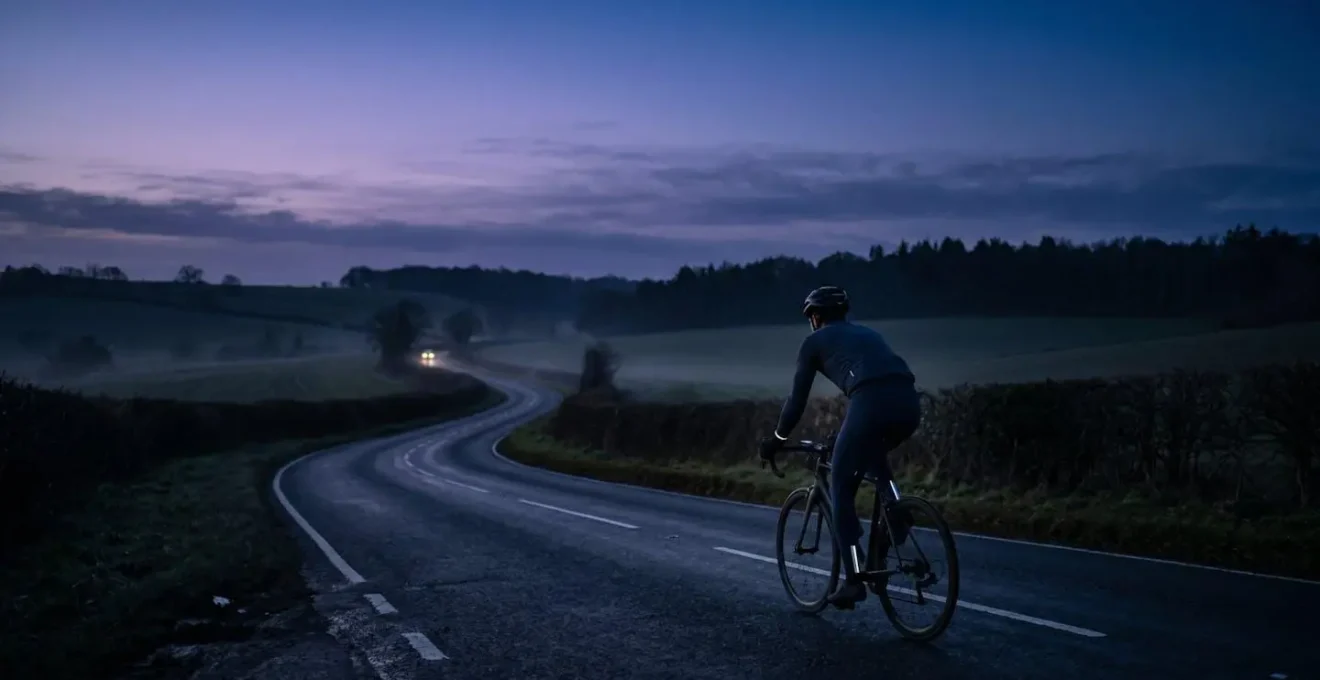
Effective visibility for cyclists isn’t about blinding brightness; it’s about being intelligently conspicuous by solving a design problem, not a luminance one.
- Your brain instinctively recognizes human motion. Placing reflective material on your ankles (bio-motion) makes you far more identifiable than a static reflective vest.
- The best jacket is useless if it gets wet from the inside. Understanding breathability ratings (MVTR) is more important than waterproof ratings (HH) for high-effort riding.
Recommendation: Focus your safety strategy on biological recognition and light patterns that communicate, rather than simply shouting with fluorescent colors.
The classic cyclist’s dilemma on a dark winter evening: wrap yourself in so much fluorescent yellow you could guide aircraft, or wear your preferred, well-fitted black kit and feel utterly invisible. It’s a frustrating compromise between safety and style, a choice that forces you to abandon your aesthetic for the sake of being seen. The common advice rarely helps, cycling between “wear bright colours” and “buy the brightest lights,” pushing you further into that construction-worker chic you desperately want to avoid.
But what if this is a false dichotomy? What if the key to being seen on a dark country lane isn’t about becoming the brightest object on the road, but the most recognisable one? True winter performance—both in terms of safety and comfort—is a design challenge. It requires a deeper understanding of the science behind human perception, thermal dynamics, and the advanced technical fabrics that make up your kit. It’s about moving from brute-force brightness to intelligent visibility.
This guide abandons the tired “be bright” mantra. Instead, we will deconstruct the principles of being seen and staying warm from a designer’s perspective. We will explore the science of bio-motion, decode the language of lighting systems, and explain how to maintain the integrity of your most expensive technical gear. This is your manual for mastering the art of stealth visibility and embracing the dark, cold months with confidence and style.
To navigate this complex but rewarding topic, we have broken down the essential principles into distinct areas of focus. This structure will guide you from core body comfort to the nuanced science of visibility, providing actionable insights at every step.
Summary: A Designer’s Guide to Smart Cycling Visibility and Comfort
- The 3-Layer Rule: Preventing Sweat Freeze on Coffee Stops in December
- Bio-Motion: Why Reflective Ankles Are 5x More Visible Than a Jacket Strip
- Waterproof vs. Water-Resistant: Why You Get Wet Inside Your Jacket After 1 Hour
- Why Fabric Softener Is Killing the Breathability of Your £150 Jacket
- Transition Gear: Trousers You Can Ride In and Wear to a Meeting
- Flashing Modes: Do Super-Bright Day Lights Actually Reduce Accidents?
- Dark Mornings: How to maintain the Habit When It’s Raining Sideways in November?
- Lumens vs. Lux: What Do You Actually Need to See Potholes in the Dark?
The 3-Layer Rule: Preventing Sweat Freeze on Coffee Stops in December
The concept of layering is fundamental to winter riding, but its common explanation is often too simplistic. The real goal isn’t just to stay warm; it’s to manage moisture and prevent the dreaded “flash freeze.” This happens when the sweat you’ve generated on a climb rapidly cools during a descent or, most famously, at the coffee stop, creating a thermal bridge that chills you to the bone. A true three-layer system is a dynamic micro-climate you control.
Your first layer, the base layer, should be a synthetic or merino wool fabric designed to wick sweat away from your skin. Cotton is forbidden; it holds moisture and acts as a cooling agent. The second, a mid-layer, is your insulation. This is typically a long-sleeved jersey with a fleece backing, designed to trap air warmed by your body. The crucial third layer is the outer shell—a windproof and water-resistant (or waterproof) jacket or gilet that protects your warm-air bubble from the elements. The key is that these layers, and their zippers, must be adjustable to regulate temperature and moisture build-up throughout the ride, not just at the start.
The most critical moment for this system is when you stop. To avoid the post-effort chill, follow a simple but effective protocol:
- Step 1: Put on your 4th layer (a packable gilet or shell) IMMEDIATELY upon stopping, even before entering the café. This traps body heat and blocks wind.
- Step 2: Unzip your jersey slightly at the chest to allow controlled ventilation and prevent moisture buildup while you’re stationary.
- Step 3: Keep the outer layer on until your core temperature stabilizes, then you can adjust.
- Step 4: Before leaving, remove and pack the 4th layer. Zip up gradually as you begin pedaling to manage your temperature proactively.
This level of active thermal management is what separates a comfortable winter rider from a miserable one.
Bio-Motion: Why Reflective Ankles Are 5x More Visible Than a Jacket Strip
Here lies the central thesis for the style-conscious cyclist: visibility isn’t about raw reflectivity, but about perceptual legibility. A driver’s brain is hardwired over millennia to recognize the specific, oscillating motion of a human walking or running. A static reflective panel on a jacket is just a bright, unidentifiable shape. But reflective details on your ankles, shoe covers, and pedals tap directly into this primal recognition system.
This principle is called bio-motion. As you pedal, your feet and ankles create a unique, sinusoidal up-and-down and circular motion. Even with minimal reflective material, this movement pattern instantly signals “human in motion” to an observer’s subconscious, often from much further away than a large, static block of reflective material on your torso. It allows a driver to not only see you but to *understand* what they are seeing in a fraction of a second, triggering a more appropriate and cautious response.
This isn’t just theory; it’s backed by science. As a leading researcher in the field explains, the information conveyed by moving extremities is far richer than any static marker.
A reflective vest doesn’t offer the same richness of information as when we mark our extremities. Because the visual parts of our brains are hardwired to human movement.
– Richard Tyrrell, Professor at Clemson University specializing in applied aspects of human vision and perception
Therefore, the most effective (and aesthetically discreet) visibility strategy is to focus reflective elements on your moving parts: ankle bands, seams on your tights, heels of your shoes, and even reflective pedal spindles. This transforms your body’s natural movement into a powerful, instantly recognizable safety signal, allowing the rest of your kit to remain stylishly understated.
Waterproof vs. Water-Resistant: Why You Get Wet Inside Your Jacket After 1 Hour
There is no greater disappointment in cycling apparel than investing in a premium “waterproof” jacket only to find yourself soaked from the inside out after a hard effort. This common experience stems from a fundamental misunderstanding of the battle between two opposing forces: keeping rain out (waterproofing) and letting sweat escape (breathability).
Waterproofness is measured in “hydrostatic head” (HH), in millimeters. A rating of 10,000mm can handle moderate rain, while premium jackets boast ratings of 20,000mm or more, capable of withstanding torrential downpours. However, this is only half the story. Breathability is measured by the “Moisture Vapour Transmission Rate” (MVTR), in grams of water vapour that can pass through a square meter of fabric in 24 hours. A basic jacket might have an MVTR of 5,000g, while a high-performance one will exceed 20,000g. The problem arises when the rate at which you produce sweat vapour exceeds your jacket’s MVTR. The vapour then condenses back into liquid on the inside of the fabric, and you get wet.
This detailed guide breaks down how these ratings translate to real-world performance, helping you choose the right jacket for your specific type of riding. A jacket with specs found in premium cycling jackets, for instance, will balance these properties for high-intensity efforts.
| Rating | Waterproof (HH mm) | Breathability (MVTR g/m²/24h) | Best For | Real-World Performance |
|---|---|---|---|---|
| Entry Level | 5,000-10,000mm | 5,000-10,000g | Light rain, commuting | Handles steady drizzle; feels clammy during hard climbs |
| Mid Range | 10,000-15,000mm | 10,000-15,000g | Moderate rain, touring | Good for most conditions; may struggle in torrential downpours or intense efforts |
| Performance | 20,000mm+ | 20,000-25,000g+ | Heavy rain, high-intensity cycling | Handles prolonged downpours; breathable enough for steep climbs and hard efforts |
For a style-conscious cyclist undertaking intense training, a high MVTR is often more critical than an extreme HH rating. A jacket with a 20,000mm waterproof rating and a 20,000 MVTR breathability rating represents the gold standard, ensuring you stay dry from both outside and in. Accepting a lower waterproof rating in exchange for a higher breathability rating is a smart trade-off for anyone who rides hard.
Why Fabric Softener Is Killing the Breathability of Your £150 Jacket
You’ve invested heavily in a high-performance jacket with a sophisticated membrane and impressive breathability ratings. Yet, after a few washes, it feels like you’re riding in a plastic bag. The likely culprit is not the jacket, but the silent assassin of technical apparel: fabric softener. Standard detergents and softeners are designed to make cotton towels fluffy by coating their fibres with a waxy, lubricating residue.
When applied to technical fabrics, this same process is catastrophic. The breathable membrane in your jacket works because it’s perforated with millions of microscopic pores, each one large enough to let a water vapour molecule (sweat) out, but too small to let a liquid water droplet (rain) in. Fabric softener systematically clogs these pores with its waxy coating, effectively suffocating the fabric and destroying its ability to breathe. Furthermore, it can also coat the outer fabric, compromising the Durable Water Repellent (DWR) finish and causing it to “wet out” faster.
The good news is that this damage is often reversible. If you suspect your gear has been compromised, you can perform a rescue operation to restore its performance. This involves stripping the residue and reactivating the DWR coating. It’s a simple process that can bring your expensive kit back to life.
- Step 1: Wash – Use a technical detergent (like Nikwax Tech Wash) on a gentle cycle. Never use standard detergents with softeners.
- Step 2: Rinse – Run 2-3 additional rinse cycles to thoroughly strip all residue from the membrane’s pores.
- Step 3: Re-proof – If water no longer beads on the surface, apply a new DWR treatment (spray-on or wash-in).
- Step 4: Reactivate – Apply gentle heat. Tumble dry on low for 20 minutes or iron on a cool setting with a protective cloth. This makes the DWR polymers stand up, restoring repellency.
Treating your technical apparel with the right detergents is as important as the initial purchase. Protecting your investment means protecting the microscopic technology woven into its fibres.
Transition Gear: Trousers You Can Ride In and Wear to a Meeting
The daily commute presents a unique design challenge: the need to transition seamlessly from the bike to the professional environment without a complete change of clothes. For the style-conscious cyclist, arriving at a meeting in lycra is not an option. This has driven the development of “chameleon” garments—specifically trousers—that blend high-performance cycling features with boardroom-appropriate aesthetics.
These are not simply stretchy chinos. True transition trousers are engineered with a specific set of features that address the dual demands of riding and working. The goal is to provide freedom of movement on the bike, protection from the elements, and a sharp, tailored look off the bike. The magic is in the integration of technical details that are functional in the saddle but invisible in the office.
The Chameleon Fabric Criteria for Bike-to-Work Trousers
Modern commuter-focused cycling brands have developed trousers that seamlessly transition from bike to boardroom by integrating five key technical features: 4-way stretch fabric for unrestricted pedaling motion, a gusseted crotch that eliminates seam pressure during the riding position, a DWR (Durable Water Repellent) finish to shed road spray and light rain, a tapered athletic fit that prevents chain snag while maintaining professional aesthetics, and stealth reflectivity integrated as subtle details (reflective threads in seams or hidden elements on interior cuffs visible only when rolled). This approach allows cyclists to maintain a professional appearance without sacrificing on-bike performance or safety visibility.
This fusion of function and form represents the pinnacle of modern cycling design. It allows the act of cycling to be integrated into a professional lifestyle, not an activity that must be separated from it. Choosing the right transition gear means you can step off your bike and into a meeting with confidence, with no one the wiser about the technical performance hidden within the fabric.
Flashing Modes: Do Super-Bright Day Lights Actually Reduce Accidents?
The proliferation of super-bright daytime running lights (DRLs) has fundamentally changed cycling visibility. The evidence is clear: using lights during the day makes you more conspicuous and reduces accidents. However, the conversation has moved beyond “if” you should use lights to “how.” The arms race for ever-higher lumen counts and more frantic flashing patterns overlooks a critical scientific nuance: the difference between noticeability and legibility.
A harsh, erratic strobe light is extremely noticeable; it grabs a driver’s attention. However, this same pattern can make it difficult for the driver’s brain to process your speed and distance, impairing their ability to judge the situation. This is the “legibility” paradox. A light can be so “loud” that it becomes incoherent. As a landmark 2025 randomized controlled trial demonstrated, DRLs significantly reduce accident risk, but the *type* of flash matters. The study found DRLs reduced multiparty personal injury accidents by 25% overall.
This has led to the development of more intelligent “disruptive pulse” patterns. These lights cycle through a bright-dim-bright phase rather than a harsh on-off strobe. This pattern captures attention while providing enough constant illumination for a driver’s brain to track your movement effectively. It’s a light that communicates “cyclist here, moving at this speed” rather than just shouting “something bright ahead!” This approach balances attention-grabbing power with the crucial need for a driver to understand your trajectory. Modern smart lights take this further, using accelerometers to function as brake lights and ambient sensors to switch modes automatically.
It is also crucial to be a responsible user of light. As safety experts at Lupine Lighting Systems warn, “Lights that flash between 3-30 times per second may have a negative effect on children and adults suffering from photosensitive epilepsy.” Using a thoughtfully designed pulse pattern is not only more effective, but also more courteous to other road users.
Key Takeaways
- True visibility is about being recognized as a human in motion (bio-motion), not just a bright object.
- Winter comfort depends on actively managing moisture with a breathable layering system, not just piling on insulation.
- The long-term performance of your expensive gear is determined by how you care for it; avoid fabric softeners at all costs.
Dark Mornings: How to maintain the Habit When It’s Raining Sideways in November?
The biggest challenge of winter cycling isn’t always the cold or the dark, but the psychological battle that takes place at 6 AM when your alarm goes off. When it’s raining sideways in November, willpower alone is a fragile and finite resource. The key to consistency is not motivation, but habit. And the key to habit is the ruthless elimination of friction.
Every small decision you have to make in the morning—”What jersey should I wear?”, “Where is my other glove?”, “Are my lights charged?”—is a point of friction that drains your resolve. The secret to getting out the door is to make the decision to ride the *only* decision you have to make. This is achieved by performing a “friction audit” and creating a zero-decision morning routine. The goal is to make gearing up as automatic and thoughtless as brushing your teeth.
By preparing everything the night before, you create an unstoppable momentum. When you wake up, the path of least resistance is not to crawl back into bed, but to simply step into the kit that is already waiting for you. This systematic removal of barriers is far more powerful than any amount of raw motivation.
Your Action Plan: The Friction Audit Checklist
- Evening Ritual: Lay out complete kit the night before—jersey, bibs, socks, gloves—arranged in donning order on a chair. This visual cue eliminates decision fatigue.
- Technology Prep: Charge all lights, head unit, and power meter. Fill water bottles and prepare nutrition. Pre-program your route or workout into the cycling computer.
- Apply the 10-Minute Rule: Give yourself psychological permission to quit after just 10 minutes of riding. Once warm and moving, 9 out of 10 times you’ll complete the full ride. This removes overwhelming pressure.
- Indoor Warm-up Hack: Spend 10 minutes on an indoor trainer before heading outside. Elevating core temperature makes the transition to cold air manageable rather than shocking.
- Reward System Reframe: Consciously link ride completion to the post-ride reward—the earned warm shower, the deserved hot coffee. Make the reward ritual as consistent as the ride itself.
Lumens vs. Lux: What Do You Actually Need to See Potholes in the Dark?
When it comes to front lights, the market has become an arms race of lumens, with manufacturers boasting ever-higher numbers. But “more lumens” doesn’t automatically mean a better or safer light. To make an informed choice, you must understand the difference between lumens and lux, and the critical importance of beam pattern. Lumens measure the total amount of light emitted by the source. Lux measures the amount of light that actually falls on a specific surface at a specific distance. A 1000-lumen light with a poor beam pattern (a “torch beam”) might create a blindingly bright but tiny hotspot, leaving the rest of the road in darkness and creating dangerous tunnel vision.
A well-designed bike light sculpts its lumens into a wide, even “carpet” of light, illuminating the road surface ahead without dazzling oncoming traffic. According to cycling safety experts, your light requirements depend entirely on your environment. For well-lit urban streets, 300-500 lumens is sufficient to be seen. For navigating unlit roads and spotting hazards like potholes, you’ll need 800-1500 lumens or more, but only if that power is shaped effectively.
This has led experienced night riders to adopt a sophisticated two-light system, separating the functions of seeing the immediate foreground from actively scanning for distant hazards. This strategy provides a level of awareness and safety that no single light can match.
The Expert Two-Light System: Carpet Plus Thrower Strategy
This advanced setup consists of two lights: (1) A wide-beam, medium-power light (400-600 lumens) on the handlebars, creating a broad ‘carpet’ of illumination for the road immediately ahead. (2) A powerful, narrow-beam ‘thrower’ light (800+ lumens) on the helmet. This second light moves with your head, allowing you to look through corners, spot distant potholes, and scan your surroundings independently of the bike’s direction. Together, they provide both comprehensive foreground awareness and targeted long-distance detection.
Ultimately, your front light is a tool to interpret the road ahead. Choosing the right tool isn’t about buying the most powerful one, but the one that delivers the right amount of light, in the right shape, to the right place. That is the difference between simply having a bright light and truly being able to see.