You think a big, expensive lock is enough to protect your bike in a city like London or Bristol. It’s not. I’m telling you, as someone who used to be on the other side, your security isn’t in one tool. It’s about making your bike a pain to steal, worthless to sell, and too risky to touch. This is how we thieves decide who to target—and this is how you get crossed off our list before you’re even on it.
I used to have a little game I played. Walking down a street in Bristol, I’d scan a rack of bikes and give each one a score. Not for its brand or its colour, but for its “stealability.” That score was based on a simple equation: time and tools. How long would it take me, and what could I get away with using? The cyclist who bought a flashy £2,000 e-bike and slapped a single, badly-placed D-lock on it? Easy mark. The rider who thought locking it in a “busy” spot was enough? They didn’t understand that to us, busy just means cover.
You’ve probably heard the usual advice: buy a good lock, secure the frame, don’t leave it in a quiet alley. That’s thinking like a bike owner. It’s defensive. To truly protect your property, you need to start thinking like the person who wants to take it. You need to understand our mindset, our shortcuts, and what makes us walk right past your bike and pick your neighbour’s instead. It’s not about having an unbreakable bike; it’s about having a less attractive target than the next one.
Forget what you think you know. I’m going to show you how we vet a target, from the psychology of the parking spot to the specific hardware we hate dealing with. This isn’t a list of products to buy; it’s a strategic mindset. We’ll cover the correct way to use a lock, the critical mistakes people make with overnight parking, why an ugly bike is a safe bike, and why your choice of lock can mean the difference between a successful insurance claim and a total loss. It’s time to learn the trade secrets.
This guide breaks down the thief’s mindset into a practical security strategy. Follow along as we deconstruct the process, from the fundamental locking technique to the high-level considerations for protecting your investment.
Summary: Think Like a Thief: A Practical Guide to Bike Security
- Frame and Wheels: The Correct Way to Secure Your Bike to a Sheffield Stand
- The 24-Hour Rule: Why Leaving Your Bike Outside Overnight Is a Gamble
- Ugly but Safe: How Making Your Bike Look “Less Stealable” Protects It?
- Sold Secure Gold: Why Your Insurance Won’t Pay Out if You Use a Cheap Lock?
- AirTags and Trackers: Do They Actually Help You Get Your Bike Back?
- Balcony or Hallway: How to Store a Heavy E-Bike in a Small Flat?
- Mini vs. Standard: Why a Smaller Shackle Might Be Harder to Attack?
- D-Lock or Chain: Which Offers the Best Protection for a £2,000 E-Bike?
Frame and Wheels: The Correct Way to Secure Your Bike to a Sheffield Stand
Let’s get one thing straight. Most people use a D-lock wrong. They loop it high up on the frame, leaving a huge, inviting gap. To us, that gap isn’t empty space; it’s a workspace. It’s room to fit a bottle jack, a pry bar, or just get enough leverage to twist the whole thing open. The first rule of locking is to minimise the attack surface. You want to make the inside of your D-lock as cramped and awkward as possible.
The “Sheffield Stand,” that simple U-shaped bar, is your best friend, but only if you use it right. Always go for the rear wheel and frame. Thread the lock through the rear triangle of your frame (that small triangle of tubes above the back wheel), through the wheel rim itself, and around the stand. Crucially, push the lock as low to the ground as possible. This makes it harder to get leverage and keeps it away from a swinging sledgehammer. As the experts at Cycling UK put it:
Fill the shackle of the lock with as much bike and street furniture as will fit, leaving as little daylight in the lock as possible.
– Cycling UK, Guide to locking your bike
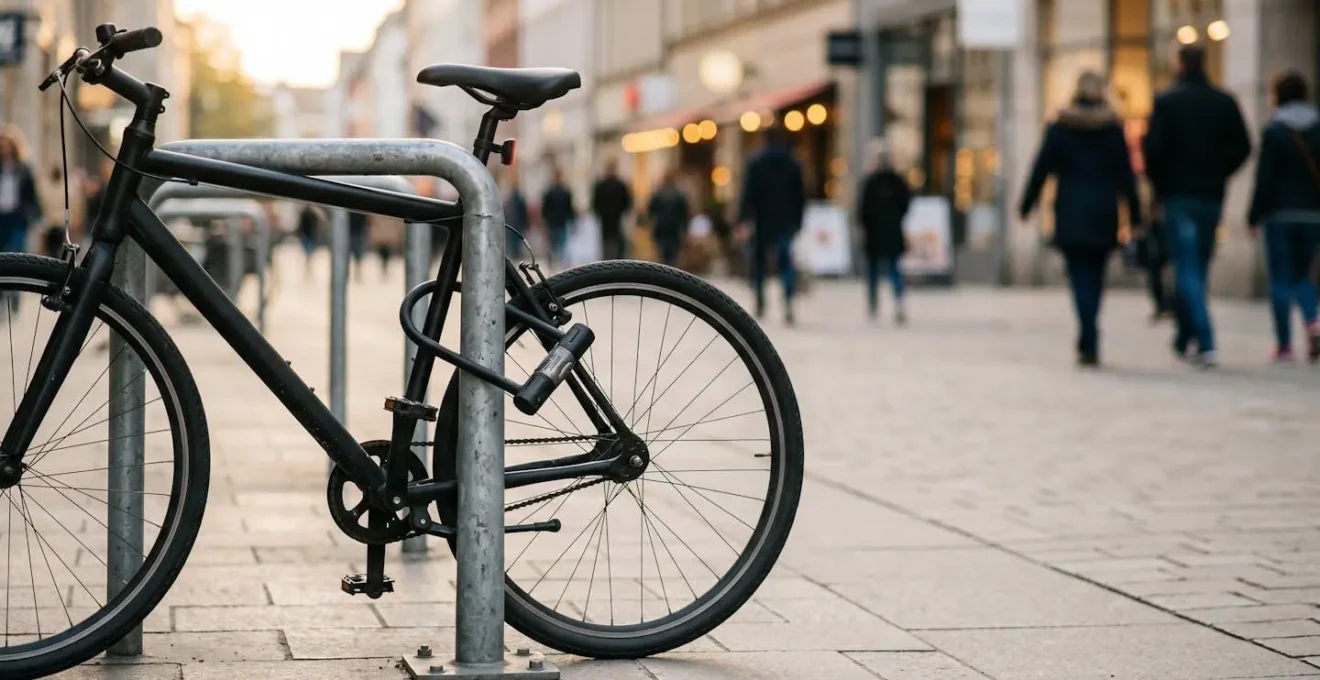
This single technique defeats the most common and quietest attacks. We can’t pry open what we can’t get a tool into. Your goal is to make using tools a nightmare. The image below shows you exactly what we hate to see: no space, no leverage, no easy win.
As you can see, the lock is packed tight. There’s no room for a jack. Attacking this setup would require a noisy angle grinder, and that brings a different kind of risk we don’t like. Also, be picky about your anchor. We used to call signposts “sucker poles” because you can lift the whole sign off and slide the bike right over the top. Always check that what you’re locking to is solid, welded, and concreted into the ground.
The 24-Hour Rule: Why Leaving Your Bike Outside Overnight Is a Gamble
If there’s one thing a thief loves more than a poorly locked bike, it’s time. Specifically, the uninterrupted, unobserved time that darkness provides. Leaving your bike out overnight, even in a “good” neighbourhood, is like leaving a plate of biscuits out for a dog. Sooner or later, it’s going to disappear. It’s no surprise that theft rates spike during late evening and overnight hours; what you’re giving us is the gift of time without witnesses.
Time allows us to use bigger, better tools. A pair of hand-held bolt cutters might be risky at 3 PM. But a 4-foot pair that can snap a cheap lock like a twig? That’s a 3 AM tool. The same goes for portable angle grinders. The longer your bike is left in one place, especially overnight, the more it moves from being a target of opportunity to a planned project.
Don’t believe me? Here’s how the pros work. We don’t just stumble upon your bike at midnight. We scout it during the day. We see a decent bike, locked in the same spot for the third day in a row. That tells us it’s a resident’s, and it’s probably going to be there tonight. That’s when the planning starts.
The Pre-Cut Stand: A Professional Tactic
A classic professional move that police have found in London involves the Sheffield stands themselves. During the day, thieves will scout a location and find a bike that’s likely to be left overnight. They use a portable grinder to cut almost all the way through the metal stand, often at the base. They then cover the cut with mud or tape. At night, they return, snap the last piece of metal by hand, bend the stand open, and slide the bike off without ever touching the owner’s expensive lock. This organised approach shows leaving a bike in a predictable spot overnight is an open invitation for a planned, low-risk attack.
The 24-hour rule is simple: if you can, bring your bike inside at night. Every single time. If you absolutely cannot, at least vary your parking location and never, ever leave it in the same public spot for more than a day. Don’t make it easy for us to make a plan.
Ugly but Safe: How Making Your Bike Look “Less Stealable” Protects It?
There are two types of bike theft: the joyride theft by an opportunist, and the professional theft for profit. You can’t do much about the first, but the second is where the real money is, and it’s the one you need to worry about if you own a decent bike. Professional thieves steal bikes to resell them, either whole or for parts. The key to deterring us is to destroy the resale value. In other words, make your bike ugly.
I’m not talking about taking a hammer to your frame. I’m talking about “reversible ugliness” and personalisation. A pristine, brand-name bike is easy to sell online. A bike covered in weird stickers, with electrical tape wrapped around the main tubes, and a frame number visibly etched into the paint? That’s a headache. It’s harder to sell, which means less profit. Less profit means we’ll look for an easier target. It’s a simple business decision.
Think about it from our perspective. We see two bikes. One is a clean, standard model. The other is the same model but looks heavily used, has a torn saddle cover, and some ugly custom paintwork. Which one do you think is getting stolen? The clean one, every time. It’s anonymous and ready to sell. The ugly one is too “hot,” too recognisable. The owner will spot it a mile away, and so will potential buyers. We call this adding a resale penalty.
Action Plan: How to Apply “Reversible Ugliness”
- Personalise with purpose: Use unique markings, stickers, or even a dab of odd-coloured paint in a discreet spot. Something to make it uniquely yours and identifiable in a police line-up.
- Cover the brand: Use gaffer tape or electrical tape to cover glossy paint and brand logos on the main frame. It looks worn and cheap, which is exactly the point.
- Saddle camouflage: A high-end saddle is a target. Cover your expensive Brooks or Fizik saddle with a cheap, torn, or ugly saddle cover.
- De-logo components: If you have expensive components, consider covering their logos too. An unbranded carbon handlebar is less tempting than one that screams “ENVE”.
- The Commuter “Clunker”: If you commute daily to a high-risk area, seriously consider using a less valuable bike for that purpose. Save the pride and joy for the weekend.
This strategy isn’t about neglecting your bike; it’s about being smart. It’s a form of visual camouflage designed to make a thief’s brain categorise your bike as “too much hassle.”
Sold Secure Gold: Why Your Insurance Won’t Pay Out if You Use a Cheap Lock?
Let’s talk about the business side of things. If you’ve spent good money on a bike, you’ve probably insured it. But here’s a secret most people learn the hard way: your insurance policy is only valid if you play by their rules. And their number one rule is about your lock. If your bike gets stolen and you were using a cheap, unrated cable lock, your insurer will laugh you out of the room. They won’t pay a penny.
Insurers aren’t stupid. They know that a £10 lock from a supermarket offers zero protection against a thief with a pair of bolt cutters. That’s why they mandate the use of locks that have been independently tested and rated by an organisation called Sold Secure. For most UK insurers, if you have a bike worth any real money, you need a lock with a “Gold” rating, at a minimum. In fact, many policies now state that bikes insured for more than £1,500 require Sold Secure Gold-rated locks as a standard condition.
So what do these ratings mean? They’re all about the “Time & Tools” equation. Sold Secure tests locks against specific tools for a set amount of time. A lock passes a rating if it can withstand the attack for the required duration. This gives you a real-world idea of what you’re paying for.
Here’s a breakdown of what those ratings actually mean in the real world, and what tools we’d need to beat them. This table is a thief’s cheat sheet in reverse.
| Sold Secure Rating | Attack Resistance Time | Tools Resisted | Recommended Bike Value | Typical Insurance Requirement |
|---|---|---|---|---|
| Bronze | 1 minute | Basic hand tools | Up to £250 | Low-value bikes only |
| Silver | 3 minutes | Medium bolt cutters, pry bars | £250-£1,000 | Mid-value commuters |
| Gold | 5 minutes | Large croppers, lump hammers, TCT hacksaw | £1,000-£2,500 | Standard requirement for most e-bikes |
| Diamond | 10+ minutes | Angle grinders, specialist destructive tools | Over £2,500 | High-value and electric bikes |
As you can see from this data-driven look at lock standards, the rating directly corresponds to the seriousness of the tools required. A Bronze lock is a joke to a professional. A Gold lock forces us to use heavy-duty tools and spend precious minutes, increasing our risk. A Diamond lock? That often means needing an angle grinder, which is loud and draws attention. Choosing a lock isn’t just about security; it’s about satisfying a legal contract with your insurer. Don’t give them an excuse not to pay out.
AirTags and Trackers: Do They Actually Help You Get Your Bike Back?
So, the worst has happened. You followed all the rules, but a determined thief with an angle grinder and too much time on their hands has made off with your bike. But you were smart—you hid an AirTag or a GPS tracker in the frame. You can see your bike on a map. Game over for the thief, right? Not so fast.
Trackers are a fantastic tool, but they are a recovery tool, not a prevention tool. And their effectiveness comes with some major caveats that the marketing materials don’t tell you. The first reality check is law enforcement. You might have a live location for your bike, but that doesn’t mean a police car is going to go screaming to the scene. If your bike is pinging from inside a private residence, like a block of flats or a house, they’ll likely need a warrant. That takes time—time the thief can use to find your tracker, disable it, and move the bike.
The second, and most important, reality check is your personal safety. The number one rule when you get a location ping is: DO NOT go and try to get it back yourself. I cannot stress this enough. You have no idea who you are dealing with. The people who steal bikes for a living are not nice people. They are often involved in other criminal activity, and they can be violent. Confronting someone in their own territory over a bicycle is a recipe for getting seriously hurt. Your life is worth more than any bike.
A tracker’s true role is to provide data for a police report and, potentially, for your insurance company. It turns a “theft” into a “theft of a tracked asset,” which can sometimes add priority. It also helps prove you no longer have the bike. But it is not a magical recovery device. It’s one layer in a multi-layered security strategy. Locks prevent; trackers help recover. You need both.
Balcony or Hallway: How to Store a Heavy E-Bike in a Small Flat?
You’d think you could relax about security once your bike is home, but you’d be wrong. A staggering 59% of bike thefts occur at home or in residential areas. That communal hallway, “secure” bike store, or even your ground-floor balcony are prime hunting grounds for us. We know where you live, and we know you have to put your bike somewhere.
For those living in small flats, especially with a heavy e-bike, the storage question is a security nightmare. The hallway seems convenient, but it’s often a shared space with weak main doors. A balcony feels private, but a ground-floor or first-floor balcony is just an outdoor parking spot with a better view for thieves. We can and do climb them.
The only truly safe place is inside your flat. Full stop. But if that’s impossible, you need to treat your “at-home” storage with the same seriousness as street parking. First, always bring the battery inside. An e-bike without a battery is a heavy, less-valuable bike. The battery is expensive and easy to carry. Never leave it on the bike, even in a hallway.
Second, if you must use a communal hallway or balcony, you need to anchor it. This means installing a proper, Sold Secure rated ground or wall anchor into concrete or brick. Then, lock your bike to that anchor with a Gold or Diamond rated lock. You are recreating the security of a Sheffield stand inside your building. Check your building rules, but drilling a couple of holes is a small price to pay for security. Also, check your insurance policy. Many will not cover theft from a communal hallway or balcony unless there are visible signs of forced entry *to the building itself*, and they often classify ground-floor balconies as “outside.”
Mini vs. Standard: Why a Smaller Shackle Might Be Harder to Attack?
When it comes to D-locks, bigger isn’t always better. It feels counter-intuitive, but a smaller, more compact “mini” D-lock can be significantly more secure than a large, standard-sized one. The reason goes back to our first principle: minimising the attack surface.
A thief’s quietest and most effective tool for breaking a D-lock isn’t a pair of cutters, but a hydraulic bottle jack. It’s the kind you find in the boot of a car. We can slip it inside the shackle of a large D-lock, and with a few easy pumps of the handle, the hydraulic pressure will pop the lock open with a quiet ‘bang’. It’s devastatingly effective, but it has one weakness: it needs space to work. And this is where the mini D-lock shines.
A shorter, narrower lock is harder to attack than a big one, though it is more awkward to attach in some situations.
– Cycling UK, Guide to locking your bike
A mini D-lock, when used correctly, simply doesn’t have enough empty space inside for a jack to be inserted. By forcing you to lock the bike tightly against the stand, it automatically enforces good locking discipline. However, this security comes at the cost of convenience.
Attack Analysis: The Mini D-Lock’s Advantage and Disadvantage
The primary advantage of a mini D-lock is its resistance to leverage and jack attacks. By completely filling the internal shackle space with your frame, wheel, and the anchor point, you leave no room for a tool to be inserted. However, this creates a major flexibility problem. A mini lock often won’t fit around a lamppost or a thick Sheffield stand, severely limiting your parking options. Against an angle grinder, the game changes. Shackle thickness and the quality of the hardened steel become the most important factors, not the size of the lock. A high-quality standard D-lock can offer the same anti-jack security if the user is disciplined enough to always fill the space, while still providing the versatility to lock to more objects.
The choice between a mini and a standard lock is a trade-off between absolute security in ideal situations and practical flexibility in the real world. For a commuter who always uses the same, slim bike racks, a mini-lock is a superb choice. For someone who needs to lock up in varied, unpredictable locations, a standard size might be a necessary compromise.
Key Takeaways
- Your security strategy is more important than your lock. Think like a thief: inconvenience, risk, and low resale value are your best deterrents.
- Always minimise the empty space within your D-lock shackle to prevent leverage and jack attacks. Lock low to the ground.
- Leaving a bike outside overnight allows thieves to plan attacks with better tools. Bring it inside if you can. If not, vary your location.
D-Lock or Chain: Which Offers the Best Protection for a £2,000 E-Bike?
We’ve reached the final boss: securing a high-value target like a £2,000 e-bike. This is the kind of prize that makes professional thieves willing to take more risks and use more serious tools. Your garden-variety cable lock is useless. Your mid-range D-lock is a minor inconvenience. For a bike of this value, you need to think in layers and use the right tool for the job. The question isn’t “D-lock or chain?” The answer is “It depends on where you are.”
The ultimate weapon for any serious bike thief is a portable, battery-powered angle grinder. As one security expert notes, a grinder is the great equaliser.
The professional bike thief’s favorite tool is the portable angle grinder. It can cut through most standard hardened steel locks in under a minute.
– LeoGuar Bikes, How to Lock Bike with U Lock: Ultimate E-Bike Security Guide
This means your goal is to make using a grinder as difficult and time-consuming as possible. This is where a two-lock strategy becomes essential. For a high-value bike, one lock is not enough. You need to use two different types of locks. Why? Because it forces the thief to carry and use two different types of tools or spend twice as long cutting. A D-lock is tough and rigid. A heavy chain is hard to hold still while cutting. The combination is a real pain.
For your primary “on-the-go” lock, a Sold Secure Diamond D-lock is a fantastic choice. It’s relatively portable and offers incredible resistance. For at-home storage, or any situation where you can leave a lock behind, a massive, heavy security chain (14mm+ links) is king. The weight makes it impractical to carry, but for static security, it’s unbeatable. You use the D-lock to secure the rear wheel and frame to the anchor, and the chain to secure the front wheel to the frame and anchor, creating a web of security that is extremely time-consuming to defeat. Always ensure the padlock on your chain has the same or higher security rating as the chain itself; a great chain with a cheap padlock is a classic weak link.
This two-lock system, combining a top-tier D-lock and a heavy chain, presents a formidable challenge. It screams “too much work” and will make all but the most determined, well-equipped thief move on to the next bike rack. It’s the ultimate expression of making your bike an inconvenient target.
Now you have the knowledge. You understand the “Time & Tools” equation, the importance of making your bike an inconvenient and unprofitable target. The next time you lock up, you won’t just be securing your bike—you’ll be sending a clear message to anyone watching. You’ll be thinking like a thief, and that’s the best security you can have.
Frequently Asked Questions on Bike Security and Trackers
Will police respond immediately if my tracker shows my bike’s location?
Police departments are often under-resourced and may not be able to act immediately on tracker data. If the location points to a private dwelling, they typically require a warrant, which takes time to obtain.
Should I try to recover my bike myself if I can see its location on a tracker?
No. Attempting personal recovery is strongly discouraged due to serious safety risks. The tracker’s role is to provide data for law enforcement, not as a tool for confrontation. Professional thieves may be dangerous, and confrontation could result in injury.
How do trackers differ from locks in bike security strategy?
Locks are visible deterrents designed to prevent theft from occurring. Trackers are hidden recovery tools that function after the theft has occurred. They represent two distinct layers of a complete security strategy and are not interchangeable – both are needed for comprehensive protection.