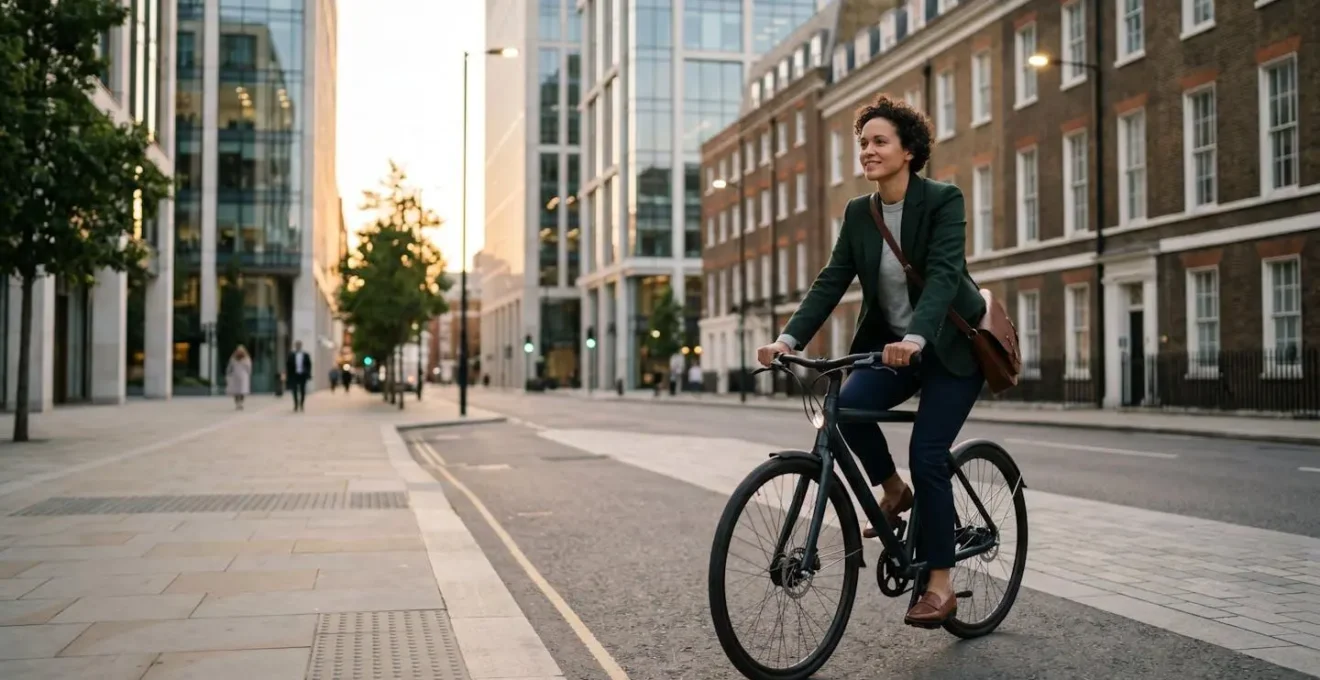
The secret to a polished arrival isn’t changing your identity, but curating your commute.
- Integrate high-performance, office-appropriate apparel into your daily wardrobe.
- Master the five-minute transition with smart grooming hacks and strategic packing.
Recommendation: Embrace the commute as a statement of style and efficiency by choosing versatile gear and a mindful route, transforming your journey from a challenge into a strategic advantage.
The reflection in the glass-fronted lobby tells a familiar story for many London professionals. There’s the crisp suit, the sharp haircut… and the faint sheen of perspiration from a hurried cycle. The dilemma is real: embrace the freedom and speed of a two-wheeled commute, or resign yourself to the cramped confines of the Tube to preserve your professional veneer? The fear of arriving looking like a “MAMIL” (middle-aged man in Lycra) or a frazzled, windswept mess is a significant barrier for many city workers.
Common advice often revolves around a complex logistical operation: pack a full change of clothes, hope for an office shower, and perform a hurried transformation in a cramped loo. We’re told to use panniers to avoid a sweaty back and to simply accept helmet hair as a fact of life. But this approach treats cycling as an inconvenient preamble to the workday, a secret to be hidden upon arrival. It frames the cyclist and the professional as two separate, conflicting identities.
But what if the true key to mastering the urban commute lies not in separating these two worlds, but in elegantly fusing them? The modern approach isn’t about a frantic changeover; it’s about a seamless transition. It’s about curating your commute with the same attention to detail you apply to a presentation. This is the art of performance tailoring and strategic preparation, transforming your journey into an extension of your professional persona—efficient, stylish, and controlled.
This guide will deconstruct the bike-to-boardroom challenge, piece by piece. We will explore how to manage your arrival, conquer helmet hair, select gear that works both on and off the bike, and even turn your daily ride into a source of mental clarity. It’s time to stop hiding your commute and start owning it.
The following sections break down the essential strategies for cultivating a stylish and practical cycling identity in the city, ensuring you arrive at your desk looking as sharp as you feel.
Summary: Your Guide to Professional Cycle Commuting in London
- The 5-Minute Change: How to Transition from Saddle to Boardroom seamlessly
- Helmet Hair Hacks: Styling Tips for Arriving at the Office Looking Fresh
- Cyclist or Professional? How to Break the Stereotype in a Corporate Environment
- One Bike, Two Lives: Configuring Your Commuter for Sunday Social Rides
- The Zen of Commuting: Turning Rush Hour Stress into Mental Clarity
- Quiet Streets vs. Cycle Superhighways: Choosing the Stress-Free Route to Work
- Stiff Soles, Soft Walk: Finding SPD Shoes That Don’t Clack in the Office
- How to Commute 15 Miles Daily in the UK Without Arriving at the Office Sweaty?
The 5-Minute Change: How to Transition from Saddle to Boardroom seamlessly
The moment of arrival is critical. The first five minutes after you’ve locked up your bike set the tone for your entire day. A flustered, frantic search for a clean shirt is the enemy of a professional image. The goal is a seamless transition, an effortless shift from rider to executive. This isn’t about having a full F1-style pit stop; it’s about smart preparation that makes the final steps astonishingly simple. The core principle is ‘reverse layering’: wearing your professional attire as a base layer, protected by technical shells that are quickly and easily removed upon arrival. This eliminates the need for a full change.
This technique is a game-changer. Imagine your crisp work shirt is already on, shielded from the elements by a lightweight, breathable cycling jacket. When you arrive, you simply shed the outer layer, run a comb through your hair, and you’re 90% ready. This is where your choice of bag becomes paramount. A pannier bag is non-negotiable; it keeps your back entirely free of sweat patches and prevents the straps of a backpack from creasing your shirt or jacket. It also allows you to carry items like a laptop and rolled-up trousers without them pressing against your body.
As the image demonstrates, the magic is in the fabrics. A technical outer shell slides effortlessly over a smooth cotton shirt or merino top. Other small details make a huge difference in these crucial five minutes. Keeping your bike’s chain clean is not just for performance; it’s to prevent a black smear of grease from ruining your work trousers—an instant giveaway of your commute. Similarly, trouser straps or cycle clips are an elegant, old-school solution to keep expensive fabrics away from the oily mechanics of your bike. It’s about thinking ahead to eliminate every potential point of failure before you even set off.
Helmet Hair Hacks: Styling Tips for Arriving at the Office Looking Fresh
Nothing shatters a polished image faster than the dreaded “helmet hair”—that flattened, slightly damp, and directionless mess left behind after your ride. It’s the most visible sign of your commute and often the most difficult to fix. However, with a few strategic preparations, you can tame your mane and arrive at your desk looking fresh and put-together. The battle against helmet hair is won before you even put your helmet on. The first rule is to ensure your hair is completely dry before you ride. Trapping wet or damp hair under a helmet compresses the follicles and locks them into a flat, lifeless shape as they dry.
The material that sits between your hair and your helmet can make all the difference. A simple but incredibly effective trick is to line your helmet with a silk scarf. Silk reduces friction far better than the foam or plastic of a helmet’s interior, allowing your hair to move slightly rather than being matted down. This helps prevent frizz and maintain a smoother finish. For this to be effective and hygienic, it’s crucial to wash the scarf frequently to prevent a build-up of sweat and bacteria that could affect your scalp’s health.
Once you arrive, a quick revival is in order. Forget sticky gels or heavy waxes. A light mist of beach spray or sea salt spray can rehydrate your locks and turn any minor disarray into intentional-looking texture or waves. For those with longer hair, the style you choose for your ride is key. A low ponytail or a loose French braid that sits below the helmet’s main structure is far better than a high bun that creates pressure points and disrupts your hair’s natural fall. Finally, a small, curated grooming kit at your desk—containing a comb and a reactivation spray—is your final weapon for a quick touch-up, ensuring you’re ready for that first meeting of the day.
Cyclist or Professional? How to Break the Stereotype in a Corporate Environment
Walking into a corporate environment in cycling gear can sometimes feel like you’re breaking an unwritten dress code. There’s a lingering stereotype of the cyclist as a hobbyist, slightly out of place in a world of suits and formal meetings. Breaking this perception isn’t about hiding your chosen mode of transport; it’s about reframing it. Your commute is not an amateur pursuit; it’s a strategic choice for efficiency, well-being, and even economic productivity. The key is to project professionalism in every detail, from your attire to the way you talk about your journey.
The perception is changing, supported by significant data. The Cycle to Work scheme is no longer a niche perk but a major contributor to the national economy and workforce health. Recent research commissioned by the Cycle to Work Alliance revealed that the scheme adds an impressive £573 million to the UK economy annually. More importantly, it’s driving real behavioural change; in 2023/24, a remarkable 38% of scheme participants were new to bike commuting. This isn’t just a handful of enthusiasts; it’s a mainstream movement of professionals choosing a smarter way to travel.
This choice has tangible benefits for employers, which helps reposition the commuter cyclist as an asset. The same research highlights significant productivity gains, showing that newly commuting cyclists save their employers an average of £63 each per year through reduced sickness absence. This is coupled with an additional £115 in productivity gains from more consistent work attendance. When you cycle to work, you are not just exercising; you are contributing to a more resilient and productive workforce. Highlighting these benefits in conversation—framing your commute as a tool for focus and health—shifts the narrative from an eccentric hobby to a smart professional habit.
One Bike, Two Lives: Configuring Your Commuter for Sunday Social Rides
The ideal urban commuter bicycle is a masterpiece of versatility—a workhorse from Monday to Friday and a thoroughbred for weekend leisure. The notion that you need a separate bike for commuting and for social rides is a myth. The key lies in a modular setup, using quick-release accessories and adaptable components that allow your bike to shed its weekday skin and embrace a sleeker, more recreational aesthetic for that Sunday morning spin to Richmond Park or a leisurely ride along the canal.
The most significant transformation comes from what you can easily add or remove. Quick-release mudguards and pannier racks are your best friends here. They provide essential protection from road spray and carrying capacity during the week but can be detached in minutes, leaving you with a lighter, cleaner-looking bike for the weekend. This simple change can dramatically alter your bike’s silhouette and feel. Similarly, your choice of luggage can adapt. Swap the functional pannier for a compact, stylish saddlebag that holds just the essentials—keys, a multi-tool, and a payment card for the obligatory coffee stop.
Other adjustments are more subtle but just as effective. Tyre pressure, for instance, can be fine-tuned for the occasion. A higher pressure provides lower rolling resistance for smooth, fast tarmac on your commute, while slightly reducing the pressure can offer more comfort and grip on the mixed surfaces you might encounter on a park trail or country lane. Your apparel also plays a role in this dual identity. A high-quality merino wool jersey is a perfect example of versatile clothing. Its natural temperature-regulating and odour-resistant properties make it ideal for a commute, while its smart appearance ensures you don’t look out of place when stopping at a café. A packable wind vest is another Swiss army knife layer, providing core protection for both a breezy morning commute and an unpredictable weekend ride.
The Zen of Commuting: Turning Rush Hour Stress into Mental Clarity
The daily commute for many Londoners is a source of profound stress—a crush of bodies on the Tube, unpredictable delays, and a draining start to the day. The cycle commute, however, offers a powerful alternative. When approached correctly, it ceases to be a mere journey from A to B and transforms into a moving meditation, a protected bubble of time to process thoughts, de-stress, and arrive at the office with a clear, focused mind. This is the “Urban Zen” of commuting: turning a logistical necessity into a strategic wellness practice.
This isn’t just a feeling; it’s a quantifiable benefit. The positive impact of active travel on mental and physical health is well-documented. For example, extensive research from Cycling UK shows that regular cyclists take 15% fewer sick days than their non-cycling colleagues. This statistic isn’t just about physical fitness; it points to a more resilient, less stressed workforce. The gentle, rhythmic physical activity of cycling helps regulate cortisol levels and release endorphins, effectively washing away the stress of the morning rush hour and preparing your brain for a productive day.
The key to unlocking this benefit is to treat your commute not as a race, but as a ritual. It’s about finding a “flow state,” where your mind is engaged but not strained. This is achieved by choosing routes that minimise conflict with heavy traffic, listening to the sounds of the city or a calming podcast, and focusing on your breathing and the rhythm of your pedalling. This mindful approach allows you to arrive at work not just physically, but mentally. You’ve had time to think, to plan, and to mentally transition into your professional role, giving you a distinct advantage over colleagues who have just emerged, frazzled, from the underground.
Quiet Streets vs. Cycle Superhighways: Choosing the Stress-Free Route to Work
In a city as vast and varied as London, the path you take is just as important as the bike you ride. Your choice of route directly impacts your stress levels, your safety, and the state in which you arrive at the office. The decision between a direct, fast-moving Cycle Superhighway and a meandering network of quiet backstreets is a strategic one, tailored to the needs of your day. It’s a choice that a growing number of Londoners are making, with cycling becoming an increasingly mainstream mode of transport. In fact, recent 2024 data indicates that 12.5% of UK adults now cycle for commuting or leisure.
Cycle Superhighways are the arteries of London’s cycling network—designed for speed and efficiency. They are perfect for days when you’re running on a tight schedule. However, they can also be busy, demanding a higher level of concentration and exposing you to more air pollution. On days when you have an important meeting first thing, or simply need to arrive feeling calm and composed, the quieter routes are invaluable. Weaving through London’s expanding network of Low Traffic Neighbourhoods (LTNs) can create a surprisingly peaceful and pleasant journey, even through the heart of the city.
Mastering your route is an art form that goes beyond just following a blue line on a map. It requires a more sophisticated approach to planning, using tools that provide richer information.
Your Action Plan: Strategic Route Planning in London
- Assess Daily Needs: Choose direct Cycle Superhighways when time is of the essence, but opt for quieter routes to preserve mental energy before important meetings or high-stakes days.
- Use Advanced Tools: Go beyond standard maps. Use specialised apps like Komoot to get detailed information on road surfaces, helping you avoid jarring cobblestones or poorly maintained paths.
- Leverage Official Resources: Consult Transport for London’s (TfL) official Journey Planner for up-to-the-minute information on route closures, diversions, and recommended cycle paths.
- Connect the Neighbourhoods: Actively plan routes that link together multiple Low Traffic Neighbourhoods (LTNs). This allows you to create your own bespoke, low-stress superhighway away from major traffic.
- Factor in Air Quality: Make health-conscious decisions by using real-time air quality data. Resources from King’s College London’s monitoring projects can help you identify and avoid pollution hotspots on your commute.
This deliberate approach to route planning turns your journey into a controllable, optimised experience, ensuring you arrive not just on time, but in the right frame of mind.
Stiff Soles, Soft Walk: Finding SPD Shoes That Don’t Clack in the Office
There is perhaps no sound more jarring in a quiet office than the tell-tale ‘clack, clack, clack’ of cycling cleats on a hard floor. It’s an auditory announcement that you are a ‘cyclist’ first and a ‘professional’ second. Traditional road cycling shoes, with their exposed cleats and rigid soles, are completely impractical for any walking. The solution lies in a category of footwear that brilliantly merges on-bike performance with off-bike walkability: SPD shoes with recessed cleats. As explained by the experts at Total Women’s Cycling:
SPD shoes and pedals, usually worn by mountain bikers and commuters, have recessed cleats, making them easier to walk in. Some more casual styles are optimized to be even easier to walk in thanks to more flexible soles.
– Total Women’s Cycling, Stylish SPD Cycling Shoes Review
The design genius of the SPD system for commuters is that the metal cleat sits within a recess in the sole, surrounded by a rubber or composite tread. This means when you walk, you are walking on the shoe’s sole, not the cleat itself. This not only eliminates the noise but also provides a much more stable and natural gait. You can walk from the bike rack to your desk, grab a coffee, or attend a meeting without needing to change your shoes or feeling like you’re ice skating on a polished floor.
Case Study: Shimano Explorer Series for Walkable Commuting
Brands have recognised this crucial need for dual-purpose footwear. The Shimano Explorer series, for example, is specifically engineered for cyclists who demand high walkability. These shoes often resemble lightweight hiking or smart-casual trainers but feature the hidden SPD cleat compatibility. The design prioritises all-day comfort, directly addressing the common issue of traditional cycling shoes being too stiff and noisy for an office environment. This makes them an ideal investment for the serious urban commuter who needs their footwear to perform seamlessly in both worlds.
Investing in a pair of these hybrid shoes is one of the single most effective steps you can take to achieve a truly seamless bike-to-boardroom transition. They are the final piece of the puzzle, allowing you to move through your workplace with the quiet confidence of any other professional, your secret cycling weapon hidden in plain sight.
Key Takeaways
- True professionalism is about integration, not separation; your commute is part of your professional identity.
- Strategic choices in apparel (reverse layering, performance fabrics) and gear (panniers, SPD shoes) are paramount.
- A curated commute enhances well-being and productivity, reframing it as a strategic asset rather than a logistical hurdle.
How to Commute 15 Miles Daily in the UK Without Arriving at the Office Sweaty?
A 15-mile commute is a serious undertaking, placing you well beyond the norm. To put it in perspective, the 2024 Mobilityways census data reveals the average UK cycling commute is around 8 km (approximately 5 miles). Tackling three times that distance and arriving fresh requires a master strategy, not just a few tips. It demands a holistic approach that combines pacing, technology, fabric science, and even a potential re-evaluation of your equipment. Arriving sweat-free is not about avoiding effort, but managing it with intelligence.
The foundation of a long, sweat-free commute is the 80/20 pacing strategy. This means riding 80% of your journey (the first 12 miles) at a steady, conversational pace. This is not a workout. Your heart rate should remain low, minimising heat and perspiration. The final 20% (the last 3 miles) becomes your active cool-down. Here, you ease off the power completely, letting the airflow do the work of drying any minor perspiration before you even step off the bike. This single change has a more significant impact than any piece of gear.
Fabric choice is your next line of defence. Cotton is your enemy; it absorbs moisture and holds it against your skin. Instead, build your professional wardrobe around modern, technical fabrics. Brands like Lululemon (with their ABC pants) or Mizzen+Main have built their reputation on creating office-appropriate attire with hidden performance features like four-way stretch and extreme breathability. For base layers, wrinkle-resistant merino wool is unparalleled for its ability to regulate temperature and wick moisture away without retaining odour. When packing, always roll these garments rather than folding them to keep them pristine.
For a commute of this length, particularly one that might include London’s challenging hills like Highgate or Muswell Hill, it is wise to consider an e-bike not as a cheat, but as a strategic business tool. An e-bike allows you to maintain a consistent, low-exertion heart rate across varied terrain, effectively guaranteeing a sweat-free arrival regardless of the day’s challenges. It’s the ultimate tool for ensuring perfect consistency, allowing you to reap all the mental and physical benefits of a long ride without any of the professional drawbacks.
By curating your gear, route, and mindset, the daily cycle commute transforms from a logistical problem into a powerful professional ritual. Begin today by implementing these strategies to turn your journey into a statement of style and efficiency.