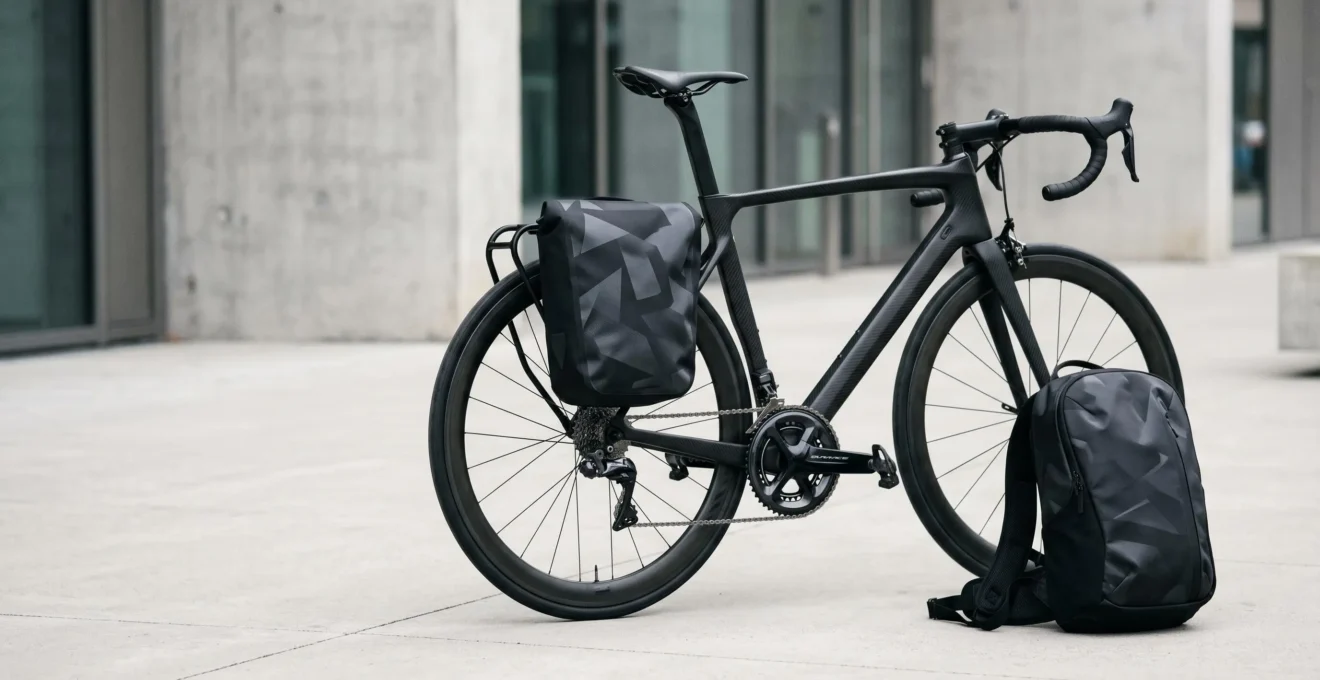
Carrying a laptop on a carbon road bike demands more than choosing a bag; it requires an integrated system that preserves agility and speed.
- Modern axle-mounted racks solve the “no eyelets” problem and are the safest way to load a carbon frame.
- The aerodynamic cost of panniers is real, but a single, well-placed bag minimizes drag more effectively than a backpack that disrupts rider airflow.
Recommendation: Prioritize a frame-mounted, waterproof, convertible pannier system for the optimal balance of performance, comfort, and professionalism.
The dilemma is familiar to any performance-minded commuter. You have your responsive, lightweight carbon road bike, engineered for speed and efficiency. You also have your essential laptop, the gateway to your professional life. The default solution, a backpack, inevitably leads to the dreaded sweaty back, compromised posture, and an elevated center of gravity that feels clumsy in corners. The conventional wisdom often suggests panniers are the answer, but this is usually followed by a cascade of problems: “Your race bike doesn’t have eyelets,” “A rack will ruin the bike’s feel,” or “Panniers are for slow, heavy touring.”
This forces a false choice: sacrifice comfort with a backpack or sacrifice performance with a clunky, ill-fitting rack system. But what if this entire premise is flawed? The real challenge isn’t about simply choosing between a bag on your back or a bag on your bike. It’s about achieving what can be called load-integrated agility—a setup where your luggage becomes a seamless extension of the bike’s performance ecosystem, not a hindrance. This approach moves beyond the simple backpack vs. pannier debate and into the realm of system engineering, where aerodynamics, frame safety, and biomechanical efficiency are paramount.
This guide will deconstruct the problem from an expert’s perspective. We will dissect everything from the physics of heel clearance on short chainstays and the science of waterproofing to the real-world aerodynamic penalties and the all-important test of whether your luggage looks professional when you walk into a client meeting. The goal is to equip you with the knowledge to build a carrying system that respects both your laptop and your carbon machine.
To navigate this complex choice, we’ve broken down the key considerations every fast commuter faces. This structured approach will guide you from technical mounting challenges to the practical realities of daily use, ensuring you make a decision that enhances your ride, rather than compromises it.
Summary: Choosing Your Carbon Bike Commuting System
- Heel Clearance: How to Fit Panniers on a Race Bike with Short Chainstays?
- Roll-Top vs. Zips: Which Closure Actually Keeps Your Laptop Dry in a Downpour?
- No Eyelets? How to Mount Panniers on a Frame Built for Racing
- One Bag or Two? The Aero Penalty of Panniers at 20mph
- The Shoulder Strap Test: Which Pannier Looks Normal in a Client Meeting?
- Panniers vs. Backpack: Which Saves Your Back on the Weekly Shop?
- The Stabilizer Strap: Why Your Bag Slides Around and How to Fix It
- Why Do London Couriers Still Choose Messenger Bags Over Backpacks?
Heel Clearance: How to Fit Panniers on a Race Bike with Short Chainstays?
One of the first physical barriers to fitting panniers on a road bike is the geometry itself. Race bikes are designed with short chainstays for nimble handling and rapid acceleration. This brings the rear wheel closer to the bottom bracket, leaving precious little space between your heel and a traditionally mounted pannier. The result is “heel strike,” where the back of your shoe clips the bag on every pedal stroke—an infuriating and potentially unsafe problem. The solution lies in moving the pannier’s position rearward and upward, away from the arc of your pedaling motion.
For years, this problem was addressed with crude, oversized racks that compromised the bike’s aesthetics and handling. Today, however, engineered solutions are designed specifically for this challenge. Modern rack systems, often axle-mounted, feature adjustable hardware that allows for micro-adjustments. The Tailfin Carbon Rack system, for example, was developed through extensive testing on aggressive race geometries. Its key innovation is mounting hardware that can be shifted millimeters rearward, providing the crucial clearance needed to completely avoid heel strike, even with large cycling shoes. This level of adjustability is what separates a generic accessory from a true performance-oriented system.
These advanced systems are proven to work, with testing that demonstrates a 27kg carrying capacity on road bikes, including those with complex features like Trek’s IsoSpeed suspension. By moving the load-bearing point to the mechanically robust thru-axle, these racks provide a stable platform that ensures your pedaling motion remains free and unobstructed, preserving the efficient power transfer your road bike was built for.
Roll-Top vs. Zips: Which Closure Actually Keeps Your Laptop Dry in a Downpour?
For a commuter carrying a valuable laptop, “water-resistant” is not enough. You need a truly waterproof solution, and the bag’s closure system is the most critical point of failure. The debate typically centers on two designs: traditional zippers and roll-top closures. While many high-quality zippers are coated or feature storm flaps, they are inherently vulnerable to water ingress under sustained pressure, such as in a driving rainstorm. The very nature of interlocking teeth leaves microscopic gaps that water can eventually penetrate.
This vulnerability is quantified using the Ingress Protection (IP) rating system. Most panniers with “waterproof” zippers achieve an IPX4 rating. According to the official standards, this means they can resist splashes of water from any direction. However, they are not rated for powerful jets or immersion. As the OutdoorGearLab testing team noted about a popular zippered pannier, “The burly 420-D nylon material has an IPX4 waterproof rating,” which is suitable for light rain but questionable in a downpour.
This is where the roll-top closure proves its superiority for protecting electronics. By folding the material over on itself multiple times and securing it with a buckle, a roll-top creates a continuous, uninterrupted barrier. There are no seams or gaps for water to exploit.
As the image above demonstrates, the folded layers create a tortuous path that water cannot navigate. This design allows roll-top bags to achieve much higher waterproof ratings. It is common for high-end roll-top systems to be rated at IPX6 (withstanding powerful water jets) or even IPX7 (capable of full immersion for a short period). In the context of protecting a thousand-dollar laptop, the distinction is critical; where IPX4-rated zippered panniers might fail in a severe storm, an IPX6 or higher roll-top system offers genuine peace of mind.
No Eyelets? How to Mount Panniers on a Frame Built for Racing
The most common barrier for road cyclists wanting to use panniers is the absence of rack-mounting eyelets on their carbon frames. These frames are optimized for low weight and aerodynamics, and drilling holes for racks is simply not part of the design philosophy. Forcing a traditional rack onto a carbon frame using P-clamps on the seat stays is a recipe for disaster. Carbon fiber is incredibly strong under intended loads but is susceptible to crushing damage from clamping forces, which can lead to catastrophic frame failure and will almost certainly void your warranty.
So, how do you securely carry a load without compromising your frame’s integrity? The solution lies in transferring the load to parts of the bike designed to handle high stress. Modern bikepacking and commuting technology has evolved to offer several “frame-safe” mounting options. These bypass the need for eyelets entirely by using stronger anchor points.
The most robust of these are axle-mounted systems. As demonstrated by solutions like the Tailfin system, these racks attach directly to a proprietary thru-axle that replaces the bike’s stock axle. This design brilliantly transfers the entire weight of the pannier and its contents to the wheel hub and dropouts—an area already engineered for immense force. The upper part of the rack is then stabilized with a strap around the seatpost, but this strap is only for stability and bears no significant load, making it safe for all seatpost types, including deep-aero carbon profiles. This approach not only protects your frame but also creates a more rigid and stable connection, improving bike handling under load.
Your Carbon Frame Mounting Checklist: A Risk Assessment
- Assess Frame Features: Identify your bike’s mounting points. Do you have traditional eyelets, or are you working with a clean, eyelet-free carbon frame? Note your seatpost type (round, D-shaped, aero).
- Inventory Mounting Methods: List the available options—P-clamps on stays, seatpost-mounted racks, axle-mounted systems, or large bikepacking-style seat packs.
- Evaluate Frame Coherence: Confront each method with your frame’s material. Is there a risk of crushing or abrasion to carbon tubes? P-clamps pose a high risk; axle-mounts pose a low risk.
- Analyze Load vs. Stability: Compare the maximum load capacity of each system (e.g., 5-10kg for P-clamps, 27kg for axle-mounts) against the stability they offer. A lower center of gravity is generally better.
- Develop an Integration Plan: Based on risk, capacity, and stability, select the optimal system. For a carbon race bike carrying a laptop, an axle-mounted system is the engineered choice for long-term safety and performance.
One Bag or Two? The Aero Penalty of Panniers at 20mph
For a fast commuter, every watt counts. The sleek, aerodynamic profile of your road bike is one of its primary advantages, and adding luggage inevitably disrupts that carefully engineered airflow. The question is not *if* there is an aerodynamic penalty, but *how much* of a penalty different setups create, and how you can minimize it. The choice between using one pannier or a balanced pair has significant implications for both aerodynamics and handling.
Wind tunnel testing provides a clear picture of the cost. A full bikepacking setup can be surprisingly costly; one study revealed a 15.8 watts drag penalty for a setup with two panniers at just 25km/h (15.5mph). As your speed increases towards a typical 20mph (32km/h) commuting pace, this wattage penalty grows exponentially. This extra effort translates directly into slower speeds or higher energy expenditure over the course of your commute. While a backpack also creates drag by increasing your frontal area and creating a turbulent wake behind your body, well-designed panniers can be shaped to “draft” behind your legs, potentially mitigating some of their penalty.
The data clearly shows that more bags equal more drag. For the commuter carrying a single laptop and a few accessories, using a single, smaller pannier is almost always the more aerodynamic choice than a pair. An asymmetrical load may require minor adjustments in handling, but the aerodynamic savings are significant. A single pannier keeps the bike’s profile narrower and creates less turbulence than two bags projecting into the wind.
This comparative analysis from CyclingAbout highlights the dramatic difference between various luggage configurations. While a full touring setup with front and rear panniers imposes a massive 15-minute penalty over 100km, a more minimalist rear-only setup is less costly. Notice that even a pair of large rear panniers alone creates a significant time penalty.
| Configuration | Speed Impact at 25 KPH | Time Penalty (100km) |
|---|---|---|
| Baseline (no bags) | 0% | 0:00 |
| Two fork bidons only | -0.7% | +1:45 |
| Large rear panniers only | -6.5% | +13:00 |
| Large front panniers only | -6.4% | +12:48 |
| Front + rear panniers combined | -7.9% | +15:48 |
| Seat pack + handlebar bag | -1.5% | +3:30 |
The Shoulder Strap Test: Which Pannier Looks Normal in a Client Meeting?
The journey doesn’t end when you lock up your bike. For the professional commuter, the luggage must perform just as well off the bike as it does on it. This is the “bike-to-boardroom” transition, and it’s where most traditional panniers fail spectacularly. A standard pannier, with its exposed plastic hooks and utilitarian aesthetic, looks glaringly out of place in a professional setting. Carrying it awkwardly by a small handle is uncomfortable and unprofessional. This is where the convertible pannier-backpack shines as a category leader.
These bags are engineered with a dual identity. On the bike, they function as secure, stable panniers. In seconds, however, the mounting hardware can be concealed behind a zippered panel, revealing a set of comfortable shoulder straps and transforming the bag into a professional-looking backpack or briefcase. Companies like Two Wheel Gear have refined this concept for over two decades, creating systems that are both robust on the bike and sophisticated in the office. Their Pannier Backpack Convertible models feature not just hidden hardware but also dedicated laptop sleeves, organized compartments, and high-quality, canvas-style materials that eschew the glossy, technical look of touring gear.
The key is in the details: does the bag have a clean profile once the hardware is hidden? Is the material something you’d be comfortable placing on a boardroom table? Does it have a dedicated, padded compartment for your MacBook? The best designs achieve this transformation so seamlessly that an observer would never guess its primary function is as a piece of cycling equipment.
As the image shows, the goal is a complete aesthetic shift. The technical, functional side is completely hidden, presenting a clean, modern bag suitable for any business environment. This ability to transition flawlessly is a critical feature for anyone who cycles to meetings, co-working spaces, or corporate offices. It eliminates the need for a “second bag” and allows your cycling lifestyle to integrate seamlessly with your professional one.
Panniers vs. Backpack: Which Saves Your Back on the Weekly Shop?
While the focus is on a laptop, the same principles apply when carrying any significant weight, such as a weekly grocery shop or heavy project files. This is where the biomechanical argument against the backpack becomes most compelling. Carrying a load on your back fundamentally alters your posture and the way your body supports itself. To counteract the weight pulling you backward, your body must engage in what biomechanics researchers call “greater flexion of the torso and pelvis.” In simple terms, you are forced to hunch forward more than your natural cycling position allows, putting significant strain on your spine, neck, and shoulders.
Carrying backpack loads requires greater flexion of the torso and pelvis and altered sagittal torso ranges of motion compared to unloaded walking.
– Biomechanics research team, The Effects of backpack weight on the biomechanics of load carriage
This altered posture is not just uncomfortable; it’s inefficient. Your muscles are doing extra work simply to stabilize the load, which is energy that isn’t going into turning the pedals. Furthermore, a systematic review of backpack ergonomics concluded that the recommended maximum backpack load is 40% of body mass for safety, a limit that can be easily approached with a laptop, accessories, and a few groceries. For a cyclist in an aggressive forward-leaning posture, even a much lighter load can cause strain.
Panniers offer a clear biomechanical advantage by decoupling the load from your body. The weight is transferred directly to the bike’s frame, allowing your torso, back, and shoulders to remain in their natural, powerful, and efficient cycling position. Your spine stays neutral, your arms remain relaxed, and your center of gravity stays low and stable. This not only prevents the back and shoulder pain associated with heavy backpacks but also allows for more efficient power delivery and better bike control, especially when climbing or navigating technical sections. By letting the frame do the carrying, you save your body for the ride.
The Stabilizer Strap: Why Your Bag Slides Around and How to Fix It
If you must opt for a backpack, its stability is paramount for maintaining agility on a road bike. A bag that sways, shifts, or slides during out-of-saddle efforts or fast cornering is not just annoying; it’s a safety hazard. It disrupts your balance and forces your body to make constant micro-corrections, wasting energy and compromising control. The root cause of this instability is almost always an improper fit, which can be corrected by methodically adjusting the bag’s strap system.
A high-quality cycling backpack is more than a simple sack with two straps; it’s an integrated harness designed to move as one with your body. The key to achieving this is the “force triangle” created by the shoulder straps, the sternum (chest) strap, and the hip belt. The sternum strap is the most critical component for preventing lateral sway. When positioned correctly (about 2-3 inches below the collarbone) and tightened, it pulls the shoulder straps inward, securing the pack to your torso and stopping it from shifting side-to-side. It must be tight enough to eliminate sway but loose enough to allow for deep breathing during exertion.
For cyclists, the hip belt serves a different purpose than for hikers. It should be positioned higher to avoid interfering with hip flexion during the pedaling motion. Its job is to anchor the bottom of the pack and prevent it from sliding up your back. The correct adjustment procedure is a multi-step process:
- Shoulder Strap Adjustment: Position the bag high on your back and tighten the shoulder straps so the pack makes snug contact across your upper back.
- Sternum Strap Placement: Fasten the chest strap across your sternum to prevent the shoulder straps from slipping outwards and to control lateral movement.
- Hip Belt Positioning: Adjust the hip belt to stabilize the bottom of the pack, ensuring it doesn’t restrict your pedaling motion.
- Load Distribution Check: Perform a test ride in an aggressive posture, including standing and leaning into corners, to check for any unwanted movement. Fine-tune strap tensions until the pack feels like an extension of your torso.
An unstable load doesn’t just feel bad; it has cascading biomechanical effects. Research shows the body intelligently compensates for uneven loads, but this often comes at the cost of altered mechanics elsewhere, such as in your feet and knees. A stable bag is a prerequisite for an efficient and safe ride.
Key Takeaways
- Carbon frames are compatible with panniers using axle-mounted racks, which are safer and more stable than P-clamps or seatpost racks.
- For waterproofing, roll-top closures (IPX6+) offer significantly better protection for electronics than standard zippers (IPX4).
- Aerodynamically, any bag creates drag, but a single rear pannier is often more efficient than a backpack, which disrupts the rider’s airflow.
Why Do London Couriers Still Choose Messenger Bags Over Backpacks?
Observing high-performance urban cyclists, like London’s famous couriers, offers a fascinating final perspective. Many of them still choose single-strap messenger bags over backpacks or panniers. Why, when the biomechanical arguments point towards a balanced load? The answer lies in their highly specific use case: maximum access speed. For a courier, every second counts. The messenger bag’s single-strap design allows them to swing the bag to their front to access contents without dismounting the bike. This workflow advantage is critical in their line of work.
This design also leaves one shoulder and arm completely free, which improves their ability to look over their shoulder in dense traffic and to signal clearly. However, this advantage comes at a significant cost that is directly at odds with the goals of a performance commuter. As the case study on urban courier workflows notes, the messenger bag’s asymmetrical load distribution is detrimental to balanced posture, sustained comfort, and the symmetrical power delivery required for efficient pedaling over extended rides.
This brings our entire discussion into sharp focus. The courier’s choice is a trade-off: they sacrifice long-distance comfort and biomechanical efficiency for immediate access. For the fast commuter riding a carbon road bike, the priorities are reversed. Your goal is not to access a package every 90 seconds, but to arrive at your destination efficiently, comfortably, and with your posture intact. The courier’s messenger bag is a specialized tool for a specific job, but for the performance-oriented professional, it represents a compromise in balance and symmetry that is ultimately counterproductive.
The ultimate solution for the road bike commuter, therefore, is one that prioritizes a balanced, stable, and low center of gravity—hallmarks of a modern, frame-mounted pannier system. It combines the load-carrying capacity and biomechanical benefits of taking the weight off your body with the stability and frame safety required to preserve the performance you paid for.
Now that you have the framework for choosing the right system, the next logical step is to assess your specific bike and daily load to select the perfect solution for your high-speed commute.