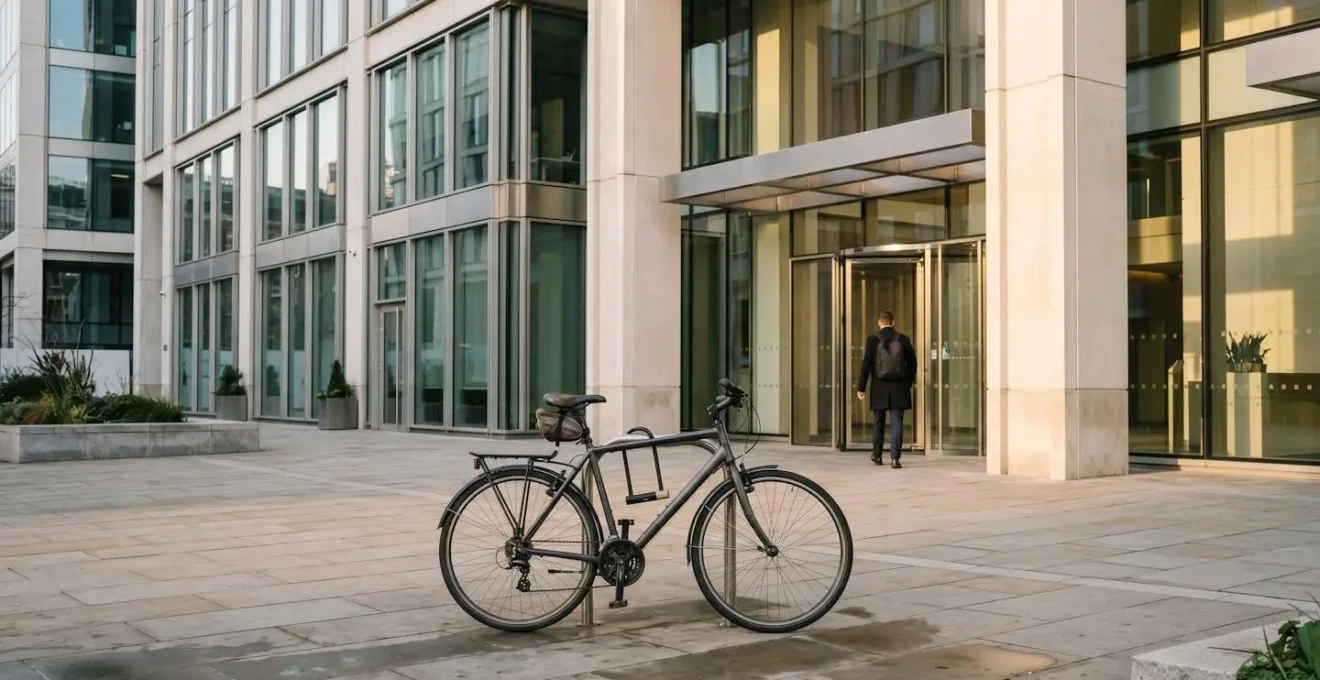
Mastering a long bike commute is not about avoiding sweat, but about executing a flawless ‘System Reset’ upon arrival to transform from cyclist to professional in minutes.
- Success hinges on pre-planned systems for hygiene, logistics, and gear—not on having an office shower.
- Key protocols include a no-shower “Sink Wash,” strategic route choice, and separating bike gear from work attire.
Recommendation: Adopt one of these structured protocols this week to make your commute the best part of your day, not a source of stress.
The thought of a 15-mile bike commute is exhilarating. You envision the freedom, the fitness gains, and the money saved. Then, the professional’s anxiety kicks in: arriving at a client meeting flushed, with helmet hair and a faint aroma of exertion. It’s the single biggest fear holding professionals back from a car-free lifestyle. The common advice often feels inadequate. “Just cycle slowly” isn’t practical for a long-distance ride, and “pack some wet wipes” barely scratches the surface of feeling truly fresh and confident for a board meeting.
Most guides focus on the ride itself, but they miss the most critical phase: the transition. The secret weapon of the veteran daily commuter isn’t a fancy bike or expensive gear; it’s a set of meticulously refined systems. The truth is that arriving at the office looking impeccable has very little to do with how much you sweat and everything to do with mastering the post-ride ‘System Reset’. It’s about a deliberate, repeatable process that takes you from cyclist to polished professional in under 15 minutes, even with no office shower in sight.
This isn’t just about coping; it’s about thriving. It’s about transforming the commute from a logistical problem into a strategic advantage for your health, wealth, and state of mind. We’re going to break down these non-negotiable protocols, covering everything from a failsafe hygiene routine and smart route planning to the art of carrying your gear without compromising your professional image. Forget the generic tips; this is the operational playbook for making the 15-mile commute work for you, not against you.
This article provides a complete blueprint, breaking down the essential systems every long-distance UK bike commuter needs to master. From post-ride freshness to financial savings, each section delivers a critical piece of the puzzle.
Summary: How to Look Like a Professional While Commuting by Bike in the UK
- No Showers at Work? The “Sink Wash” Protocol for Freshness
- Quiet Streets vs. Cycle Superhighways: Choosing the Stress-Free Route to Work
- Dark Mornings: How to maintain the Habit When It’s Raining Sideways in November?
- The Calculator: How Much Money Do You Actually Save by Ditching the Second Car?
- Commuter Insurance: Do You Really Need It If You Don’t Ride a Carbon Bike?
- Helmet Hair Hacks: Styling Tips for Arriving at the Office Looking Fresh
- The Shoulder Strap Test: Which Pannier Looks Normal in a Client Meeting?
- How to Look Like a Professional While Commuting by Bike in London?
No Showers at Work? The “Sink Wash” Protocol for Freshness
The absence of an office shower is the most common reason professionals dismiss the idea of a bike commute. But for the seasoned commuter, a shower is a luxury, not a necessity. The key is the “Sink Wash Protocol”, a systematic approach to hygiene that can be executed in any standard office washroom. This isn’t about a quick splash of water; it’s a structured, multi-step process. The first rule is patience: allow a 10-minute cooldown period upon arrival. Use this time to rehydrate and let your body temperature normalise before you even approach the sink. This prevents you from starting to sweat again mid-wash.
Your weapon of choice is a pre-packed, minimalist hygiene kit stored in your desk drawer. To see what this looks like in practice, the image below shows a perfectly curated set of essentials. The goal is efficiency and high impact.
As you can see, this is about quality over quantity. The core of the protocol involves a high-absorbency microfibre towel for rapid drying, a concentrated body wash applied to key areas, and a powerful anti-perspirant applied only once the skin is completely dry. Dry shampoo is your best friend for a quick hair refresh without water. Finally, you change into a fresh set of office clothes that you’ve either brought with you or, ideally, stored at the workplace. This entire ‘System Reset’ takes less than 15 minutes and leaves you feeling—and smelling—as fresh as if you’d just stepped out of a full shower.
Quiet Streets vs. Cycle Superhighways: Choosing the Stress-Free Route to Work
For a 15-mile commute, the fastest route is rarely the best one. Your choice of path has a profound impact on your stress levels, your safety, and how much you sweat. The temptation is to use main roads or even the designated Cycle Superhighways, but these are often high-stress environments with frequent stops, starts, and close interactions with traffic. This constant acceleration and braking is a recipe for arriving at work frazzled and sweaty. The veteran commuter knows that a slightly longer route on quiet backstreets, canal towpaths, or through parks is infinitely superior.
The goal is to find a route that allows you to maintain a steady, consistent pace. This “low-and-slow” aerobic effort is far less taxing on the body than the high-intensity intervals of city traffic. You arrive calmer, drier, and mentally prepared for the day ahead. This isn’t just a feeling; it’s backed by research into the mental health benefits of different commuting styles.
Case Study: The Mental Health Benefits of a Calmer Commute
A recent University of Edinburgh study provided a compelling reason to choose your route wisely. By analyzing 378,253 people, researchers found that individuals who cycle to work are significantly less likely to be prescribed medications for anxiety or depression. The study specifically highlights that the choice of route is a major factor, with calmer, more scenic paths offering meditative benefits that actively reduce stress and improve focus throughout the workday. Choosing the quiet street isn’t just about avoiding traffic; it’s a deliberate act of self-care.
Use tools like Komoot or Citymapper’s “quiet route” option to do a few test runs on a weekend. Invest time in finding your perfect commute; it will pay dividends in your daily well-being. A stress-free journey is a cornerstone of a sustainable cycling habit, transforming the commute from a chore into a cherished daily ritual.
Dark Mornings: How to maintain the Habit When It’s Raining Sideways in November?
Motivation is easy on a sunny June morning. The real test of a commuter comes in November, when it’s dark, cold, and raining. On these mornings, the temptation to jump in the car or on the train is immense. Overcoming this requires shifting your focus from willpower to process. The secret is the “Friction Reduction Ritual”: a series of small tasks you complete the night before to make the morning decision to cycle as effortless as possible. The goal is to eliminate every single barrier, no matter how small, that stands between you and the bike.
This means laying out every piece of clothing in the order you’ll put it on. It means charging your lights and checking your tyre pressure before you go to bed. Visibility is non-negotiable in the UK winter, and for dark commutes, cycling experts recommend a front light of 800+ lumens to not only be seen but to see potholes and hazards ahead. A powerful lighting system turns a scary ride into a confident one. Having everything ready removes the need for decision-making when you’re groggy and your warm bed is calling.
Your Nightly Friction Reduction Checklist
- Lay out all gear: Place your base layers, waterproofs, gloves, and overshoes in a visible, easily accessible spot.
- Charge everything: Plug in your front and rear lights, as well as your GPS or phone. Keep backup batteries handy.
- Check tyre pressure: Inflate your tyres to the correct PSI. A 30-second check at night saves a 10-minute delay in the morning.
- Pack your bags: Ensure your work bag is fully packed with your change of clothes, laptop, and hygiene kit.
- Review the forecast: A quick look at the next day’s weather allows you to prepare the right layers and mentally commit.
By making the alternative—driving or taking public transport—the more complicated option, you stack the deck in favour of cycling. This nightly ritual is a powerful psychological tool that builds an unbreakable habit, ensuring you reap the benefits of your commute all year round.
The Calculator: How Much Money Do You Actually Save by Ditching the Second Car?
The health and environmental benefits of cycling are well-known, but the financial argument is often the most compelling driver for change. A 15-mile daily commute (30 miles round trip) replaces a significant amount of driving, and the savings go far beyond the obvious cost of fuel. When you ditch a second car in favour of a bike, you eliminate expenses for insurance, road tax, MOT, servicing, depreciation, and parking. These “hidden” costs add up to a staggering amount over the year.
Let’s put a number on it. While individual costs vary, UK-wide data gives us a powerful baseline. According to the Office for National Statistics, the cost of commuting can be a major drain on household income. When you switch to cycling, you’re not just saving a few pounds on petrol; you’re effectively giving yourself a significant annual pay rise. In the UK, data analysis shows the average annual cost of commuting by car is £2,616. That’s over £200 a month back in your pocket.
This financial liberation is one of the most empowering aspects of becoming a cycle commuter. The image below perfectly captures the symbolic choice between the ongoing expense of driving and the freedom of cycling.
This saved money can be redirected towards holidays, investments, or simply reducing financial stress. The initial investment in a good-quality commuter bike and gear may seem high, but it typically pays for itself within the first year. Calculating your own potential savings can be a powerful motivator to overcome the initial hurdles of setting up your new routine. It transforms the bike from a simple vehicle into a powerful financial tool.
Commuter Insurance: Do You Really Need It If You Don’t Ride a Carbon Bike?
A common misconception is that bicycle insurance is only for people with expensive, lightweight carbon racing bikes. This leads many commuters on sturdy, sub-£1,000 hybrids to skip it entirely, believing the biggest risk is having their bike stolen. While theft is a concern, it is not the greatest financial risk you face as a daily commuter. The real, potentially life-altering risk is third-party liability—the financial responsibility if you cause an accident involving a person or property.
Imagine a momentary lapse in concentration in city traffic. You could accidentally scratch an expensive car, or worse, cause an injury to a pedestrian. The subsequent legal and compensation claims can run into thousands, or even millions, of pounds. Your home insurance might offer some cover, but it’s often limited. This is where specialist cycling insurance becomes essential, not for the value of your bike, but for the liability protection it offers. For a relatively small annual fee, membership with organisations like Cycling UK or a dedicated policy from an insurer provides up to £10 million in third-party liability cover.
This isn’t about protecting your bike; it’s about protecting your house, your savings, and your financial future. The value of your bicycle is almost irrelevant to this calculation.
The greatest financial risk is causing an accident involving a pedestrian or an expensive car. Liability coverage is the true must-have, regardless of bike value.
– Cycling UK Insurance Guidelines, Cycling UK Insurance Information Page
This liability coverage is the peace of mind that allows you to navigate busy urban environments with confidence. It’s a non-negotiable part of the responsible commuter’s toolkit, providing a crucial safety net for the unexpected. Considering the low cost versus the immense potential risk, it’s one of the best investments you can make in your commuting life.
Helmet Hair Hacks: Styling Tips for Arriving at the Office Looking Fresh
After conquering sweat and hygiene, the next professional hurdle is “helmet hair.” Arriving at your desk with flat, matted, or oddly-shaped hair can instantly undermine your polished appearance. The key is not to fight the helmet but to work with it, using a quick and effective revival technique upon arrival. The first step is prevention: ensure your helmet fits correctly and isn’t overly tight, and consider a silk or satin helmet liner which can reduce friction and static.
However, some compression is inevitable. The solution lies in a 30-second revival process that reactivates your hair. Keep a small water misting bottle and a travel-sized amount of your preferred styling product (pomade, wax, or cream) in your desk drawer. Forget about trying to re-style from scratch; the goal is a quick reset. Lightly misting your hair with water doesn’t make it wet, but it provides just enough moisture to make it pliable again and reactivate any product you applied in the morning.
Once misted, you can easily reshape your hair with your fingertips, working against the compression lines left by the helmet pads. The process is simple and can be done in any office washroom in under a minute. Here is the exact technique:
- Lightly mist hair with a water spray bottle to reactivate styling product.
- Use fingertips to redistribute a small amount of pomade or wax.
- Reshape hair with your fingers, lifting it away from the helmet compression lines.
- Allow to air dry for 2-3 minutes while you finish getting ready.
- Use a comb or fingers for any final styling adjustments.
This simple routine ensures that your hair looks intentionally styled, not like you’ve just spent an hour in a helmet. It’s another small but critical system that contributes to the overall goal: arriving looking completely put-together and professional.
The Shoulder Strap Test: Which Pannier Looks Normal in a Client Meeting?
Nothing screams “I just got off a bike” like walking into a client meeting with a bulky, technical-looking pannier slung over your shoulder. The bag you use is a critical component of your professional image, and most cycling-specific bags fail the “boardroom test.” They are designed for function, not form, often featuring an array of straps, clips, and high-viz materials that look out of place with a business suit. A sweaty backpack is an absolute non-starter, and a messenger bag can be uncomfortable over 15 miles.
So, what’s the solution? Do you sacrifice professionalism for practicality, or vice versa? The elegant answer adopted by a growing number of UK professionals is the “Two-Bag Inception System.” This strategy decouples your on-bike gear from your in-office accessories, ensuring you never have to compromise your appearance.
Case Study: The Two-Bag Inception System for Professional Cyclists
The system is brilliantly simple: a rugged, fully waterproof technical pannier remains on the bike’s rack. This is the “outer shell” that holds your tools, lock, waterproofs, and other cycling-specific items. Inside this pannier, you place your actual work bag—a smart leather briefcase, a minimalist laptop sleeve, or an elegant tote. Upon arrival at the office, you simply open the pannier and extract your pristine work bag. The cycling gear never enters the professional space, and you walk into your meeting looking sharp, carrying a bag that complements your attire.
This approach gives you the best of both worlds: the rugged, waterproof functionality you need for a UK commute, combined with the polished, professional image required for the office. It’s a deliberate system that solves the pannier problem once and for all, allowing you to seamlessly transition between your two worlds without ever looking out of place.
Key Takeaways
- Professionalism is a system, not a hope. Arriving fresh is about having repeatable protocols for hygiene, gear, and logistics.
- Decouple your identities. Use the “Two-Bag Inception System” to keep rugged bike gear separate from your polished office accessories.
- Prepare the night before. A “Friction Reduction Ritual” makes winter commuting effortless by removing all morning barriers.
How to Look Like a Professional While Commuting by Bike in London?
Commuting by bike in London presents a unique set of challenges and opportunities. With over 1.26 million cycle trips made on an average day, you are part of a massive movement, not an outlier. The key to looking professional is to embrace this and build a set of robust systems that make the transition from the cycle lane to the office seamless. It’s about projecting confidence and being prepared for anything the city throws at you.
The ultimate strategy is to minimise what you carry daily. The most seasoned London commuters use their office as a “base of operations.” This means keeping a full week’s rotation of work clothes (e.g., five shirts, two pairs of trousers/skirts) and at least two pairs of smart work shoes at the office. This dramatically reduces the weight and bulk you need to transport, making the ride more comfortable and the logistics simpler. Your daily carry is then reduced to your laptop, lunch, and your minimalist hygiene kit.
Combining all the systems we’ve discussed creates a holistic protocol for the London professional. It’s about more than just arriving dry; it’s about arriving with an air of control and deliberation. When a colleague comments on your commute, frame it as a strategic choice for health and efficiency, not an inconvenience you endure. This confidence, backed by flawless preparation, is the final element that cements your professional image.
Now that you have the complete playbook, the next step is to start implementing it. Begin with one system—perfect the “Sink Wash Protocol” or map out your ideal “Stress-Free Route” this weekend. Take action and begin your journey to becoming a master commuter.