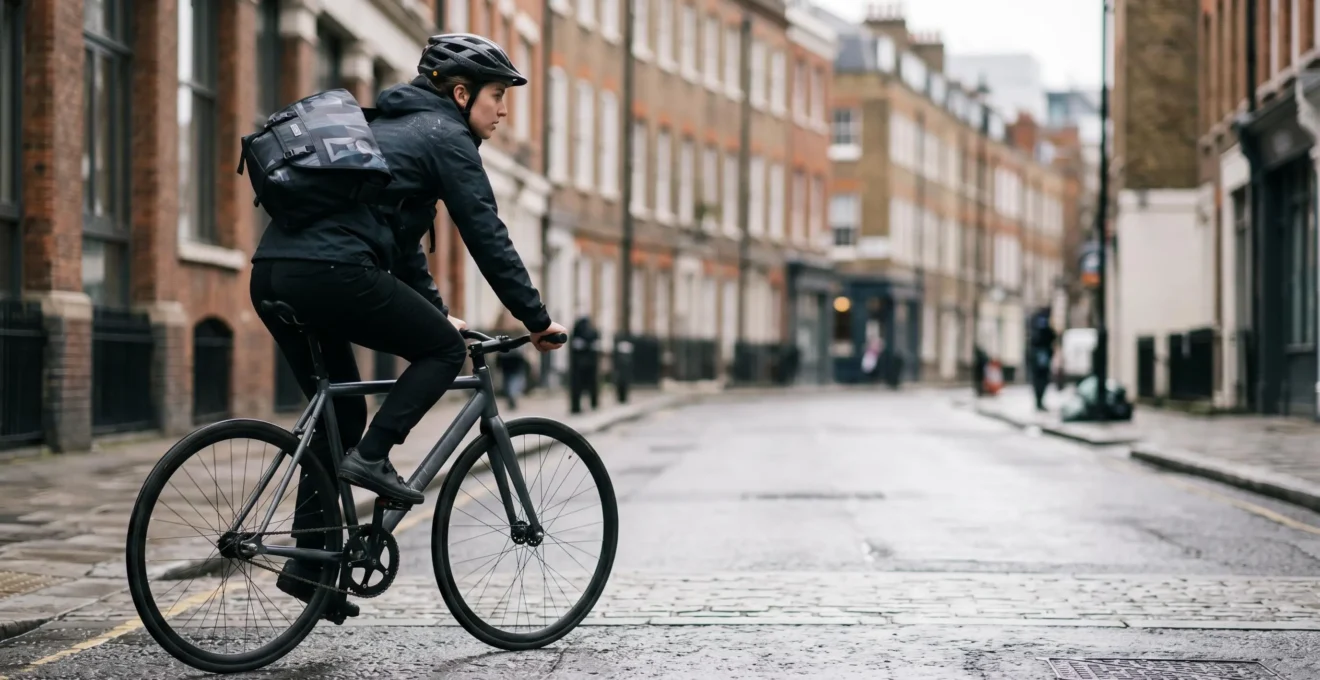
The messenger bag isn’t a fashion statement; it’s a high-performance tool meticulously designed for urban momentum.
- It enables the “swing-and-grab” maneuver for instant, one-handed access to contents without stopping or dismounting, a feat impossible with a backpack.
- When packed correctly and secured with a stabilizer strap, it integrates the load with the rider’s body, preserving balance and agility in dense traffic.
Recommendation: Stop seeing it as just a bag and start treating it as the core of your riding system. Master its unique features, and you’ll understand why it remains the professional’s choice for flow and function.
Watch any seasoned London courier weave through snarled traffic, and you’ll notice their gear is as deliberate as their line choice. The iconic messenger bag, slung over one shoulder, is a constant. Many riders, especially those new to commuting, dismiss it as a stylistic quirk, a relic from a time before advanced ergonomic backpacks. They argue backpacks distribute weight better and are more comfortable. They’re not entirely wrong, but they are missing the entire point.
The debate isn’t about comfort over long distances; it’s about efficiency in short, chaotic bursts. The choice to use a messenger bag is rooted in a philosophy of perpetual motion—a kinetic workflow where stopping is failure. A backpack requires you to stop, dismount, and remove it to access anything. A messenger bag is a mobile office, accessible in seconds without breaking your rhythm. This isn’t just about grabbing a phone; it’s about a fluid system of interaction between the rider, the bike, and the cargo.
But if the core advantage is this fluid access, why do so many people complain about them swinging around or causing shoulder pain? The truth is, most people use them incorrectly. A true courier bag is a piece of technical equipment, not a fashion accessory. Its effectiveness hinges on understanding its specific design features, from stabilization systems to waterproofing that actually works when you’re caught in a November downpour.
This article breaks down the anatomy of that professional choice. We’ll move beyond the surface-level aesthetic and dissect the functional reasons why, for a certain type of rider, the messenger bag isn’t just an option—it’s the only option. We will explore the physics of its stability, the art of packing it correctly, the hard truths about waterproofing, and how it stacks up against the alternatives when performance is paramount.
To fully grasp the logic behind this enduring piece of gear, this guide examines every critical component and real-world scenario you’ll face. The following sections break down the system, piece by piece.
Summary: Deconstructing the Professional Courier’s Choice
- The Stabilizer Strap: Why Your Bag Slides Around and How to Fix It
- Shoulder Pain: How to Pack a Messenger Bag to Save Your Spine?
- 15L or 30L: What Size Bag Do You Actually Need for Gym Kit and Laptop?
- The Black Hole Effect: How to Organize Cables and Keys in a Giant Sack?
- The Sweaty Patch: Can Any Messenger Bag Breath Against Your Back?
- Roll-Top vs. Zips: Which Closure Actually Keeps Your Laptop Dry in a Downpour?
- Rubber Seals: Why USB Ports Are the Weakest Link in Heavy Rain?
- Backpack or Pannier: Which Is Best for Carrying a Laptop on a Carbon Road Bike?
The Stabilizer Strap: Why Your Bag Slides Around and How to Fix It
The single most common complaint from someone trying a messenger bag for the first time is that it swings around to their front when they lean into a corner or stand up to pedal. This isn’t a design flaw; it’s user error. The element they’re missing is the most crucial part of the entire system: the stabilizer strap. This isn’t an optional accessory; it’s the component that transforms a sloppy sack into a piece of high-performance gear that integrates with your body.
As Wikipedia contributors note in their overview, a “true messenger bag includes a second, thinner, stabilising strap that is fastened either around the rider’s waist or diagonally across the chest.” Without it, the bag is fundamentally unstable for aggressive riding. This secondary strap’s job is to anchor the bottom corner of the bag, creating a three-point harness. This triangulation prevents the bag from shifting its center of gravity, keeping the load locked to the center of your back.
Professional systems take this even further. It’s not just a piece of webbing; it’s an engineered part of the kinetic workflow. According to experts at bag manufacturer SF Bags, high-end stabilizer straps are designed as a load distribution mechanism essential for the “swing and lock” maneuver. A courier can release the stabilizer with one hand, swing the bag to their front to access contents, then swing it back and re-engage the strap, all while coasting through traffic. This quick-release functionality is what enables the uninterrupted momentum that defines courier work.
So, if your bag is sliding, the fix is simple: use the stabilizer strap. If your bag doesn’t have one, it’s not a real messenger bag; it’s a shoulder bag masquerading as one.
Shoulder Pain: How to Pack a Messenger Bag to Save Your Spine?
The second major criticism leveled against messenger bags is shoulder and back pain. Placing an entire load on one shoulder seems inherently unbalanced, and if done incorrectly, it absolutely is. The key is not the bag itself, but how you pack it. A poorly packed messenger bag creates a lumpy, shifting mass that pulls on your shoulder and forces your body into an unnatural alignment. A properly packed bag becomes a flat, stable panel that rests securely against the contours of your back.
The goal is to create a stable, triangular structure. The fundamental rule is: heavy and flat items go first, pressed directly against the padded back panel of the bag. This includes your laptop, documents, or books. This creates a rigid “shield” that distributes pressure evenly and keeps sharp corners from digging into your back. Lighter, bulkier items like a jacket or lunch should be placed in front of this flat foundation. This method keeps the center of gravity as close to your body as possible, minimizing leverage and strain on your shoulder.
The consequences of ignoring this are real and documented. An old USPTO patent for a bag harness describes the problem perfectly, stating that with an unbalanced load, “the spine is forced to adopt a compensatory postural alignment which involves unbalanced use of back muscles and asymmetrical stress.” You’re not just carrying a load; you’re fighting it with every pedal stroke. Research on backpack ergonomics found that even carrying just 10% of your body weight incorrectly can significantly impact posture and muscle strain. With a single-strap system, proper packing is even more critical.
Ultimately, shoulder pain is a symptom of improper use, not a flaw of the bag. Pack it like a professional—flat and tight to the back—and you’ll find it far more comfortable and integrated than a top-heavy backpack that sways with every movement.
15L or 30L: What Size Bag Do You Actually Need for Gym Kit and Laptop?
Choosing the right size is a classic Goldilocks problem. Too small, and you’re strapping things to the outside, compromising weatherproofing and balance. Too large, and you’re dealing with the “half-empty sack” problem: your contents slosh around, shifting the center of gravity unpredictably during cornering and braking. A large, under-filled bag is often less comfortable and stable than a smaller, perfectly packed one. For a rider needing to carry daily essentials like a laptop and gym kit, the sweet spot often lies between 20 and 25 liters, but the exact volume depends on your specific loadout.
The mistake most people make is focusing only on the liter capacity. The shape and dimensions are just as important, if not more so. A tall, narrow 20L bag might not fit a 15-inch laptop, while a shorter, wider 18L bag could hold it perfectly. Before you buy, you need a realistic inventory of your everyday carry. Don’t just guess; lay everything out on the floor. This gives you a true sense of the volume and, crucially, the shape you need to accommodate.
For those looking to dial in their choice, following a methodical process is key. The following checklist is a gut-check used by experienced riders to avoid a costly sizing mistake.
Your Courier’s Gut-Check for Sizing a Messenger Bag
- Inventory Your Carry: Before anything else, work out what you’ll usually be carrying. Lay it all out. Now add a little extra mental capacity for those unexpected “emergency” items, like a last-minute grocery run.
- Prioritize a Padded Laptop Sleeve: The shape is as crucial as the volume. If you carry a laptop, ensure the bag has a dedicated, padded sleeve and check its dimensions against your device.
- Inspect the Strap System: Look for a main shoulder strap that is at least 5cm (2 inches) wide and well-padded. Critically, confirm it has a robust secondary stabilizer strap to lock the bag in place while riding.
- Avoid the Oversize Trap: Get a bag with enough volume for your typical load, but resist the urge to go too big. A half-empty large bag shifts weight, making it far less comfortable and stable than a perfectly packed, smaller bag.
Getting the size right is the first step to a stable and functional carry system. It ensures your bag works with you, not against you, every time you get on the bike.
The Black Hole Effect: How to Organize Cables and Keys in a Giant Sack?
A common critique of traditional messenger bags is their tendency to become a “black hole”—a single, cavernous compartment where keys, cables, and tools disappear into a jumbled mess at the bottom. While this is true for cheap, fashion-oriented bags, a professional-grade messenger bag is designed as an organizational system built for access by feel, not by sight. The key is to develop what couriers call a “tactile map” of your bag.
This means assigning a specific, permanent location for every item. Keys always go in the front zippered pocket. Your phone always goes in the dedicated strap pouch. Your multi-tool and patch kit live in a small internal sleeve. After a few rides, this becomes muscle memory. You’re not looking for your keys; your hand knows exactly where to go. This “no-look retrieval” is a cornerstone of the courier’s momentum economy, allowing you to grab what you need without breaking your focus on the road.
Professional bags are designed to facilitate this. As noted in analyses of courier gear, these bags are built with features for one-handed operation. They have specific clips, pockets, and webbing loops on the main strap for holding a phone or two-way radio. The entire design philosophy revolves around being able to swing the bag to your front and access these dedicated pockets without fumbling. It’s an external, wearable filing system.
For riders who need even more granular organization, the solution isn’t a different bag; it’s modularity. Use small, color-coded pouches or “packing cubes” for different categories of items: one for electronics (cables, power bank), one for bike tools, one for personal items. This turns the “black hole” into a tidy, quickly searchable mothership.
The Sweaty Patch: Can Any Messenger Bag Breath Against Your Back?
Let’s get one thing straight: if you’re riding hard, you’re going to sweat. No bag, whether it’s a messenger or a high-tech backpack with “advanced airflow channels,” is going to leave you perfectly dry. The dreaded “sweaty patch” is a reality of carrying anything on your back. However, the design and materials of a messenger bag can either aggravate the problem or manage it effectively. The primary issue isn’t the bag itself, but the large, uninterrupted contact patch it creates.
Unlike backpacks that try (and often fail) to create airflow with foam ridges and mesh, a messenger bag sits flush against your back. This is great for stability but terrible for ventilation. As ergonomics experts at Ergon Bike point out, many carrying systems are poorly fitting and press on the shoulder muscles, but the lack of airflow is a universal problem. The goal, therefore, isn’t to find a bag that “breathes”—it’s to find a bag made from materials that manage moisture and dry quickly.
This is where professional-grade materials make a huge difference. Cheap bags are often made of simple nylon or polyester that gets saturated with sweat and stays wet. High-quality messenger bags, however, are typically constructed from materials like 1000D Cordura® fabric or vinyl-coated polyester truck tarpaulin. These materials are chosen for their abrasion resistance and waterproof qualities, but they have a secondary benefit: they are non-absorbent. Sweat will bead on the surface or simply not soak in, meaning the bag itself dries much faster once you take it off. This is a huge advantage over a foam-padded backpack that can act like a sponge.
So, can any messenger bag breathe? No. But the right one won’t hold onto your sweat all day. Accept the sweat as part of the work, and choose a bag built from materials tough enough to handle it, and you’ll be far more comfortable in the long run.
Roll-Top vs. Zips: Which Closure Actually Keeps Your Laptop Dry in a Downpour?
When the sky opens up mid-commute, the single most important feature of your bag is its ability to be a hermetically sealed vault for your electronics. This is where the debate between closure systems becomes critical, and for any serious all-weather rider, there is no debate: the roll-top closure is fundamentally superior to a zipper. Many bags are marketed as “water-resistant,” often featuring “weatherproof” zippers. This is marketing fluff. A zipper, by its very nature, has hundreds of tiny points of potential failure. Under driving rain, water will eventually work its way through the teeth or the fabric surrounding the zip.
A roll-top closure, on the other hand, creates a continuous, fold-over seal with no entry points. When you fold the top of the bag over on itself multiple times and buckle it down, you create a physical barrier that water cannot penetrate. This design is borrowed directly from dry bags used in kayaking and sailing, where gear submersion is a real possibility. As professional gear testers have found, the high-frequency welded seams and fold-seal system of a good roll-top bag can withstand brief submersion, something no zipper can claim.
The difference is so significant that it’s reflected in official standards. According to international protection rating guidelines, commuters carrying sensitive electronics should look for bags rated at IPX6 or IPX7. An IPX6 rating means the bag can resist high-pressure water jets from any angle, while IPX7 means it can be submerged in 1 meter of water for 30 minutes. Achieving these ratings is nearly impossible with a standard zipper but is the baseline for a well-designed roll-top.
Furthermore, zippers fail catastrophically. When a zipper breaks in the field, your bag is useless. If a buckle on a roll-top breaks, you can still tie the straps in a knot to secure the closure. For a working courier, this reliability isn’t a feature; it’s a lifeline.
Rubber Seals: Why USB Ports Are the Weakest Link in Heavy Rain?
In the modern arms race of bag features, one of the most common and misguided additions is the external USB charging port. On paper, it sounds convenient: a port on the outside of your bag, connected to a power bank on the inside, allowing you to charge your phone on the go. In reality, it’s a critical point of failure that compromises the most important function of a courier bag: being an impenetrable fortress against the elements.
These ports are typically covered by a flimsy rubber or silicone flap. This flap might provide protection against a light drizzle, but in a sustained, wind-driven downpour, it’s virtually useless. Water will inevitably find its way past the seal, not only rendering the port itself useless and prone to corrosion but also creating a direct channel for moisture to enter your bag. It’s a hole you voluntarily paid to have punched in your otherwise waterproof shield.
This highlights a fundamental misunderstanding of what makes a bag truly waterproof. As gear testing experts at Eiken bluntly state, “Most backpacks sold as ‘waterproof’ aren’t. They’re water-resistant, and there’s a world of difference the first time you…discover your laptop swimming at the bottom of your pack.” A truly waterproof bag is a sealed system. Every seam is a potential leak, and every feature added to the exterior is another vulnerability. The philosophy of a professional courier bag is to have as few external failure points as possible.
The solution is simple and robust: keep your power bank inside the sealed, dry main compartment of your bag. If you need to charge your phone, run a cable out from the roll-top closure before you seal it. This maintains the integrity of the bag’s waterproof liner while still giving you access to power. It’s a low-tech, reliable solution that prioritizes function over gimmicks—the very essence of the courier mindset.
Key Takeaways
- The messenger bag is not a fashion item but a professional tool for a ‘kinetic workflow’ based on uninterrupted momentum.
- Proper use of the stabilizer strap is non-negotiable; it creates a three-point harness that locks the bag to your body, preventing dangerous shifting.
- Waterproofing is binary: a roll-top closure offers a truly sealed system, while zippers are merely water-resistant and a point of failure in heavy rain.
Backpack or Pannier: Which Is Best for Carrying a Laptop on a Carbon Road Bike?
When your ride is a lightweight carbon road bike, the question of how to carry cargo becomes even more pointed. The frame is a highly-tuned piece of performance equipment, not a utility mule. Attaching racks for panniers is often impossible without dedicated mounts, and even if you can, it introduces stress points to a frame not designed for them. It also fundamentally ruins the aesthetic and handling characteristics of a performance bike. This effectively leaves two options: a backpack or a messenger bag.
A backpack might seem like the ergonomic choice, but it places the weight high and far from your center of mass. This makes the bike feel top-heavy and less stable, especially during out-of-the-saddle efforts or fast descents. It works against the bike’s nimble nature. A pannier, while placing the weight low, adds significant drag and cumbersome weight that feels completely alien on a responsive road bike.
The messenger bag, when worn correctly, offers the superior solution for this specific context. It integrates the load with the rider, not the bike. The weight becomes part of your body mass, which you naturally use to steer and balance the bike. It requires no frame mounts, preserving the integrity and clean lines of the carbon frame. More importantly, it maintains the quick, on-the-fly access that is lost with both a backpack and a pannier system. The table below breaks down the stark differences when applied to a performance road bike context.
| Feature | Messenger Bag | Backpack | Pannier |
|---|---|---|---|
| Center of Gravity | Dynamic, integrated with rider body | High, reduces stability | Low and stable (touring) |
| Frame Impact | No mounts required, frame-safe | No frame contact | Requires rack mounts, potential stress points |
| Access While Riding | Excellent – swing to front without removal | Poor – must remove | Must stop and dismount |
| Off-Bike Portability | Excellent – briefcase or shoulder carry | Good – familiar carry | Poor – cumbersome to carry |
| Aesthetic Match | Complements performance look | Neutral | Aesthetic mismatch with carbon road bike |
For the carbon road bike rider who needs to carry a laptop, the messenger bag is the only system that respects the bike’s performance design, integrates with the rider’s motion, and delivers the rapid access required for an efficient urban workflow.