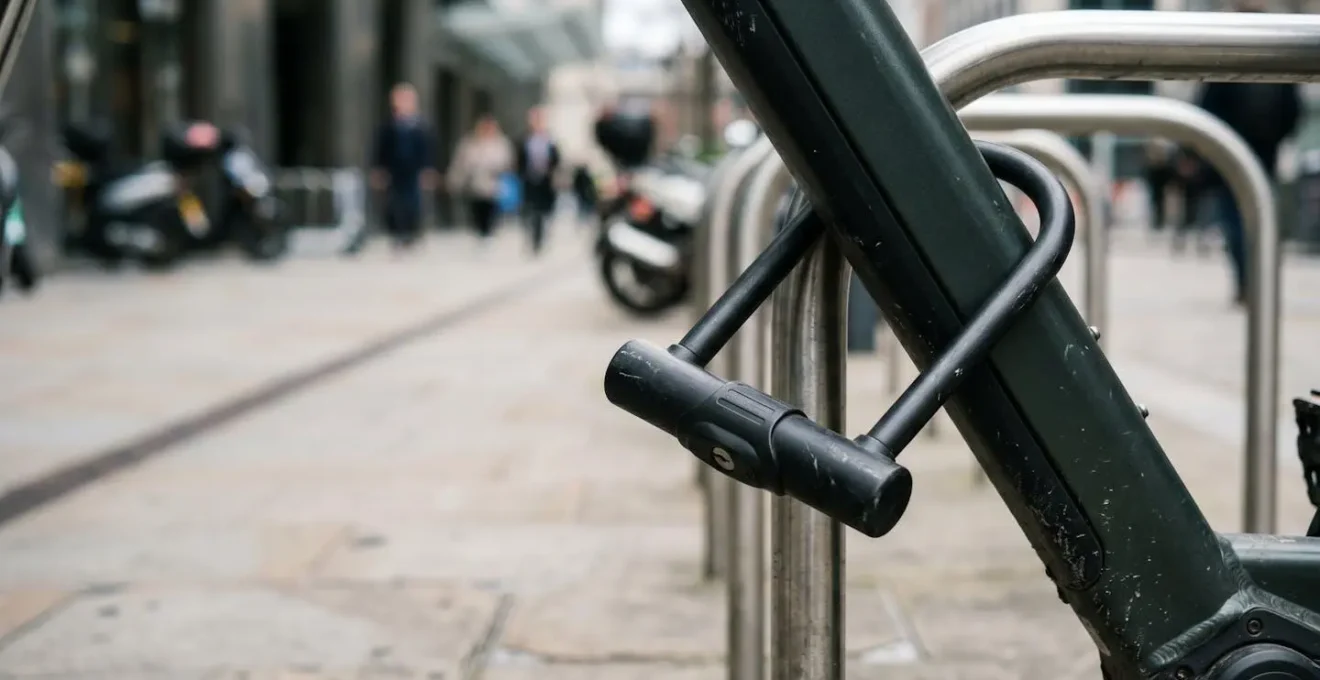
The most secure lock for your e-bike isn’t the one that’s unbreakable, but the one whose failure mode is the most difficult, time-consuming, and loudest for a thief to exploit.
- Material science dictates that a shackle or link thickness of 16mm or more is the baseline to defeat manual bolt cutters.
- Lock geometry, like that of a mini D-lock, can completely nullify leverage-based attacks by denying thieves the space needed for their tools.
- Against angle grinders, the best defence is not immunity but prolonged attack time, turning a quick theft into a high-risk, multi-minute ordeal.
Recommendation: Analyse the most probable attack vectors in your area and select hardware with the specific material and geometric properties that counter them, rather than simply choosing “D-lock” or “chain”.
For the owner of a £2,000 e-bike, the question of “D-lock or chain?” is more than a simple hardware choice; it’s a high-stakes decision. The common advice—buy a Gold-rated lock, lock it to an immovable object—is merely the entry point. As materials destruction testers, we don’t ask “which is better?”. We ask, “how does it fail?”. The security of your high-value asset depends not on a lock being invincible, but on understanding its specific failure modes and choosing the one that makes a thief’s job as difficult, noisy, and time-consuming as possible.
This isn’t a buyer’s guide that rehashes manufacturer claims. This is a breakdown of the physics and engineering of theft. We will deconstruct the attack vectors, from brute force leverage to high-speed abrasive cutting. We will analyse the material science of hardened steel and the critical role of geometry. The goal is to move beyond the superficial D-lock versus chain debate and equip you with a strategic framework for assessing any lock based on how it will perform under a real-world, determined assault.
By understanding the mechanics of how locks are defeated, you can make an informed, engineering-based decision to protect your investment. This analysis will guide you through the critical factors that truly define a lock’s protective capability.
Summary: D-Lock or Chain: A Materials Destruction Tester’s Analysis for E-Bike Security
- Is 2kg Too Heavy? Managing the Weight of a Gold Rated Lock
- Mounting Brackets: How to Carry a Heavy Lock Without It Rattling?
- Stuck Keys: How to maintain Your Lock Mechanism in Winter Grit?
- Mini vs. Standard: Why a Smaller Shackle Might Be Harder to Attack?
- Anti-Theft Guarantees: Are the “We Pay Your Deductible” Promises Real?
- Leverage Limits: Why 16mm Shackles Defeat Manual Bolt Cutters
- Frame and Wheels: The Correct Way to Secure Your Bike to a Sheffield Stand
- Angle Grinder Attacks: Can Any Lock Withstand a Portable Power Tool?
Is 2kg Too Heavy? Managing the Weight of a Gold Rated Lock
In the world of high-security locks, mass is a feature, not a bug. A top-tier lock weighing in at 2.00 kg (4.40 lbs) can feel excessive. As The Best Bike Lock’s testing notes, this is “about the same as 5.5 cans of Coke, pushing it to the limit of what is comfortably portable.” However, from a destruction testing perspective, this weight is a direct indicator of the lock’s primary defence: sheer material volume. More hardened steel means more energy is required to shear it, more time is needed to cut it, and a larger, more powerful tool is necessary to attempt either.
For an e-bike, which already benefits from motor assistance, the penalty of carrying a 2kg lock is marginal compared to the security benefit it provides. The weight isn’t just dead weight; it’s an active component of the security system. It represents the lock’s thermal mass, which helps dissipate heat from an angle grinder attack, and its physical bulk, which resists the immense forces of a leverage attack. When you pick up a heavy, Gold-rated lock, you are feeling the physical embodiment of its resistance to attack. For a £2,000 asset, trading a few kilograms for a significant increase in theft deterrence is a sound engineering decision.
Mounting Brackets: How to Carry a Heavy Lock Without It Rattling?
The integrity of a lock’s mounting bracket is a secondary, yet critical, component of the security ecosystem. A 2kg lock that rattles isn’t just an annoyance; it’s a sign of a potential system failure. Constant vibration and movement can lead to the bracket loosening, stressing the bolts, or even failing catastrophically, causing the lock to fall off during a ride. This could leave you without your primary security device when you reach your destination, or worse, cause an accident.
Ensuring the mount is properly secured is paramount. This involves regular checks to confirm all fittings are tight and that the bracket itself hasn’t developed cracks from stress. When choosing a lock, consider the compatibility with your frame, as the bulky tubes of many e-bikes can limit mounting options and force a compromise. A poorly-fitted bracket is an unreliable one. Some users forgo the supplied bracket entirely, opting for a dedicated frame bag or pannier to carry the lock. While this adds a step, it completely eliminates the failure modes associated with on-frame mounting, ensuring the lock arrives with you, silent and secure, ready for deployment.
Stuck Keys: How to maintain Your Lock Mechanism in Winter Grit?
The most robust shackle is useless if the locking mechanism itself seizes. This is an internal failure mode, often overlooked in favour of focusing on brute-force attacks. Locks spend their lives exposed to the elements, and the fine tolerances of their internal cylinders are highly vulnerable to corrosion and contamination from water, road salt, and winter grit. A stuck key or a jammed cylinder effectively bricks your security device, leaving you either unable to secure your bike or, more frustratingly, unable to unlock it.
Proactive maintenance is the only defence against this insidious attack vector. The mechanism’s action should be checked regularly. At the first sign of stiffness or grinding, preventative action is required. A liberal application of a water-repellent lubricant like GT-85 or WD-40 is essential to displace moisture and clean out contaminants. This should be done periodically, especially during winter months or in wet climates. Many high-end locks feature a dust cover over the keyway, which provides a first line of defence. It is crucial to use it consistently. Treating the lock’s internal mechanism with the same care as your bike’s drivetrain will ensure it functions when you need it most.
Mini vs. Standard: Why a Smaller Shackle Might Be Harder to Attack?
Counterintuitively, in the world of lock security, smaller can be stronger. The primary advantage of a “mini” D-lock over its standard-sized counterpart lies not in its material, but its geometry. One of the most common and effective brute-force attacks involves leverage, using tools like crowbars or even hydraulic car jacks (bottle jacks) inserted inside the shackle’s “D” to apply immense spreading force and break the lock body.
Case Study: Leverage Attack Nullification
The design principle of leverage attack resistance is clear: deny the tool space to operate. A mini D-lock, when used correctly to secure the frame tightly to a post, leaves minimal empty space within the shackle. This physically prevents a thief from inserting a bulky tool like a bottle jack. Even a crowbar attack becomes awkward and inefficient, as there is no room to achieve the necessary leverage. This principle completely nullifies this common and relatively quiet attack vector, forcing the thief to resort to a louder, riskier method like angle grinding. The lock’s strength becomes a function of its restrictive geometry, not just its material toughness.
By selecting a mini D-lock, the user makes a strategic choice to eliminate an entire class of attack. While it may reduce locking versatility—making it harder to secure the bike to larger objects—the security gain against leverage attacks is significant. It’s a calculated trade-off: sacrificing some convenience for the complete neutralisation of a specific, dangerous failure mode.
Anti-Theft Guarantees: Are the “We Pay Your Deductible” Promises Real?
Many high-security lock manufacturers offer an “Anti-Theft Guarantee,” promising to pay your insurance deductible if your bike is stolen while secured with their product. From a testing perspective, this is not a security feature; it is a post-failure process. It has no bearing on the lock’s physical resistance to attack. As the BikeRadar testing team wisely notes, a warranty is a good sign that the “lock won’t fall apart or seize up on you,” but it is not a shield against theft itself.
These guarantees come with a labyrinth of terms and conditions that must be followed to the letter. Failure to comply with even one step will void the claim. The burden of proof is entirely on you, the victim. You must prove you bought the lock, registered it correctly, used it correctly, and that the lock was defeated. This often requires you to present the broken lock to the company—a difficult task when a thief has taken it along with your bike. These guarantees are marketing tools first and financial safety nets a distant second. Relying on them for peace of mind is a strategic error; your focus must remain on preventing the lock’s failure in the first place.
Action Plan: Preparing for an Anti-Theft Guarantee Claim
- Immediate Registration: Register your lock online with its serial number and purchase details the day you buy it.
- Document Everything: Keep digital and physical copies of your bike purchase receipt, your lock purchase receipt, and the warranty certificate.
- Visual Proof: Periodically photograph your lock in use, clearly showing how it secures your bike’s frame to an anchor point. This proves correct usage.
- Bike Identification: Document and photograph your bike’s serial number. Store this information separately from the bike.
- Know the Process: Understand the requirements for filing a police report in your jurisdiction *before* a theft occurs, so you can act quickly and correctly.
Leverage Limits: Why 16mm Shackles Defeat Manual Bolt Cutters
The most basic tool of the bike thief is a pair of bolt cutters. The effectiveness of this tool is a simple calculation of mechanical advantage versus material science. From a destruction testing standpoint, there is a clear threshold where the material of the lock shackle overcomes the force that can be applied by a man-portable tool. Security experts agree that a hardened steel shackle with a diameter of 16mm or more is effectively immune to even the largest 48-inch bolt cutters.
At this thickness, two things happen. First, the jaws of most bolt cutters cannot open wide enough to get a proper bite on the shackle. Second, even if they can, the amount of force required to shear through the 16mm hardened steel rod exceeds what a human can generate, even with the long levers of a 4-foot cutter. The tool’s own steel jaws are more likely to be damaged or blunted than to cut through the shackle. This is why specifying a minimum shackle diameter is a critical part of lock selection. It’s a simple, measurable property that directly correlates to the nullification of a specific, common attack vector. Any shackle under this threshold, regardless of its brand or other features, remains vulnerable to this type of brute-force shearing attack.
Frame and Wheels: The Correct Way to Secure Your Bike to a Sheffield Stand
A multi-hundred-pound lock can be rendered useless by a single mistake in application. User error is the most common failure mode in any security system. The most robust lock, if only passed through the front wheel, is merely an expensive inconvenience for a thief who can remove the wheel in seconds and walk away with the rest of your £2,000 e-bike. The locking technique is not an afterthought; it is an integral part of the defense.
The hierarchy of security is non-negotiable. Priority 1 is always the frame. The lock must pass through the main frame triangle and secure it to an immovable object, like a Sheffield stand. For an e-bike, Priority 2 is often the rear wheel, especially if it contains a hub motor. A secondary cable or smaller lock should be used for this. The battery, if not integrated, must be secured or removed. Finally, the keyway of the lock should always face downwards to make picking or drilling attacks more difficult and conspicuous. Research showing that 60% of bike thefts occur from or near the victim’s home highlights that vigilance and correct technique must be applied everywhere, not just in “high-risk” public areas. Your shed or apartment hallway is a prime target.
Key Takeaways
- Mass Defeats Force: A shackle or chain link diameter of 16mm or greater is the critical threshold to render manual bolt cutters ineffective.
- Geometry Defeats Leverage: A smaller, tightly-fitted “mini” D-lock removes the physical space needed for leverage tools like jacks, nullifying a common attack vector.
- Endurance Defeats Grinders: No lock is immune to an angle grinder, but the best ones are designed to make the attack last for many minutes, destroying multiple cutting discs and creating significant noise and risk for the thief.
Angle Grinder Attacks: Can Any Lock Withstand a Portable Power Tool?
This is the final exam for any high-security lock. The portable, battery-powered angle grinder represents the apex of man-portable destructive power. In the lab, we can confirm a hard truth: given enough time and enough cutting discs, any consumer-grade lock can be defeated by an angle grinder. There is no such thing as an “angle grinder-proof” lock. However, that does not mean all locks are equal. The battle against the grinder is not about immunity; it is a battle against time.
The top tier of locks are no longer just made of hardened steel. They incorporate advanced materials, such as ceramic composites or graphene-infused coatings, designed specifically to fight back against abrasive cutting. These materials shred angle grinder discs, forcing a thief to stop, replace the consumable, and start again. This process multiplies the time required for a successful attack.
Case Study: Angle Grinder Destruction Test
In independent testing of top-tier, angle-grinder-resistant locks, none failed within a five-minute sustained attack. The best performers required an extrapolated time of over 40 minutes to cut through both sides of the shackle. Critically, these locks destroyed multiple cutting discs in the process. A five-minute attack generating a shower of sparks and a deafening screech is an eternity in a public space. This extended attack time dramatically increases the risk of intervention or capture, turning a potential theft from a quick snatch into a high-risk, prolonged siege. This is the true measure of an “angle grinder resistant” lock.
The ultimate choice, therefore, is not a lock that promises invincibility, but one that is engineered to make the attack so long, so loud, and so difficult that the thief will give up and move to an easier target. It transforms your bike from a target of opportunity into a fortress that is simply not worth the effort to breach.
Your task is now to re-evaluate your security setup not as a choice between a D-lock and a chain, but as a strategic deployment of mass, geometry, and material science to counter the most likely failure modes you will face.