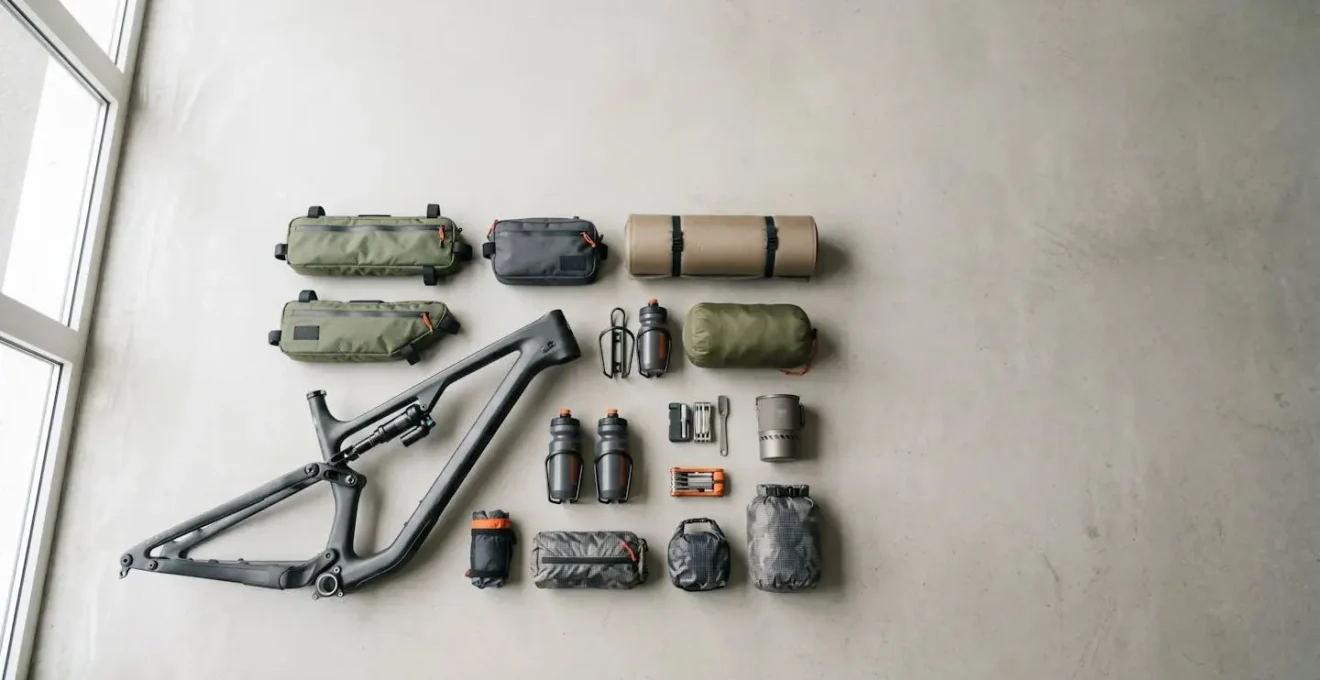
In summary:
- Protect your frame with multi-layer tape; friction between straps and paint is an unavoidable physical reality.
- Sculpt your bags by packing dense, hard items centrally to create a tapered profile that avoids knee rub.
- Prioritize a low center of gravity: heavy gear like tools and cooksets belongs in the frame, light gear in the seat pack to prevent sway.
- Use side-load bottle cages and frame-bag hydration bladders to maximize water capacity in tight spaces.
- Choose your packing style (camping vs. credit card) based on your frame’s realistic capacity, not just your ambition.
You have the bike—a nimble full-suspension machine or a compact frame that fits you perfectly. You have the dream—multi-day adventures into the backcountry. Then comes the reality check: none of the standard bikepacking bags seem to fit. The seat pack buzzes the rear tire, the frame bag won’t clear the shock, and your knees hit the handlebar roll. It feels like a game of Tetris you’re destined to lose. The common advice is often to just “buy smaller bags” or resort to a backpack, but that misses the point entirely.
As a gear maker, I see riders fighting their frames, trying to force a square-peg solution into a round-hole problem. They treat bags as individual accessories rather than components of a single, integrated system. This leads to compromised handling, damaged components, and a frustrating experience on the trail. The fundamental mistake is viewing the frame’s constraints—the small front triangle, the moving suspension linkage, the lack of eyelets—as a defect.
The real key is to flip the script. Instead of fighting your bike’s geometry, you must treat it as a design brief. The solution isn’t about finding the “perfect bag”; it’s about engineering a holistic packing system where every item is placed deliberately to optimize chassis dynamics, component function, and rider clearance. It’s about understanding the physics of weight distribution and leverage, not just filling space.
This guide will walk you through that engineering mindset. We will deconstruct the most common fitment problems on small and full-suspension bikes and provide systematic, problem-solving solutions for each. By the end, you won’t just have bags on your bike; you’ll have a purpose-built system ready for any adventure.
To navigate this complex puzzle, we’ve broken down the key challenges and their engineered solutions. This structure will guide you from protecting your investment to mastering the art of load distribution, transforming your packing from a source of frustration into a strategic advantage.
Contents: Tetris for Bikes
- Heli Tape: How to Stop Velcro Straps rubbing Through Your Carbon Paint?
- Wide Bags, Narrow Q-Factor: How to Pack Without Hitting Your Knees?
- Squashed Cables: How to Ensure Your Shifting Works with a Handlebar Roll?
- Side-Load Cages: The Essential Upgrade for Frame Bag Users
- Heavy Items Low: Why Putting Your Cooker in the Seat Pack Is a Mistake?
- Bottles or Bladder: How to Carry 3 Litres of Water on a Full-Suspension Bike?
- No Eyelets? How to Mount Panniers on a Frame Built for Racing
- Credit Card or Camping: Defining Your Bikepacking Style for the First Trip
Heli Tape: How to Stop Velcro Straps rubbing Through Your Carbon Paint?
The first rule of bikepacking is that your bags will move. No matter how tightly you cinch them, the constant vibration and flexing of the frame create micro-movements. When a gritty velcro strap rubs against your frame’s clear coat thousands of times per mile, it acts like low-grade sandpaper. For a carbon frame, this isn’t just a cosmetic issue; it can eventually compromise the outer resin layer. Protecting these contact points isn’t an option; it’s a non-negotiable part of setting up your packing system.
A simple piece of tape is insufficient. A truly robust solution involves a multi-layered strategy. Start with a base layer of quality electrical tape. It’s conformable and, more importantly, its adhesive is less aggressive, preventing it from pulling up paint or leaving a stubborn residue upon removal. This layer is your sacrificial barrier for short trips or initial setup tests.
For a semi-permanent solution, apply a dedicated frame protection film over the electrical tape in high-wear areas: under the top tube, around the headtube, and along the seat stays. A 2024 test of protection systems revealed that while standard “Heli Tape” is effective, a thicker 14-mil polyurethane tape proved most effective for the concentrated pressure points created by bag straps. For best results, use a “wet application” method (spraying the surface with a soapy water solution) to position the film and squeegee out any air bubbles for a flawless, invisible finish. Finally, always clean the frame meticulously before applying any tape, as trapped grit will accelerate damage.
Wide Bags, Narrow Q-Factor: How to Pack Without Hitting Your Knees?
One of the most common complaints from riders on smaller frames is knee rub, particularly against a bulging frame bag or an overstuffed top tube bag. This is a direct conflict between the bike’s Q-factor (the width between the pedals) and the desire to maximize storage volume. When a frame bag is simply stuffed to capacity, it naturally bows outwards, right into the path of your knees during the pedal stroke. This isn’t just annoying; it can cause chafing and alter your pedaling mechanics, leading to potential knee strain over long distances.
The solution is not to carry less, but to pack with intention. You must actively “sculpt” your frame bag from the inside out. The principle is simple: place hard, dense, and narrow items directly along the bag’s centerline. This includes things like your tool roll, tent poles, pump, or cookset. These items create an internal “spine” that provides structure. Then, pack your soft, compressible items—clothing, a sleeping bag liner—around this central core, pushing them into the sides.
This technique forces the bag to be widest at its vertical center but tapered and narrow at the top and sides, where your legs pass. It’s a proactive approach to shaping your load. Some manufacturers have engineered this solution directly into their products. For example, a case study on modern gear design highlights how certain brands use 3D tapered pack shapes with internal carbon supports to build in knee clearance, a design born from analyzing pedaling biomechanics. By mimicking this principle with your packing, you can achieve similar results with any bag.
Squashed Cables: How to Ensure Your Shifting Works with a Handlebar Roll?
A heavily loaded handlebar roll exerts significant pressure on your bike’s shifter and brake cables. When these cables are compressed against the headtube, the resulting friction or kinking in the housing can make shifting sluggish, heavy, or completely non-functional. On a technical climb when you desperately need an easier gear, discovering your shifting is compromised is a trip-ending problem. This interference is especially pronounced on smaller frames with shorter headtubes and tighter cable routing.
The goal is to create a protected, friction-free channel for your cables to pass through. You need to build a “cable garage.” This can be a simple, DIY solution. Cut sections of foam pipe insulation, old handlebar grips, or even wine corks lengthwise and place them between your handlebar bag and the headtube. These spacers create a physical gap that prevents the bag from ever directly compressing the housings. It’s a cheap but incredibly effective fix.
For a more refined approach, consider your cable routing strategy before even attaching the bag. Gently pre-bend the outer housings into a natural arc that flows around the bag’s intended position. Use a few zip-ties to loosely guide them, but avoid cinching them down tightly. The bag should rest against the housings without creating a sharp, binding angle. For short weekend trips, this is often enough. However, if you are planning an extended tour, the most reliable long-term solution is to invest in re-cabling your bike with housing that is 10-15cm longer than standard. This extra length provides ample slack for a smooth, wide arc that guarantees flawless shifting and braking, no matter how loaded your bars are.
Side-Load Cages: The Essential Upgrade for Frame Bag Users
On a traditional bike, accessing a water bottle is a simple, downward reach. But introduce a frame bag into a small or full-suspension front triangle, and that simple action becomes impossible. The bag occupies the very space your hand and the bottle need to move through for a standard top-load cage. You’re left with a bottle you can’t get out while riding, completely defeating its purpose. This isn’t a minor inconvenience; it’s a fundamental failure of the system.
This problem is a direct result of bicycle design evolution. As an analysis by The Pros Closet explains, the move toward compact frames with sloping top tubes and complex full-suspension linkages in the 1990s shrunk the front triangle, making side-load cages an essential, not optional, piece of equipment. These cages allow a bottle to be inserted and removed diagonally or laterally, using the limited side-to-side clearance that remains, even with a frame bag installed.
Choosing the right side-load cage is a strategic decision that depends on your dominant hand and your specific setup. A right-handed rider will typically prefer a right-side loading cage on the seat tube, allowing them to grab it easily with their free hand. The table below outlines a strategic placement guide to help you optimize your hydration access.
| Cage Position | Dominant Hand Match | Best Use Case | Frame Compatibility |
|---|---|---|---|
| Right Side-Load | Right-handed riders | Seat tube mount with left-side frame bag | Works with most suspension linkages |
| Left Side-Load | Left-handed riders | Down tube mount when right side obstructed | Requires checking linkage clearance |
| Symmetric (King Cage) | Ambidextrous | Fork mounts where side-loading unnecessary | Universal, slightly stiffer construction |
| Dual Side-Load Setup | Both sides | Maximum water capacity on small frames | Requires B-RAD adapters for positioning |
Heavy Items Low: Why Putting Your Cooker in the Seat Pack Is a Mistake?
Where you place weight on your bike has a greater impact on handling than how much weight you carry. The most common mistake is packing a seat pack with dense, heavy items like a cookset, tools, or food. A seat pack sits high and far behind the rear axle, and loading it with heavy gear creates a “pendulum effect.” On technical descents or while cornering, this high-up weight swings from side to side, destabilizing the bike’s chassis and making it feel sluggish and unpredictable. It undermines the very agility that makes a modern bike enjoyable to ride.
The golden rule of bikepacking load distribution is to keep heavy items as low and as central as possible. Your frame bag, specifically the area just above the bottom bracket, is prime real estate. This is the bike’s center of gravity. Placing your tools, cooker, fuel, and dense food here anchors the bike to the trail, enhancing stability. For overall balance, bikepacking experts recommend a starting weight distribution of approximately 40% on the front and 60% on the rear. This prevents the front wheel from feeling too light on steep climbs while maintaining responsive steering.
Your seat pack should be reserved exclusively for items that are light but bulky. Think of your insulated jacket, rain gear, or sleeping bag liner. These items fill the volume of the pack without contributing significantly to the pendulum effect. The same logic applies to your handlebar roll: it’s for medium-weight, compressible gear like your sleeping bag and clothes. Keeping the weight on the bars under 2kg is crucial to avoid making the steering feel heavy and slow.
Your Action Plan: Weight Distribution Audit
- Frame Zone (Heavy/Dense): Inventory your gear. Identify all tools, spare parts, water, dense food, and electronics. These MUST be positioned low in your frame bag, near the bottom bracket, to create a stable center of gravity.
- Handlebar Zone (Medium-Weight/Bulky): Collect your sleeping bag and compressible clothing. Pack these into the handlebar roll, ensuring the total weight stays under 2kg to preserve neutral steering.
- Seat Pack Zone (Light/Bulky Only): Gather your ultralight, high-volume items like an insulated jacket or rain shells. These are the only items permitted in your seat pack to eliminate the pendulum effect.
- Full-Suspension Check: Load the bike and cycle the rear suspension. If the shock feels sluggish or bottoms out easily, your downtube load may be too heavy. Redistribute 10-15% of that weight to the handlebar system to rebalance the unsprung mass.
- Test Ride & Refine: Perform a short test ride with sharp turns and a small drop. If the bike feels top-heavy or the rear sways, return to your audit and shift more dense items from the seat pack to the frame bag.
Bottles or Bladder: How to Carry 3 Litres of Water on a Full-Suspension Bike?
Water is heavy and non-negotiable, making it one of the biggest packing challenges on a space-constrained frame. A full-suspension bike often only has one set of bottle bosses, and even that becomes inaccessible once a frame bag is installed. Carrying three or more litres of water—a necessity in arid environments—can seem impossible without resorting to a backpack, which adds weight to your body and raises your personal center of gravity.
The most effective solution is a hybrid hydration system that leverages the unique advantages of both bottles and bladders. The core of this system is a 1-1.5L hydration bladder laid flat at the very bottom of your frame bag. This placement is strategic: it uses the heaviest consumable (water) as dynamic ballast, keeping the bike’s center of gravity extremely low for maximum stability on technical terrain. As you drink, the bike naturally becomes lighter and more nimble.
This bladder is supplemented with a single, easily accessible bottle for quick sips while riding. Since the frame triangle is occupied, you must look to unconventional mounting locations. The most common and effective options include:
- Fork Mounts: Many modern gravel and adventure forks come with “three-pack” bosses. Using an anything-style cargo cage here can securely hold a 1L bottle.
- Stem-Mounted Feed Bag: A small pouch that sits next to your stem can hold a standard 0.7L bottle, keeping it right at your fingertips.
- Under-Saddle Mounts: Adapting a triathlon-style, behind-the-saddle bottle mount can add capacity without interfering with a seat pack.
- Under the Top Tube: Using adapters like the Wolf Tooth B-RAD system, it’s sometimes possible to mount a cage inverted beneath the top tube, utilizing otherwise wasted space.
Combining a 1.5L bladder in the frame bag with a 1L bottle on the fork and a 0.7L bottle in a stem bag gives you over 3 litres of capacity without compromising handling or requiring a backpack.
No Eyelets? How to Mount Panniers on a Frame Built for Racing
While modern bikepacking is dominated by soft bags, there are times when small panniers are desirable for their easy access and capacity. The problem is that road, gravel, and mountain bikes are rarely designed with the rack eyelets needed to mount a traditional pannier rack. This forces riders to consider adapter systems, which come with a minefield of compatibility and safety concerns, especially for carbon or thin-walled aluminum frames.
The central debate, as posed by experts, is whether it’s better to use a complex adapter system or simply opt for a modern, large-volume seat pack. As the team at Cycling Weekly asks:
For a bike with no eyelets, is it better to use a complex rack adapter system for small panniers, or simply opt for one of the new-generation 16L+ seat packs that are stabilized with a saddle rail clamp?
– Cycling Weekly Bikepacking Experts, Best bikepacking bags 2026 buyers guide
The answer depends on your priorities: capacity versus frame safety. Traditional P-clamps, which wrap around the seat stays, are a risky choice for carbon frames as they can create crushing pressure points. A stabilized 16L seat pack offers perfect frame safety but has a lower weight capacity. For those needing the robust capacity of a rack, thru-axle mounting systems are the gold standard. These systems attach the rack directly to a special extended rear axle, placing zero stress on the frame’s delicate seat stays, making them the best choice for full-suspension and carbon bikes. The table below compares the most common solutions.
| Mounting System | Frame Safety | Weight Capacity | Full-Suspension Compatible | Installation Complexity |
|---|---|---|---|---|
| Traditional P-Clamps | Risky for carbon/thin aluminum | 15-20kg | No – interferes with pivot points | Low – direct clamp to seat stays |
| Thule Tour Rack (frame-safe clamps) | Designed for carbon-safe clamping force | 18kg | Limited – depends on stay clearance | Medium – requires precise positioning |
| Tailfin System (structural mount) | Excellent – distributes load via skewer/axle | 27kg | Yes – mounts to rear axle only | High – custom fitment required |
| Thru-Axle Mount (Robert Axle Project) | Excellent – zero frame contact | 20kg | Yes – gold standard for FS bikes | Medium – requires compatible rack |
| 16L+ Seat Pack Alternative | Perfect – strap-based, no hard points | 8-10kg | Yes – saddle rail clamp system | Low – simple strap attachment |
Key Takeaways
- Your frame’s limitations are not a bug; they are a design brief that dictates a minimalist, efficient packing strategy.
- Mastering chassis dynamics by keeping heavy weight low and central is more important for handling than the total weight carried.
- A combination of DIY solutions (cable garages, tape) and strategic upgrades (side-load cages, axle-mounted racks) can solve nearly any fitment issue.
Credit Card or Camping: Defining Your Bikepacking Style for the First Trip
You’ve solved the technical puzzles of fitting bags to your bike. Now comes the most important strategic decision: what kind of trip will you actually take? For riders with limited-capacity frames, this question is not answered by ambition, but by physics. You cannot simply decide to do a week-long, self-supported desert crossing if your full-suspension frame can only realistically carry gear for an overnight “credit card” tour between towns.
This is the essence of constraint-based planning. Instead of asking what trip you want to do, you must first ask what trip your bike’s packing system allows. This flips the planning process on its head and forces a minimalist discipline that often leads to a better experience. Your packing style—fully self-sufficient camper or lightweight hotel-hopper—is defined by the gear you can safely and efficiently carry.
To define your style, use this practical framework:
- The Repair Kit Test: Look at your tools. If your kit includes a spare derailleur hanger, spokes, and a chain tool for catastrophic failures, you are a self-supported camper. If your primary repair tool is a phone and a credit card to call a taxi or book a room, you are a credit-card tourer.
- The 80/20 Comfort Rule: For camping, identify the 20% of gear that provides 80% of your comfort. This is usually a high-quality sleeping pad, an effective insulating layer, and a stove for a hot meal or drink. On a space-constrained bike, these are your non-negotiables. Everything else is a luxury that must be justified.
- Water-First Planning: Your route and gear list must be built around water. Calculate your daily water needs based on the environment and plan your route around reliable refill points. Your remaining gear capacity is what’s left *after* you’ve allocated space for 2-6 litres of water storage.
Ultimately, embracing the limitations of your frame forces you to be a smarter, more efficient packer. It encourages you to choose versatile, multi-use items and to leave the “just-in-case” luxuries at home, leading to a lighter bike and a more enjoyable ride.
Now, stop seeing your frame as a limitation and start treating it as the design brief for your next perfectly engineered packing system. Analyze the constraints, design your system, and get out on the trail.