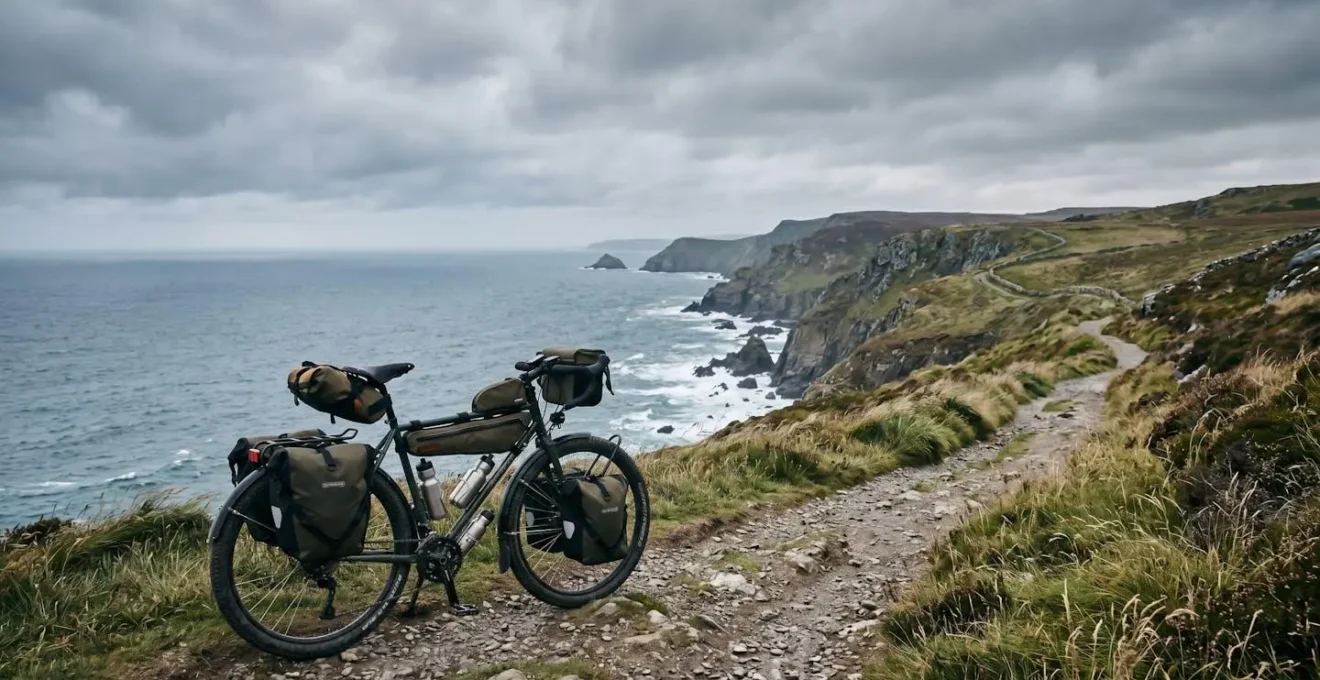
The romantic vision of UK coastal touring is a trap; true success lies in treating salt, wind, and hills not as scenery, but as relentless adversaries requiring specific, systematic countermeasures.
- Salt isn’t just cosmetic; it’s a corrosive agent demanding a daily “tax” of cleaning to prevent catastrophic component failure.
- Constant headwinds and steep gradients destroy ‘average speed’ plans and require a mental and physical shift to power-based pacing, not mileage.
- Remote logistics, especially in Scotland, punish assumptions and reward meticulous pre-planning for food, water, and shelter.
Recommendation: Ditch the ‘go-with-the-flow’ mindset. Adopt a proactive strategy of managing cumulative fatigue on your mind, body, and bike before you even turn a pedal.
The brochures and Instagram posts sell a beautiful lie: a cyclist silhouetted against a golden sunset over a calm, shimmering sea. They show the gentle sweep of a coastal road, the promise of fish and chips in a quaint harbour town. As a veteran of the UK’s coastline, from the savage beauty of the NC500 to the rugged cliffs of Cornwall, I can tell you that vision is real, but it’s earned. It’s the reward, not the reality. The day-to-day reality is a relentless battle against three specific, often underestimated, antagonists: salt, wind, and hills.
Most guides will tell you to pack waterproofs and have good brakes. That’s table stakes. The rookie mistake is underestimating the *cumulative impact* of these forces. It’s not one windy day that breaks you; it’s the fifth. It’s not one steep climb, but the twentieth 20% ramp in a single afternoon. The real key to conquering the UK coast isn’t about having stronger legs; it’s about having a smarter strategy. It’s about understanding the deep, mechanical, and psychological nature of these challenges and applying a system to mitigate them before they compound into a trip-ending failure.
This guide isn’t about the best pubs. It’s a veteran’s manual for managing the true nature of the coast. We will dissect the insidious effect of salt on your machine, the psychological warfare of a headwind, the unique brutality of coastal gradients, and the logistical traps that await the unprepared. Forget what you think you know; this is how you actually succeed.
To navigate these challenges effectively, it’s essential to understand each component of the coastal threat. This guide is structured to tackle each adversary in turn, providing the strategies you need to master them.
Contents: A Veteran’s Map to UK Coastal Challenges
- The Salt Air Factor: Why You Need to Rinse Your Bike Daily on Coastal Trips?
- Fighting the Gale: Mental Strategies for Riding into a Headwind all Day
- Short and Steep: Why Coastal Roads Are Harder Than Alpine Passes?
- Booking Ahead vs. Winging It: Strategies for Busy Coastal Towns in Summer
- The Detour Trap: How to Balance Views with Daily Mileage Targets?
- Escaping the Storm: When to Bail Out on a Mountain Route?
- Booking Early: Why You Should Secure Your Bed 6 Months Before the Event?
- Highlands Survival: Preparing for Remote Solo Bikepacking in Scotland
The Salt Air Factor: Why You Need to Rinse Your Bike Daily on Coastal Trips?
The sea air isn’t just refreshing; it’s a corrosive fog carrying microscopic salt particles that are determined to destroy your bicycle. This isn’t a long-term problem; it’s a 24-hour one. The single biggest mechanical failure I see on coastal tours stems from riders underestimating this. They think, “I’ll give it a good clean at the end of the week.” By then, it’s too late. Your chain will be a gritty, rusty mess, your gear shifts will become agricultural, and your bolt heads will start to bloom with oxidation. Think of daily cleaning not as a chore, but as the “salt tax” you pay for the privilege of riding by the ocean.
The science is simple and brutal. As experts in bicycle maintenance point out, “Salt particles can accelerate surface oxidation on untreated or exposed steel parts.” This insidious process doesn’t just attack the obvious frame scratches. It creeps into the most vulnerable and crucial components: spoke nipples, brake calipers, derailleur springs, and cable ferrules. A seized brake caliper or a snapped spoke nipple isn’t just an inconvenience; it can be a catastrophic failure in a remote location. Your evening routine must, without fail, include a freshwater rinse.
Small hardware, such as bolt heads, spokes, and cable ends, is usually affected first.
– XDS Bike Co., Coastal Bicycle Rust Prevention Guide for Ocean Riders
A simple ‘field rinse’ using a water bottle focused on the drivetrain, brakes, and other hardware immediately after your ride can neutralize the worst of the day’s salt. This should be followed by a more thorough clean with a biodegradable bike wash in the evening. Applying a protective spray like GT85 or Fluid Film to vulnerable parts before you even start the tour provides an essential sacrificial layer. Ignoring this daily ritual is the fastest way to turn your prized touring bike into a monument to rust.
Fighting the Gale: Mental Strategies for Riding into a Headwind all Day
A coastal headwind is not like other winds. It’s a physical wall, a relentless, soul-crushing force that doesn’t just slow you down—it attacks your morale. The constant noise, the pressure on your chest, the feeling of fighting for every single metre of progress can break even the strongest rider. The rookie mistake is to fight it head-on, treating it as a test of strength. You’ll lose. A 20mph headwind can require 40-50% more power to maintain a modest speed. The veteran knows that battling the gale is a psychological game, not a physical one.
First, abandon all expectations of speed and distance. Your GPS average speed is now a meaningless, depressing number. Switch your computer to display cadence or heart rate—metrics you can control. The goal is no longer to cover 80 miles, but to maintain a sustainable effort for six hours. Break the day into tiny, manageable chunks: ride for 20 minutes, then have a snack. Focus on getting to the next village, not the end of the day. As legendary coach Chris Carmichael advises, you must resist the wind’s provocation to push harder than you can sustain.
If your maximum sustainable climbing power is 265 watts, you don’t magically get more powerful with the wind in your face. Don’t let the relentless noise or push of the wind provoke you into pushing harder than you can sustain.
– Chris Carmichael, Cycling in Wind: Skills for Solo Riding and Drafting
Master the art of “environmental intelligence.” Look for shelter everywhere. On a UK coastal road, this often means hugging the hedgerow or stone wall. A crosswind is an opportunity, not just a nuisance; use the landscape to turn it into a partial tailwind or to find a brief moment of respite. Get low, stay aerodynamic, and find a gear that allows you to maintain a high cadence (90+ rpm) without grinding your knees to dust. This isn’t about being fast; it’s about being efficient and, above all, preserving the mental energy you’ll need to do it all again tomorrow.
As the image shows, using natural features for shelter is not a sign of weakness; it’s a mark of an experienced rider. That hedgerow is your best friend, a temporary shield in a long war. Embrace it.
Short and Steep: Why Coastal Roads Are Harder Than Alpine Passes?
Many cyclists train for long tours by seeking out long, steady climbs. They prepare for an Alpine pass, a place where you can settle into a rhythm for an hour at a consistent 7% gradient. This is the absolute worst way to prepare for the UK coast. Coastal roads don’t do ‘steady’. They do ‘savage’. A typical Cornish or Northumbrian coastal mile is a chaotic series of 15-25% ramps followed by sharp descents, only to immediately throw you onto the next wall. There is no rhythm. There is no recovery. This is what makes them so much harder.
The difference is about maintaining a physiological rhythm. On an Alpine pass, your body can adapt to a sustainable, aerobic effort. You find your pace and stay there. On a coastal route, every steep ramp is a short, sharp, anaerobic spike. You’re constantly red-lining your heart rate, flooding your legs with lactic acid, and then getting a “junk recovery” on the descent before the next effort. It’s like doing a set of heavy squats every five minutes, all day long. This pattern is a recipe for blowing up, as the cumulative fatigue is far greater than that of a single, longer climb of the same total elevation.
Case Study: Coastal Gradient Fatigue vs. Alpine Steady Climbing
Analysis of climbing efforts reveals a critical distinction. Climbs with radically changing gradients every few hundred metres present a significantly greater challenge than steady climbs with similar difficulty ratings. The repeated anaerobic spikes from short, steep coastal gradients (15-20%) prevent the establishment of a physiological rhythm. This contrasts sharply with long Alpine passes, where consistent 7-8% gradients allow for sustainable aerobic pacing and even recovery within the effort itself. The body is simply not designed for the constant “on-off” power demands of a classic UK coastal road, leading to premature exhaustion.
This is why comparing average speeds is so misleading. Data shows that the difference in average speed between a flat ride and a hilly one isn’t as dramatic as you’d think, but it hides the true cost. For example, research shows that speed comparisons are misleading when elevation is involved; the effort to achieve 22 km/h over 1,500m is exponentially greater than maintaining 28 km/h on the flat. For gearing, you need an “emergency” gear. A 1:1 ratio (like a 34t chainring and a 34t cassette sprocket) should be your minimum. A sub-1:1 ratio is even better. Forget your ego; you will be grateful for that dinner-plate-sized sprocket when you’re winching yourself up the 10th cliff-face of the day.
Booking Ahead vs. Winging It: Strategies for Busy Coastal Towns in Summer
The classic touring dream is one of freedom: riding until you’re tired and then finding a cosy B&B in the next village. On the UK coast in summer, this dream is a recipe for disaster. Popular routes like the NC500 or the Cornish coast are booked solid months, if not a year, in advance. Arriving in a small town at 6 pm, exhausted and hungry, only to find every single room is taken, is a soul-destroying experience. For peace of mind, booking your key stops ahead is non-negotiable.
However, a fully rigid itinerary kills the spirit of adventure. The veteran tourer adopts a hybrid approach. You book the non-negotiable linchpins of your trip—the isolated pub in the middle of nowhere, the Saturday night stay in a popular harbour—but leave flexibility for the sections in between. This is where the “Modern Winger’s Toolkit” comes into play. Your phone is your friend, but not for searching at the last minute. The key is preparation. Before your trip, identify potential cyclist-friendly establishments, noting those that advertise secure bike storage and early breakfasts. These are your people.
One of the most effective strategies is the ‘Five Miles Inland‘ rule. Accommodation right on the coastal path carries a huge premium in price and a deficit in availability. By looking just 8-10km inland, you often find better value, more vacancies, and a warmer welcome. Leverage last-minute booking apps, but use them strategically during your mid-afternoon coffee stop, not when darkness is falling. Another fantastic resource is the Warmshowers.org community, a network of fellow cycle tourists offering emergency accommodation. It’s your get-out-of-jail-free card. Finally, the best way to “wing it” successfully is to build in a ‘flexibility buffer’. Plan to ride 50 miles instead of 70. This gives you the time and energy to find accommodation without the pressure of a looming deadline.
The Detour Trap: How to Balance Views with Daily Mileage Targets?
You’ll see a signpost: “Picturesque Cove, 2 miles.” Or a dotted line on your map leading to a remote lighthouse. This is the Detour Trap. It looks innocent, but it’s a primary cause of blown-up schedules and exhausted riders. On a loaded touring bike, a simple “2-mile” detour is never just 2 miles. That sign doesn’t tell you that the path is a tyre-slashing gravel track, that it involves a 150-metre descent you’ll have to climb back out of, or that it’s an out-and-back route, meaning your 2-mile jaunt is actually a 4-mile, one-hour addition to your day.
Before you even think about taking that turn, you must learn to do a quick but realistic “True Cost Calculation.” This isn’t about being cynical; it’s about being strategic so you can actually enjoy the view without ruining your day. You need to assess not just the distance, but the elevation, the surface, and crucially, the “awe time”—the time you’ll actually spend at the destination. A beautiful view is worthless if you arrive stressed, knowing you’re now an hour behind schedule.
Every junction like this is a decision that impacts your energy and your schedule. The paved road is predictable; the track to the lighthouse is an unknown quantity. Your choice must be an informed one. The following checklist helps you make that calculation in moments, turning a potential mistake into a conscious choice.
Your Action Plan: Calculating the True Cost of a Detour
- Distance Cost: A 2-mile detour on flat tarmac might add 15-20 minutes. On a rough track or across a field, immediately double this estimate to 30-40 minutes.
- Elevation Cost: Quickly check contour lines on your GPS or map. For every 100m of climbing on a loaded bike, add at least 30 minutes to your total time, on top of the distance cost.
- Surface Cost: Is the track gravel, mud, or sand? A rough surface can easily reduce your speed by 50-70% compared to tarmac. What takes 10 minutes on the road can take 30 on a bad track.
- Awe Time: Be honest. You’re not going to ride all the way to a lighthouse just to turn around. Budget a minimum of 15-30 minutes for photos, a snack, and actually enjoying the view you worked for.
- Return Journey Cost: The most common mistake. If it’s an out-and-back detour, you must double all your previous calculations. That “one hour” detour is now two hours.
Escaping the Storm: When to Bail Out on a Mountain Route?
On a coastal tour, the weather is more than an inconvenience; it’s a safety issue. A sudden squall can drop visibility to near zero, turn roads into rivers, and bring winds that can physically push you off your bike. The temptation is always to “push on through,” but on an exposed coastal or mountain-adjacent route, that’s a gamble you can’t afford to lose. The veteran rider’s mantra is: “It’s better to be in the pub wishing you were on the hill, than on the hill wishing you were in the pub.” Knowing when to bail is a critical survival skill.
Your decision to bail out shouldn’t be a panicked, last-minute choice. It should be a pre-planned strategy. Before you set off each morning, your pre-ride ritual must include identifying all potential bail-out points—pubs, cafes, bus shelters, villages—and marking them on your map or GPS. You need to know where your nearest safe haven is at all times. A critical rule is to never position yourself more than 5 miles from identified shelter when forecasts show deteriorating conditions.
Learn to read the signs the sea gives you. The speed and type of cloud formations approaching from the water are your best early warning system. Rapidly moving, low, dark clouds signal an imminent and often violent change. A sudden shift in wind direction, especially from offshore to onshore, often precedes a storm’s arrival by 30-60 minutes. This is your final warning to seek shelter. Furthermore, on coastal routes, tide times can be more critical than weather. Getting cut off by a rising tide on a causeway or tidal road is a life-threatening mistake. Treat these tidal deadlines as absolute and unchangeable.
Booking Early: Why You Should Secure Your Bed 6 Months Before the Event?
For any major coastal tour during the peak season—think the NC500 in July, or Cornwall in August—the term “The Event” is fitting. You are not a lone cyclist on a quiet road; you are part of a massive, seasonal migration of tourists, all competing for the same limited resources. In this context, the advice to “book your bed 6 months before the event” is not conservative; it’s the baseline for a stress-free trip. The reason isn’t just about getting a room; it’s about getting the *right* room.
The entire logistical chain of your tour hinges on a few key “linchpin” accommodations. These are the B&Bs or small inns located in the remote, beautiful, and sparsely populated sections of your route. In a village with only one place to stay, that one place dictates the schedule for everyone. If you can’t get a room there on your desired night, your entire multi-day itinerary can be thrown into chaos. These are the places that book out 6, 8, even 12 months in advance. Securing these linchpins is your first priority.
Booking early also gives you choice. You get to pick the cyclist-friendly place with the secure bike lock-up and the host who understands you need an early, calorie-dense breakfast. Wait too long, and you’ll be left with the expensive, inconvenient hotel that sees your bike as a nuisance. Furthermore, booking transport like ferries (e.g., to the Hebrides) or trains well in advance is essential, as spaces for bikes are often extremely limited. Your accommodation dates and your transport dates must align perfectly. By securing your bed six months out, you aren’t just booking a room; you are buying certainty and building the foundational structure upon which your entire epic journey will rest.
Key Takeaways
- The “Salt Tax” is Real: Daily, meticulous cleaning is not optional. It’s a non-negotiable ritual to prevent rapid, catastrophic corrosion of your bike’s components.
- Pace by Effort, Not Speed: Relentless headwinds and steep gradients make average speed a useless metric. Shift your focus to managing power, cadence, and mental energy to avoid burnout.
- Logistics are Everything: In remote areas like the Scottish Highlands, pre-planning your food, water, and bail-out points is a survival skill, not a preference. Assume nothing is available.
Highlands Survival: Preparing for Remote Solo Bikepacking in Scotland
Touring the Scottish Highlands coast is the ultimate expression of UK cycling. It’s also the ultimate test of your preparation and self-sufficiency. Here, the challenges of salt, wind, and hills are amplified by a fourth, overriding factor: remoteness. Services are scarce, phone signal is a myth, and the landscape is unforgiving. Assuming you can “just find a shop” is a critical error. Your bike and your bags are not just transport; they are your life support system.
You must carry a “mobile larder” at all times. This means a minimum of 2,000 calories of non-perishable, high-density food (nut butter, dried fruit, jerky) that you never touch… until you need it. Water capacity is equally critical; a minimum of 2-3 litres is essential, as “the next village” might be a 3-hour ride away. Navigation cannot rely on a phone with an intermittent signal. A dedicated GPS unit with pre-loaded routes and full offline mapping is your primary tool, backed up by both offline maps on your phone and a waterproof paper map of the critical sections.
Case Study: The Estuary Illusion in Scottish Coastal Geography
A frequent and dangerous trap in the Highlands is the ‘estuary illusion’. On a map, a village just one mile across a sea loch appears tantalisingly close. However, the geography of the west coast often requires a brutal 15 to 25-mile inland detour to reach the nearest bridge crossing. This can add 2-3 hours of unexpected riding time. A rider relying on the proximity of that village for food and water, only to be confronted by this reality, faces a serious situation. Successful Highlands touring requires identifying these bridge crossings in advance and planning supplies based on the location of services at these inland detour points, not on misleading coastal proximity.
Power management is another vital consideration. A 10,000mAh power bank is the minimum to keep your GPS and phone alive. Charge everything at every opportunity. The “coastal connectivity myth”—the idea that you’re never far from civilization—is shattered in the Highlands. You are on your own. This isn’t meant to be intimidating; it’s liberating. With the right preparation—sufficient food, water, navigation, and power—you are truly free to immerse yourself in one of the world’s most spectacular cycling environments.
Stop planning a holiday and start planning an expedition. Apply this mindset of proactive management and deep preparation, and you’ll not only survive the UK coast—you’ll conquer it, earning every single beautiful view along the way.