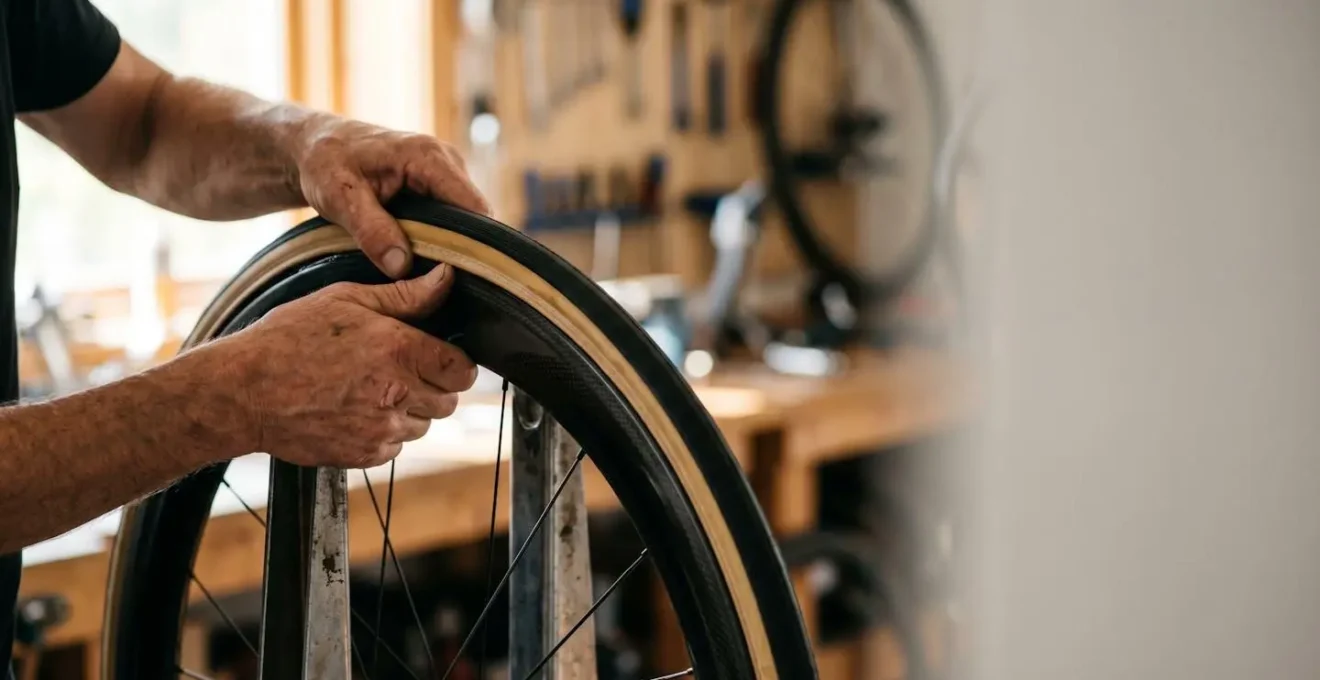
The real choice for amateur racers isn’t about which tyre is faster, but which hassle you’re willing to accept.
- Tubulars demand a significant “payment” of time and skill in the workshop before you even ride.
- Modern tubeless systems shift that potential hassle to the side of the road, where a sealant failure can be race-ending.
Recommendation: Honestly assess your mechanical skill, patience, and budget. Choose the system whose inevitable problems you are better equipped to solve.
There’s a romance to tubulars, isn’t there? The feel, the history, the sound they make cornering on clean tarmac. For decades, it was simple: if you were serious about racing, you were on tubulars. We spent hours in garages and workshops, surrounded by the sharp scent of glue, carefully stretching and mounting tyres in a ritual passed down from one generation of racer to the next. The conversation was about technique, not technology.
Today, the landscape is dominated by tubeless technology, promising lower rolling resistance, self-sealing punctures, and easier setup. The common advice is that tubulars are an archaic hassle best left to the pros. But is it that simple? The debate often misses the point, focusing on isolated metrics instead of the complete ownership experience. It’s not just about what happens on the bike, but the time, money, and stress involved off it.
This guide cuts through the marketing noise. We’re not just going to compare spec sheets. We’re going to talk about the “hassle budget”—the finite amount of time, money, and mental energy you have as an amateur racer. The real question isn’t “Which tyre is better?” but “Which system’s problems are you more willing to live with?” We’ll look at the reality of gluing tyres in a home workshop, what really happens when you puncture 50 miles from home, and whether the fabled performance advantage even exists at amateur speeds.
This article provides a structured breakdown of the critical decision points that every competitive club racer faces. By examining the practical realities of each system, you can make an informed choice based on your own resources and risk tolerance, not just on tradition or trends.
Summary: The Amateur Racer’s Guide to the Tubular vs. Tubeless Dilemma
- Gluing Tubulars at Home: How to Avoid Rolling a Tyre in a Corner?
- How to Fix a Tubular Puncture 50 Miles From Home Without a Phone Signal?
- Tubular vs. Tubeless: Which Is Actually Faster at 100psi?
- The Hidden Costs of Racing Tubulars: Tape, Glue, and Unrepairable Flats
- Why Do Pros Still Choose Tubulars for Safety on Alpine Descents?
- Bacon Strips and Plugs: What to Do When the Sealant Sprays Everywhere?
- Blowout Risk: Why You Must Check Tyre Compatibility with Hookless Rims?
- Tubeless Setup Guide: How to Seat a Tyre Without an Air Compressor?
Gluing Tubulars at Home: How to Avoid Rolling a Tyre in a Corner?
The single biggest argument against tubulars is the gluing process. It’s not just a task; it’s a craft that demands patience and precision. A poorly glued tyre isn’t just inconvenient; it’s a catastrophic failure waiting to happen. Rolling a tyre in a high-speed corner is one of the most feared crashes in cycling, and it’s almost always due to improper bonding. This is the biggest upfront cost to your “hassle budget”—a multi-day process that you cannot rush.
The key isn’t just slathering on glue. It’s about preparation, creating multiple, fully cured layers, and ensuring a perfect match between the tyre’s base tape and the rim bed. As old-school mechanics know, the bond strength comes from the edges of the rim, not the center. If your tyre’s shape doesn’t perfectly match the rim’s curve, you’ll have a weak bond no matter how much glue you use. Heat from heavy braking, especially on carbon rims during a long descent, can also compromise an overly thick layer of adhesive, turning it soft when you need it most.
The process is meticulous. You’re building up thin, even coats on both the rim and the tyre’s base tape over several days. Each layer must dry completely before the next is applied. Rushing this curing time is the number one mistake amateurs make. You’re investing time now to buy safety and confidence later. It’s a trade-off: a significant investment of workshop time to (theoretically) reduce your roadside worries.
Your Pre-Ride Gluing Audit Checklist
- Bond Check: After 24hrs of curing, firmly try to push the tyre sideways off the rim at several points. There should be zero movement or peeling at the edge.
- Edge Inspection: Visually inspect the entire circumference on both sides. Look for any gaps or areas where the base tape isn’t perfectly flush with the rim edge.
- Pressure Test: Inflate to max recommended PSI and leave for several hours. Check for any signs of the tyre shifting on the rim.
- Heat Simulation (Advanced): After a short, easy ride, feel the rim. A well-bonded tyre helps dissipate heat. Any localized hot spots could indicate a bonding issue.
- First Ride Feel: During your first easy ride, perform some gentle-to-moderate cornering. Listen and feel for any shifting, clicking, or unusual noises from the wheels.
How to Fix a Tubular Puncture 50 Miles From Home Without a Phone Signal?
This is the nightmare scenario that keeps many racers on clinchers. The classic answer for a tubular puncture was to carry a pre-glued spare tyre folded under your saddle. You’d rip the flat one off, wrestle the new one on, and ride home cautiously on a less-than-perfectly-seated tyre. It was a ride-saver, but not a race-saver. Today, the conversation is dominated by sealant. It’s often said that sealant has made carrying a spare obsolete, but the reality at road pressures is more complex.
The problem is that sealant designed for low-pressure MTB or gravel tyres struggles at 90-100psi. It can often fail to plug a hole, instead spraying a latex mess all over your frame and the riders behind you. A detailed analysis by experts at Cycling Weekly found that even with years of experience, “tubeless disasters” are a real phenomenon. Their testing showed that at road pressures, many punctures either refuse to seal or require constant air top-ups just to limp home. This is the hidden cost of the tubeless “convenience”—it works brilliantly until it doesn’t, and when it fails, it often fails messily and completely.
For a tubular, a small puncture can often be fixed with a dose of high-quality sealant injected through the valve. It’s more likely to work because the tyre’s structure is self-contained. For a larger cut, you’re back to the spare tyre or calling for a ride. So, what’s the better option? It depends on your definition of risk. The tubeless system offers a chance to self-repair small punctures without stopping, but carries a risk of a messy, unfixable failure. The tubular system forces a stop for almost any puncture but offers a more predictable (if laborious) solution with a spare tyre, assuming you carried one.
Tubular vs. Tubeless: Which Is Actually Faster at 100psi?
For years, the ‘feel’ and supposed speed of tubulars were unchallenged articles of faith. The argument was that the supple casing and perfect tyre/rim interface created a faster-rolling wheel. Then, instrumented testing came along and complicated the narrative. The science of rolling resistance has shown that the biggest thief of watts is the friction between the tyre and an inner tube. By eliminating the tube, tubeless systems gained an immediate, measurable advantage.
But how much of an advantage? And does it apply to all setups? The answer lies in the details. A modern tubeless tyre consistently measures as the lowest rolling resistance option. However, the difference between a high-end tubeless tyre and a high-end tubular with a lightweight latex inner tube is often surprisingly small. In fact, according to comprehensive rolling resistance testing by Bicycle Rolling Resistance, a standard clincher tyre with a latex tube can perform almost as well as a tubeless setup, with the penalty for a standard butyl tube being a more significant 2.5 to 3.8 watts per tire.
This suggests the real enemy of speed was the heavy, inelastic butyl tube all along, not necessarily the clincher or tubular format itself. For an amateur racer, the tiny watt savings of the absolute best tubeless setup over a top-tier tubular are likely to be lost in the noise of imperfect aerodynamics, road surface variations, and tactical decisions. The data below shows that while tubeless leads, the margins can be slim.
| System Type | Rolling Resistance Impact | Weight Savings | Pressure Range |
|---|---|---|---|
| Tubeless | Lowest rolling resistance (baseline) | 50-100g per wheel vs tubed | 60-90 psi optimal |
| Tubular with Latex Tube | +0.2W minimal difference vs tubeless | Lighter rim construction possible | 25-200 psi range |
| Clincher with Butyl Tube | +2.5W to +3.8W vs tubeless | Heaviest option | 80-120 psi typical |
| Clincher with Latex Tube | Very close to tubeless performance | Moderate weight | 80-120 psi typical |
The Hidden Costs of Racing Tubulars: Tape, Glue, and Unrepairable Flats
The initial purchase of a set of tubular wheels and tyres is just the entry fee. The “hassle budget” for tubulars is heavily weighted towards ongoing costs in both time and money. Every time you get a flat that sealant can’t fix, you’re not just replacing a £5 inner tube; you’re often writing off a £80+ high-end tyre. The process of removing the old tyre, cleaning the hardened glue off the rim (a truly miserable job), and starting the multi-day gluing process again is a significant investment.
This financial and time commitment is a major reason why the system is less popular with self-sponsored amateurs. As the Ursus technical team notes, the practicalities often outweigh the perceived benefits.
At an amateur level these tires are oftentimes avoided as they are not comfortable to carry and replace in the event of a flat. The higher price of tubulars compared to that of clinchers also affects the purchasing decision.
– Ursus Technical Team, Ursus Official Wheels Guide
Contrast this with a tubeless setup. A puncture that seals costs you nothing but a few PSI and a bit of sealant. One that requires a plug costs a few pounds for the plug. A catastrophic gash that ruins the tyre is expensive, yes, but mounting a new tubeless tyre is a 15-minute job, not a weekend-long project. Over a season of racing and training, these costs and time commitments add up, making the economic case for tubeless quite compelling for anyone who isn’t sponsored.
Why Do Pros Still Choose Tubulars for Safety on Alpine Descents?
The classic argument for tubulars in the pro peloton has always been safety. The theory is simple and compelling: because the tyre is glued to the rim, it cannot “roll off” during a high-speed blowout. In the event of a puncture on a 60 mph Alpine descent, a pro can theoretically continue to ride on the flat tyre to a stop, or even to the team car, maintaining control. The tyre casing and the glue bond provide a last line of defence.
A properly glued tubular tyre may be regarded as safer in the event of a puncture at high speeds because it is not as susceptible to roll off the rim.
– Wikipedia contributors, Tubular tyre technical article
This argument holds true and has been a cornerstone of pro-level equipment choice for decades. However, the landscape is shifting dramatically. With improvements in tubeless tyre construction, bead security, and the advent of hookless rims (which require extremely tight tolerances), the risk of a tubeless tyre blowing off the rim has been significantly reduced, provided the correct tyre and pressure are used. More importantly, teams are making a data-driven decision: the rolling resistance benefits of tubeless might save more energy over a 200km race than the tubular saves in one potential, rare crash scenario.
As a result, what was once doctrine is now just an option. While some traditionalists remain, recent industry analysis shows that even professional WorldTour teams have largely abandoned tubulars in favour of tubeless setups for most races. The “safety” argument, while still technically valid, is no longer the trump card it once was, as teams now weigh it against measurable performance gains elsewhere.
Bacon Strips and Plugs: What to Do When the Sealant Sprays Everywhere?
When tubeless sealant fails to do its job on a road tyre, the next line of defence is the plug, often called a “bacon strip.” This is the tubeless equivalent of patching a tube, but done from the outside, in seconds. The idea is to force a sticky, rubberised strip into the hole, which, combined with the sealant, clogs the leak. When it works, it’s a magical, race-saving fix. But “when it works” is the crucial phrase.
The effectiveness of plugs is a hotly debated topic in workshop circles. The challenge on a road tyre is the combination of a small hole and high pressure. The tool used to insert the plug can sometimes make the hole bigger, and the high pressure can force the plug back out. Under real-world conditions, expert testers at Cycling Weekly found that tubeless repair tools can indeed be ride-savers, with properly fitted plugs lasting the entire life of the tyre. They concluded that with the right kit and technique, the repair can be permanent.
However, this optimistic view isn’t universal. Many riders and mechanics share stories of plugs failing to hold, or of the messy struggle to get one to seat while sealant covers their hands and bike. The process requires a certain knack: you need to clear the hole, insert the plug to the right depth, and remove the tool without pulling the plug back out. It’s a skill, and trying to learn it on the side of a wet road during a race is a high-stress situation. This is a key part of the tubeless “roadside time” budget: a potentially quick fix that carries a high risk of failure for the inexperienced.
Blowout Risk: Why You Must Check Tyre Compatibility with Hookless Rims?
Just as the tubular world has its non-negotiable rules about glue, the modern tubeless world has introduced its own set of critical compatibility checks, most notably with hookless rims. Hookless technology, where the inner rim wall is straight-sided, relies entirely on the precise diameter of the tyre bead and rim bed to create a secure, airtight seal. There is no “hook” to help retain the tyre under pressure. This means that using a non-compatible tyre, or exceeding the maximum pressure, can lead to a catastrophic blowout.
This introduces a new kind of hassle. While the tubular system is complex, it is a known quantity. The standards for tyre and rim interfaces have been established for decades. The new world of tubeless and hookless has created a confusing matrix of compatibility charts, ETRTO standards, and brand-specific recommendations that the user *must* check. You can no longer assume that any tubeless tyre will work with any tubeless rim.
This complexity is part of a larger trend. While tubulars are seen as a specialist product, their market position is clear. A 2024 global racing bicycle wheels market analysis reveals that the tubular market is a niche driven by a core of serious and professional cyclists who understand and accept the system’s demands. As the DataIntelo report notes, “The complexity of their installation and maintenance limits their popularity among amateur cyclists.” Tubulars are for enthusiasts. Tubeless, marketed as the simple solution for everyone, has ironically created its own complex ecosystem of standards that can trap the unwary. The hassle hasn’t been eliminated; it has just changed form.
Key Takeaways
- The debate is not about “better” but about which “hassle” you prefer: predictable workshop time (tubulars) vs. unpredictable roadside time (tubeless).
- Modern data shows the rolling resistance gap between the best tubular and best tubeless setups is minimal, questioning the “free speed” argument for tubeless at the amateur level.
- The safety argument for tubulars (not rolling off the rim) is valid but becoming less relevant as even pro teams switch to tubeless for performance gains.
Tubeless Setup Guide: How to Seat a Tyre Without an Air Compressor?
One of the final hurdles for many home mechanics considering tubeless is the setup process, specifically “seating” the tyre. This involves getting a large enough blast of air into the tyre to force its beads out against the rim walls to create an initial seal. For a stubborn tyre/rim combination, a simple track pump often isn’t enough, leading to the belief that you need an expensive air compressor. While a compressor makes the job trivial, it’s not strictly necessary. High-volume floor pumps, CO2 cartridges, or a “booster” chamber can all provide the necessary blast of air.
The process can be frustrating. It can involve soapy water, removing the valve core, and a lot of frantic pumping. But let’s put this “hassle” in perspective. A difficult tubeless setup might take you an hour of wrestling in the garage. This is a one-time cost on your time budget for the life of that tyre. Now, let’s compare that to the alternative. As the experts at Condor Cycles state, “Gluing a tubular road or cyclo-cross tyre is absolutely doable. It is a multi-day process though.”
Consider the timeline for correctly and safely gluing one tubular tyre:
- Day 1: Pre-stretch the tyre on a spare rim to make it easier to mount.
- Days 2-4: Apply three separate layers of glue to the tyre’s base tape, allowing 12-24 hours of drying time between each coat.
- Day 5: Apply the final layer of glue to the rim, mount the tyre, and meticulously align it.
- Day 6+: Inflate the tyre and let the bond cure for a full 24 hours before you can even think about riding it.
When you view the one-off frustration of seating a tubeless tyre against the minimum 5-day commitment of a single tubular, the definition of “hassle” becomes much clearer. The tubeless system asks for a potential short burst of effort, while the tubular system demands a long, drawn-out period of meticulous work.
Ultimately, the choice is a personal audit of your own skills, patience, and priorities. If you are a meticulous mechanic who finds zen in the craft and values the classic ride feel above all, the tubular hassle may be a worthy price. If you value your time, prefer a quick-and-dirty roadside fix, and can’t be bothered with a week-long setup process for one tyre, the modern tubeless system is the logical choice. Evaluate your personal “hassle budget” and choose the technology whose problems you’re most willing to own.